Stock Analysis · SailPoint Inc (SAIL)
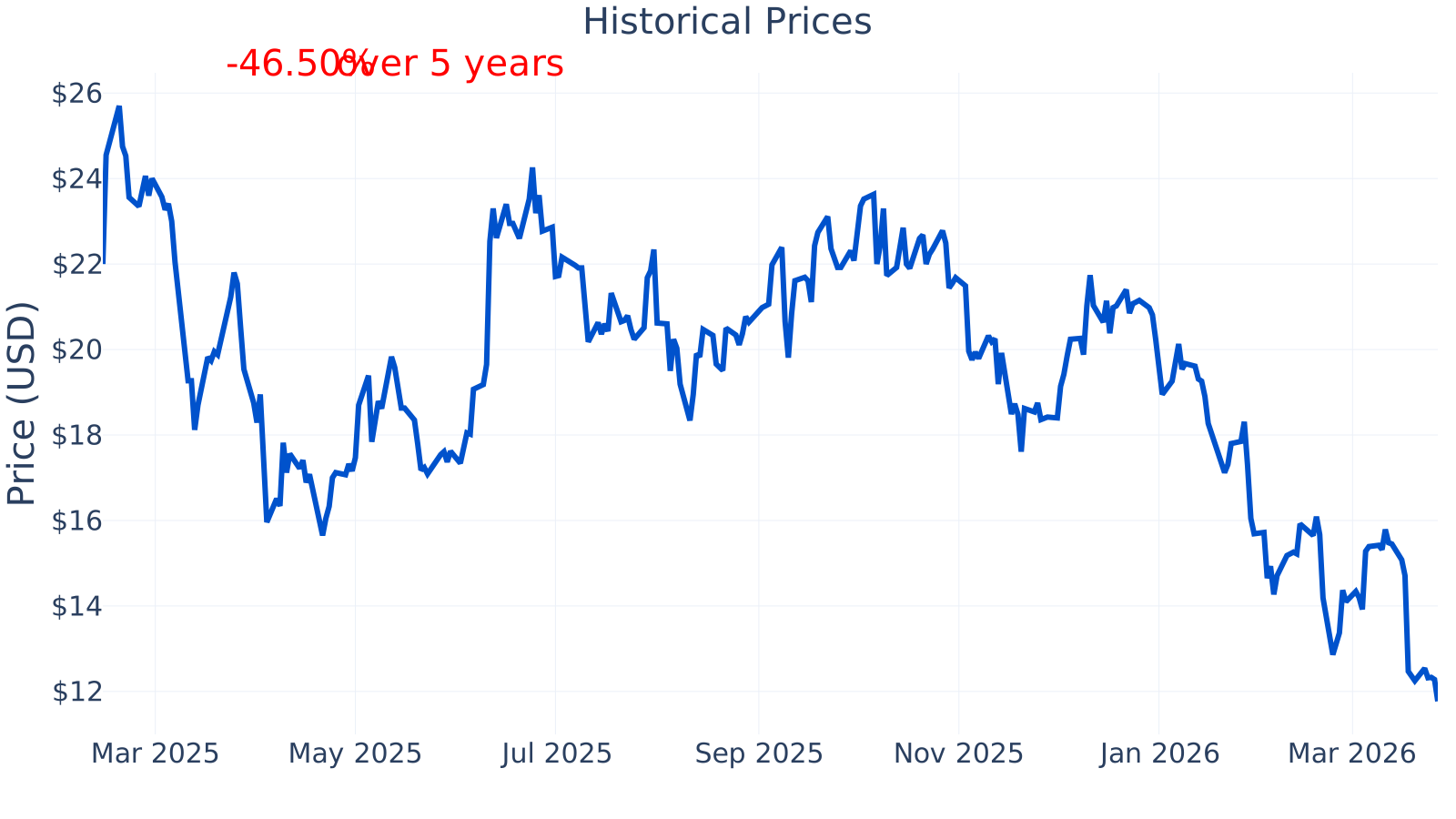
Overview
SailPoint Inc (SAIL) provides software that helps organizations control and manage “who has access to what” inside their IT systems. This area is commonly called identity security (or identity and access management). In practice, SailPoint’s tools are used to set up and enforce access rules, automate approvals, detect risky access, and support compliance requirements (for example, proving that only the right employees can reach sensitive data).
The company sells its products primarily to organizations that need strong internal controls across many applications and users (often mid-sized to large enterprises), especially in regulated industries.
Based on how identity-security software is typically monetized and how SailPoint describes its business in SEC filings, its revenue generally comes from:
- Subscription revenue (SaaS / term subscriptions) — recurring fees for access to the platform over time
- Maintenance and support — ongoing support tied to software usage (more common in legacy/on-prem arrangements)
- Professional services — implementation, configuration, and advisory services (usually a smaller portion than recurring software revenue)
Percentages by revenue line can vary by period and are best read directly from the company’s latest Form 10-K / 10-Q revenue notes and segment disclosure.
From FY2022 to FY2026 (as shown), total revenue rises from about $450M to about $1.07B. Over the same span, the largest spending lines are operating expenses (notably sales/marketing and R&D), which helps explain why net income remains negative even as revenue grows.
Key Figures
| Metric | Value | Industry ⓘ |
|---|---|---|
| Date | Mar 30, 2026 | |
| Context | ||
| Sector | Technology | |
| Industry | Software - Infrastructure | |
| Market Cap ⓘ | $6.64B | |
| Beta ⓘ | N/A | |
| Fundamental | ||
| P/E Ratio ⓘ | N/A | 25.89 |
| Profit Margin ⓘ | -25.21% | 7.12% |
| Revenue Growth ⓘ | 22.70% | 15.80% |
| Debt to Equity ⓘ | 0.28% | 24.92% |
| PEG ⓘ | N/A | |
| Free Cash Flow ⓘ | $51.75M | |
SailPoint’s market capitalization is about $6.6B. The most notable items in the latest metrics are: year-over-year revenue growth of ~22.7% (above the industry median of ~15.8%), a negative profit margin of ~-25.2% (below the industry median of ~7.1%), and very low debt-to-equity (~0.3%) compared with the industry median (~24.9%). Trailing twelve-month free cash flow is positive (~$51.8M).
Growth (medium)
Identity security is tied to long-term trends that tend to persist even when IT budgets fluctuate: more cloud adoption, more applications per employee, more regulatory scrutiny, and the growing need to control access for contractors, partners, and automated “machine” identities. In that context, the category generally benefits from sustained demand because access control is a baseline requirement for cybersecurity and compliance programs.
SailPoint’s growth strategy, as reflected in how the business is commonly described in its filings and investor materials, centers on expanding recurring software usage (subscriptions), adding more capabilities to the platform, and embedding identity controls deeper into customer workflows. If successful, that approach can support multi-year growth because identity programs are typically long-lived and become more valuable as they cover more systems.
The most recent year-over-year revenue growth shown increases from about 19.8% to about 22.7%, indicating an acceleration in the period displayed.
Free cash flow over the trailing twelve months moves from about -$59.7M to about +$51.8M in the period shown. For long-term business building, improving cash generation can be an important operational milestone even when accounting profitability remains negative.
Risks (high)
The main risk visible in the fundamentals is profitability. SailPoint shows a negative profit margin in the period displayed, which means that after all expenses, the company is not yet producing accounting profits. The “bridge” from revenue to net income also indicates substantial operating expenses, and the ability to scale those costs more slowly than revenue is typically key for software businesses over time.
Profit margin improves from about -33.0% to about -25.2% in the dates shown, but it remains well below the industry median (around 6%–7%). This gap highlights execution risk: growth needs to translate into sustainable profitability for the business model to look more durable across cycles.
Competition is another major risk. Identity security is a crowded space with well-capitalized vendors and platform companies that can bundle identity features into broader security or IT suites. Key competitive pressures often include pricing, breadth of integrations, time-to-deploy, and the ability to handle complex enterprise requirements. Common competitor groups include:
- Large platform vendors offering identity capabilities as part of broader suites (which can pressure standalone vendors on price and distribution)
- Specialized identity providers focusing on adjacent areas such as single sign-on and authentication, which can overlap in buyer budgets
- Other identity governance / administration vendors targeting similar compliance and access-control use cases
SailPoint’s competitive advantages are generally associated with specialization in identity security for complex enterprises, deep connectors/integrations, and experience with governance-oriented deployments. Whether that remains durable depends on ongoing product execution and how rapidly larger suites close capability gaps.
Financial risk from leverage appears limited in the figures shown.
Debt-to-equity is about 0.3% in the most recent point shown versus an industry median around 14%–20% over the same dates, suggesting relatively low balance-sheet leverage compared with peers. That can reduce refinancing risk, but it does not remove operating risks tied to costs, competition, and execution.
Valuation
Traditional valuation metrics like the price-to-earnings (P/E) ratio are less informative when net income is negative, because the “E” (earnings) is not positive. That is the case in the P/E history shown here, where the company P/E is displayed as 0 across the dates (consistent with unmeaningful P/E during loss-making periods), while the industry median remains around ~30.
In practice, when a company is not yet profitable, market participants often focus more on revenue growth, gross margin structure, operating expense discipline, free cash flow trends, and the size/durability of the customer base. In SailPoint’s case, the context is mixed in the figures shown: revenue growth is above the industry median and free cash flow has turned positive, while profit margins remain meaningfully negative versus peers. Whether the current stock price is “expensive” or “cheap” cannot be concluded from P/E in this context; it depends more on expectations for future margins and cash generation relative to the growth outlook.
Conclusion
SailPoint operates in identity security, a part of cybersecurity that is closely tied to long-running drivers such as cloud adoption, compliance needs, and the ongoing requirement to control access to sensitive systems. The company’s recent figures show strong revenue growth relative to its software-infrastructure peer median and an improvement in free cash flow.
At the same time, the key long-term uncertainty is profitability: margins remain negative and operating costs are a dominant factor in overall results. Competitive pressure is also structurally high in cybersecurity and identity, especially from larger vendors that can bundle features. Balance-sheet leverage appears low in the period shown, which reduces certain financial risks but does not resolve execution challenges.
Overall, the long-term case to monitor is whether growth and product adoption translate into sustained profitability and cash generation while maintaining differentiation in a competitive market.
Sources:
- SEC EDGAR — SailPoint Inc filings (Form 10-K, Form 10-Q, Form 8-K)
- SailPoint Investor Relations — SEC filings and shareholder materials
- Wikipedia — “SailPoint” (company overview and basic history)
This article is for informational purposes only and does not constitute financial advice. Some content is AI-generated. See Disclaimer


