Stock Analysis · Rush Street Interactive Inc (RSI)
Overview
Rush Street Interactive, Inc. (RSI) is a digital gambling company. It operates online casino games (often called “iCasino”) and online sports betting in jurisdictions where these activities are legal. The company runs consumer-facing brands (such as BetRivers and PlaySugarHouse) and focuses on acquiring and retaining players through marketing, product design, promotions, and customer support. Its operations depend heavily on state-by-state regulation in the U.S., along with operations in certain international markets, as described in its SEC filings.
In simple terms, RSI earns money when players place bets or play casino games on its platforms. Over time, the goal is to build a base of repeating customers so that marketing costs per customer can fall and the business can generate steady cash flow.
Based on company reporting categories commonly used in filings, the main revenue drivers are typically:
- Online casino (iCasino) (usually the largest contributor in U.S. online gambling operators where it is offered)
- Online sports betting
- Other / ancillary (for example, smaller lines tied to platform-related activities depending on what is reported in filings)
Percentages by revenue stream can vary by period and jurisdiction; for exact splits, the company’s segment and revenue disclosures in the 10‑K and 10‑Q are the authoritative reference.
Across recent years, total revenue expanded from about $488 million (2021) to about $1.13 billion (2025). Over the same span, the company moved from operating losses to an operating profit, and from a net loss to a positive net income in the latest year shown. This suggests that scale and cost discipline have started to translate into profitability, although results can still be influenced by marketing intensity, product investment, and state-specific taxes and fees.
Key Figures
| Metric | Value | Industry ⓘ |
|---|---|---|
| Date | Mar 09, 2026 | |
| Context | ||
| Sector | Consumer Cyclical | |
| Industry | Gambling | |
| Market Cap ⓘ | $4.86B | |
| Beta ⓘ | 1.55 | |
| Fundamental | ||
| P/E Ratio ⓘ | 67.32 | 42.41 |
| Profit Margin ⓘ | 2.94% | 5.85% |
| Revenue Growth ⓘ | 88.80% | 17.80% |
| Debt to Equity ⓘ | 12.54% | 227.00% |
| PEG ⓘ | N/A | |
| Free Cash Flow ⓘ | $147.93M | |
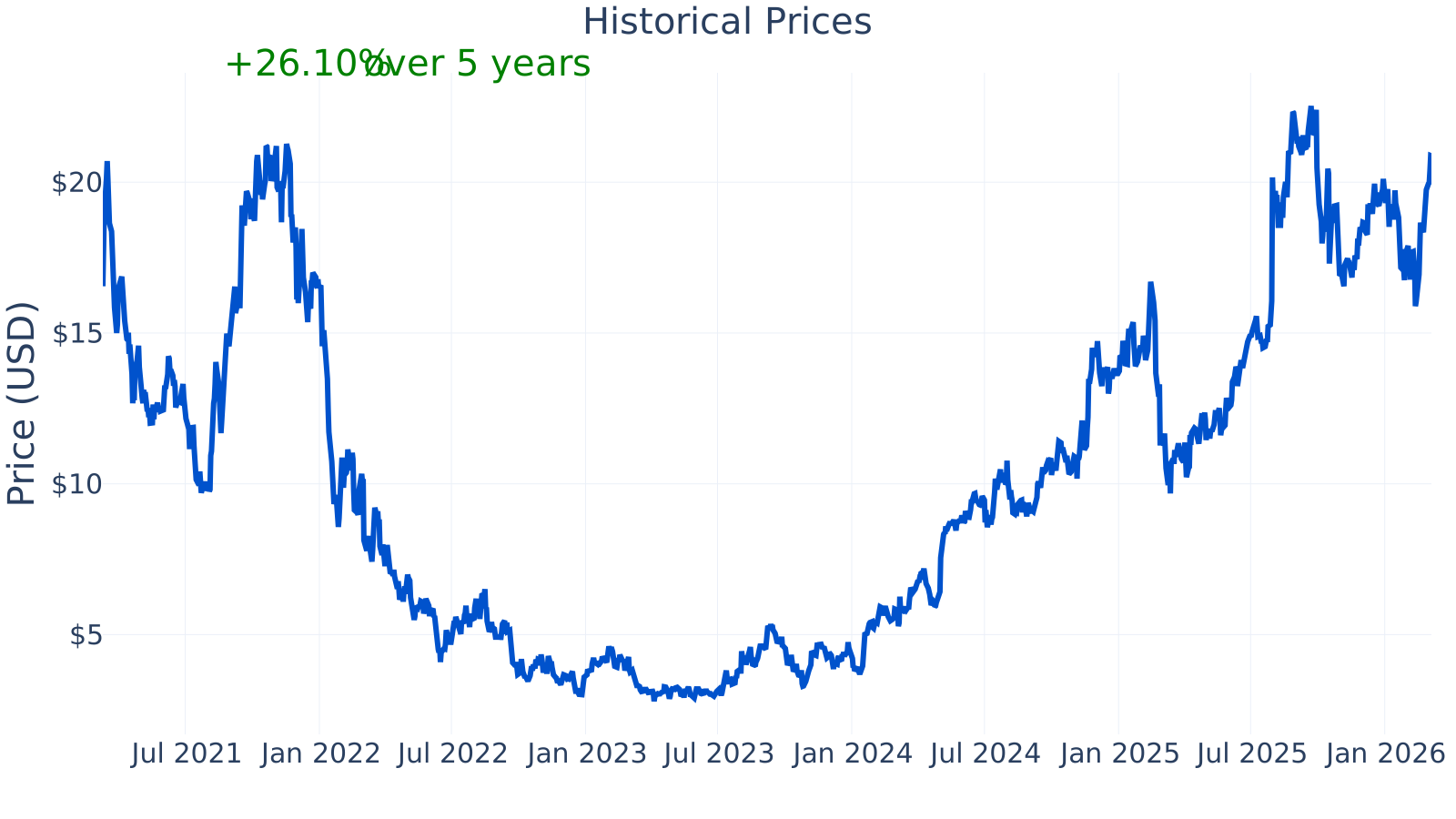
At the latest point shown, RSI’s market capitalization is about $4.86 billion. The stock’s beta of ~1.55 indicates it has tended to move more than the broader market (higher volatility). Profitability is currently positive, with a profit margin of ~2.94%, which is below the industry median shown (~5.85%). Year-over-year revenue growth is listed at about 88.8%, materially above the industry median shown (~17.8%), and the company shows a relatively low debt-to-equity of ~12.5% versus the industry median shown (much higher). Free cash flow over the trailing twelve months is positive at about $147.9 million.
Growth (Medium)
RSI operates in online gambling, where long-term growth is often tied to legalization and adoption trends. In the U.S., online sports betting and online casino are regulated primarily at the state level, so market expansion can occur when additional states legalize or broaden permitted products. That legal framework creates a “stepwise” growth pattern: new state launches can add revenue, but the timing is uncertain and depends on legislation, licensing, and regulatory approvals.
RSI’s strategy (as described in filings) typically centers on operating its own brands, investing in product experience, and managing marketing spend with an emphasis on long-term customer value. If the company continues to improve efficiency—meaning it can generate more gross profit per customer dollar spent on marketing—that can support sustainable cash generation rather than growth that relies mainly on heavy promotions.
The company’s year-over-year revenue growth has been strong in multiple recent periods, and the latest value shown (~27.8% at the most recent quarter endpoint in the series) indicates ongoing expansion, even after earlier periods where growth naturally cooled from very high levels. The “latest metrics” section also shows an especially high YoY revenue growth figure (~88.8%), highlighting that growth can be lumpy depending on the period being measured.
Free cash flow improved meaningfully over time: it moved from negative levels in 2022–2023 to positive starting in 2024 and reached about $147.9 million in the latest trailing-twelve-month figure shown. For an online operator, this can be an important sign because it suggests the business is increasingly funding itself after operating costs and ongoing investment needs.
Risks (High)
The biggest risk factor is regulation. Online gambling is heavily regulated, with rules that can differ by state/country and can change over time. Taxes, licensing fees, advertising restrictions, responsible-gaming requirements, and enforcement intensity can all affect profitability. Expansion also depends on winning licenses and maintaining compliance, which can require ongoing costs.
Competition is another major risk. The online betting and casino space includes large, well-funded operators that can spend aggressively on promotions and advertising. Competitive pressure can reduce margins and increase customer acquisition costs, particularly in newly launched markets. In addition, consumer behavior can shift quickly, and product differentiation can be hard to sustain when competitors offer similar odds, promotions, and game catalogs.
RSI does have potential advantages typical of scaled operators: recognized brands in its active markets, player databases, operating know-how, and technology/processes to run regulated betting. However, it is not the only scaled participant, and leadership varies by state and by product category (sports betting vs. iCasino). As a result, competitive advantage often comes down to execution—product quality, retention, and disciplined marketing—rather than an unassailable moat.
RSI’s leverage looks relatively modest in the period shown. The latest debt-to-equity is about 12.5%, far below the industry median shown (which is above 100% in multiple periods). Lower leverage can reduce financial risk during downturns or periods of elevated promotional competition, though it does not remove operating and regulatory risks.
Profitability has improved materially over time. The series shows profit margins were negative for an extended period and gradually moved toward breakeven, reaching a positive level and ending around 2.94%. That said, margins remain sensitive to marketing intensity, product mix (sports betting can have different economics than iCasino), and state-level tax and fee structures.
Main competitors typically include other U.S.-focused online sportsbook and iCasino operators (including large national brands and casino-linked operators). Relative positioning often differs by state, and the most relevant comparison is frequently market share and profitability in the specific jurisdictions where RSI is live—details that are discussed periodically in company filings and investor materials.
Valuation
At the latest point shown, RSI’s price-to-earnings (P/E) ratio is about 67.3, which is above the industry median shown (~42.4). A higher P/E often indicates that the market is pricing in faster future earnings growth, improving margins, or both. The historical P/E series also shows periods where the ratio is not meaningful (often when earnings were negative), followed by very high values when profitability first turned positive and earnings were still relatively small compared to the market value.
In practical terms, this valuation places more weight on continued execution: sustaining revenue growth while expanding margins and maintaining positive free cash flow. If profitability grows steadily, the P/E can come down over time even without a lower stock price; if earnings growth disappoints or becomes more volatile, valuation can look demanding relative to near-term fundamentals.
Conclusion
Rush Street Interactive is an online gambling operator that has shown substantial revenue growth over multiple years and a notable shift toward profitability and positive free cash flow. The business model can scale, and the company’s relatively low leverage reduces one common risk seen in parts of the gambling industry.
At the same time, the long-term outcome remains closely tied to regulation, competitive intensity, and the company’s ability to grow without reverting to heavy promotional spending that compresses margins. With a P/E ratio above the industry median shown, the market appears to be assigning meaningful value to continued earnings expansion, making future execution and consistency important factors in how the valuation holds up over time.
Sources:
- SEC EDGAR — Rush Street Interactive, Inc. filings (Form 10-K, Form 10-Q, Form 8-K)
- Rush Street Interactive — Investor Relations materials and press releases (company-hosted)
- Wikipedia — “Rush Street Interactive” (basic company background)
This article is for informational purposes only and does not constitute financial advice. Some content is AI-generated. See Disclaimer


