Stock Analysis · Rush Street Interactive Inc (RSI)
Overview
Rush Street Interactive Inc. (“RSI”) is a digital gaming company. It operates online casino products (often called “iCasino”) and online sports betting in regulated markets, primarily in the United States and also in certain international jurisdictions. The company runs consumer-facing brands that provide real-money wagering where local laws allow it, and it manages core activities such as game content, marketing, customer support, payments, and responsible gaming programs.
RSI’s revenue is mainly generated from real-money wagering activity on its platforms. In general terms, that includes money kept by the operator after paying out winnings (net of certain player incentives), plus fees tied to sports betting and, in some cases, revenue-share arrangements with partners. Public filings typically describe revenue by product (online casino vs. sports betting) and by geography/market, but the exact percentage breakdown can vary by reporting period.
Main revenue drivers (from largest to smallest, typical for RSI’s mix):
- Online casino (iCasino): revenue from casino-style games played online (slots, table games, etc.), generally the largest contributor for RSI.
- Online sports betting: revenue from sports wagers (the “hold” RSI retains after payouts, net of certain costs and promotions).
- Other / ancillary: smaller items such as certain partner-related arrangements and other operating revenue, depending on how the company reports in a given period.
Across 2021–2024, total revenue rose from about $488 million (2021) to about $924 million (2024). Over the same time, operating income moved from a loss (about -$94 million in 2021) to a profit (about $24 million in 2024), and net income improved from a loss (about -$29 million in 2021) to a small profit (about $2 million in 2024). This points to a business that has been scaling while also narrowing losses and reaching profitability in the most recent year shown.
Key Figures
| Metric | Value | Industry ⓘ |
|---|---|---|
| Date | Feb 08, 2026 | |
| Context | ||
| Sector | Consumer Cyclical | |
| Industry | Gambling | |
| Market Cap ⓘ | $4.05B | |
| Beta ⓘ | 1.57 | |
| Fundamental | ||
| P/E Ratio ⓘ | 67.96 | |
| Profit Margin ⓘ | 2.83% | 1.42% |
| Revenue Growth ⓘ | 88.80% | 12.75% |
| Debt to Equity ⓘ | 4.39% | 198.79% |
| PEG ⓘ | N/A | |
| Free Cash Flow ⓘ | $99.84M | |
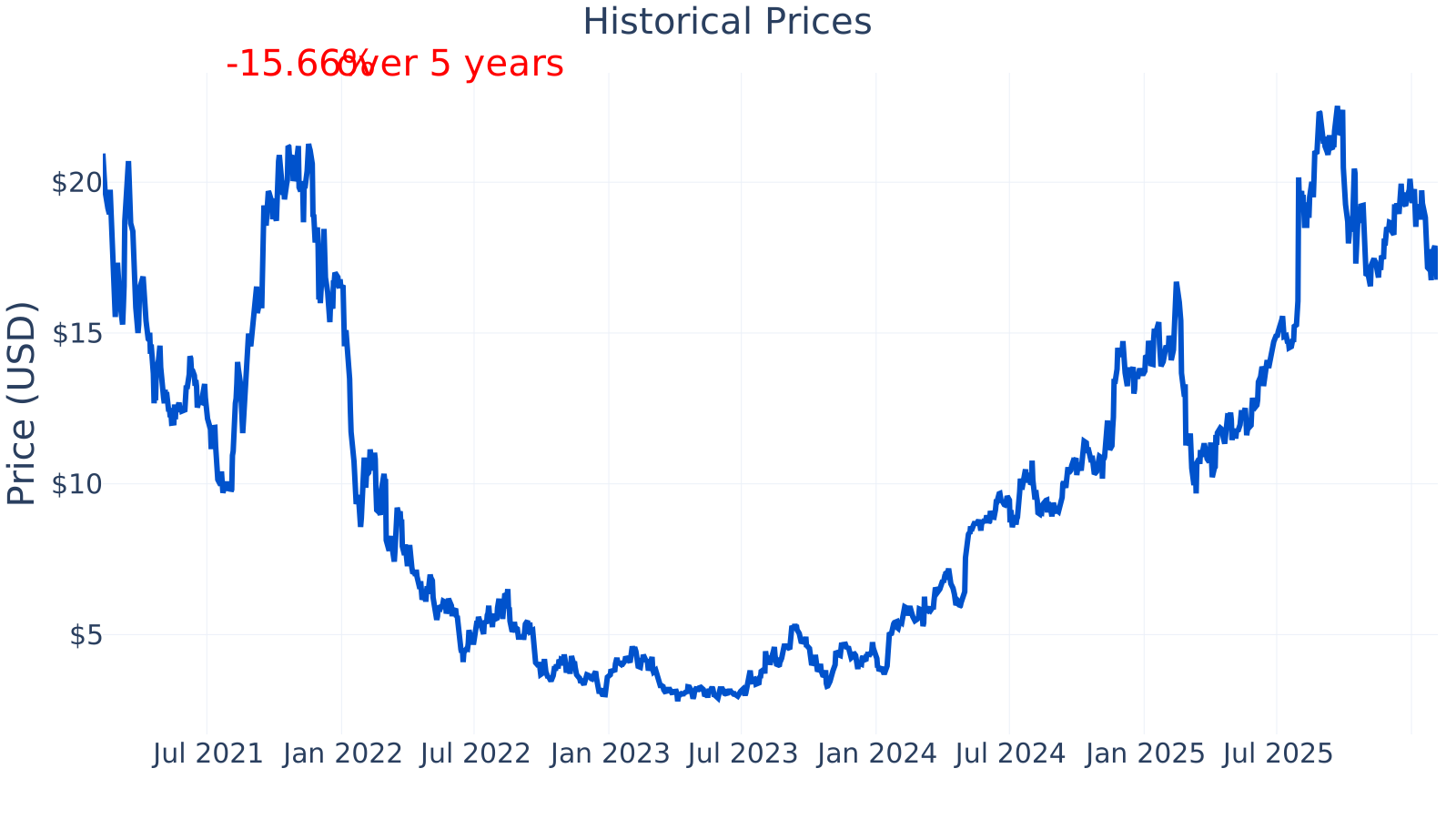
RSI’s market capitalization is about $4.1 billion. The stock’s beta is about 1.57, which describes higher-than-market historical volatility. The latest P/E ratio shown is about 68, which can occur when earnings are positive but still relatively small versus the company’s market value. Profit margin is about 2.83% (roughly in line with the industry median shown). Revenue growth year-over-year is listed at about 88.8% (well above the industry median shown), which suggests a period of unusually fast expansion. Debt-to-equity is about 4.4%, far below the industry median shown, indicating comparatively low reliance on debt. Trailing twelve-month free cash flow is about $99.8 million, which signals that recent operations have generated cash after capital spending.
Growth (Medium-High)
RSI operates in regulated online gambling, where long-term growth is closely tied to (1) legalization and regulation across additional states/jurisdictions, (2) consumer adoption of mobile wagering, and (3) the economics of customer acquisition and retention. In markets where online casino is legal, iCasino has often been a major profit pool for operators because players typically engage more frequently than in seasonal sports betting.
A central question for RSI’s growth is whether it can expand revenue while keeping marketing and promotional spending disciplined enough to protect margins. The company’s recent history shows improvement in profitability measures alongside revenue expansion, which is consistent with a strategy that prioritizes scaling in regulated markets while aiming for better unit economics over time.
Year-over-year revenue growth was very high in early 2021, then moderated into the mid-teens to ~20% range through much of 2022–2023, and then re-accelerated in 2024 (roughly low-30% range in multiple quarters shown) before landing around the ~20% range again in 2025 quarters shown. That pattern is common in expanding industries: growth can slow as a base gets larger, then re-accelerate with new market openings, product improvements, or stronger customer retention.
Free cash flow moved from negative levels in 2022–2023 to positive in 2024 and increased further into 2025 (about $74.6 million by 2025-03-31 and about $99.8 million on the latest table). For a digital operator, sustained positive free cash flow can increase flexibility for marketing, technology investment, and regulatory capital needs—without relying as heavily on outside financing.
Risks (High)
This article is for informational purposes only and does not constitute financial advice. Some content is AI-generated. See Disclaimer


