Stock Analysis · Ross Stores Inc (ROST)
Overview
Ross Stores, Inc. is a U.S. discount apparel and home fashion retailer best known for its Ross Dress for Less stores and, to a smaller extent, dd’s DISCOUNTS. The company’s model is “off-price”: it generally sells branded merchandise at lower prices than traditional department stores by buying items from manufacturers and other retailers (often opportunistically) and then selling them through a large network of physical stores. In its filings, Ross emphasizes value, frequent new merchandise (“treasure-hunt” shopping), and disciplined cost control as central parts of how it operates.
Ross’s revenue is primarily generated through in-store retail sales in the United States. In broad terms, the main sources of revenue are:
- Retail sales at Ross Dress for Less (largest contributor)
- Retail sales at dd’s DISCOUNTS (smaller contributor)
In its annual reporting, the company describes its business as operating primarily as one reportable segment, which means it does not always publish a detailed percentage split between the two banners in the way some retailers do. Revenue is overwhelmingly tied to selling apparel, accessories, footwear, and home-related products through its stores, rather than through a heavy e-commerce mix.
Across the periods shown, total revenue trends upward overall (despite year-to-year variability), while cost of goods sold remains the largest expense item. Net income is positive throughout the period shown, which is consistent with a retail model that relies on scale, fast inventory turnover, and tight expense management.
Key Figures
| Metric | Value | Industry ⓘ |
|---|---|---|
| Date | Mar 09, 2026 | |
| Context | ||
| Sector | Consumer Cyclical | |
| Industry | Apparel Retail | |
| Market Cap ⓘ | $68.87B | |
| Beta ⓘ | 0.98 | |
| Fundamental | ||
| P/E Ratio ⓘ | 33.14 | 14.87 |
| Profit Margin ⓘ | 9.43% | 8.32% |
| Revenue Growth ⓘ | 12.20% | 8.90% |
| Debt to Equity ⓘ | 80.49% | 92.83% |
| PEG ⓘ | 3.13 | |
| Free Cash Flow ⓘ | $2.21B | |
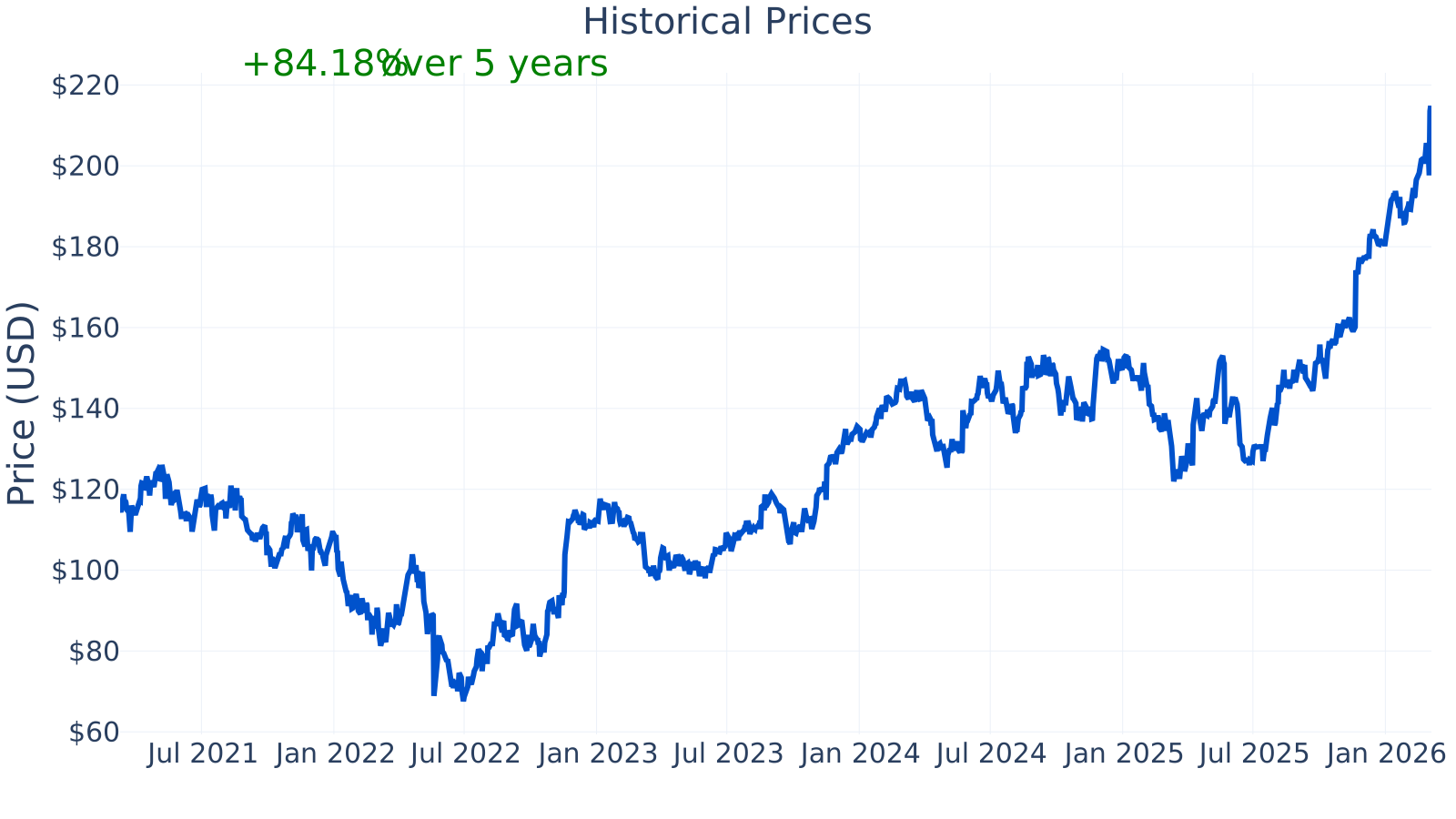
Ross Stores’ market capitalization is about $68.9B, and its beta of 0.98 suggests the stock has historically moved roughly in line with the overall market. The company’s P/E ratio is 33.14 versus an industry median near 14.87, indicating the market is valuing Ross at a higher multiple than many peers. Profitability is solid for the group: the net profit margin is ~9.43% compared with an industry median of about 8.32%. Revenue growth year over year is shown at about 12.2%, above an industry median near 8.9%. Debt-to-equity is about 80%, modestly below the industry median near 93%. Trailing twelve-month free cash flow is approximately $2.21B, reflecting meaningful cash generation after operating needs and capital spending.
Growth (medium)
Ross operates in discount/off-price retail, a part of consumer spending that tends to benefit when shoppers focus on value. In practical terms, the company’s growth depends on a mix of (1) opening and operating more stores efficiently, (2) driving comparable-store sales through strong merchandise assortments and consistent customer traffic, and (3) protecting margins through disciplined buying, inventory management, and expense control.
The year-over-year revenue growth line shows retail-like volatility (including periods of negative growth), followed by a more recent improvement to about 12.2%. That rebound matters because it suggests the business can re-accelerate after softer periods, although retail demand can shift quickly with consumer confidence, inflation, and competition.
Free cash flow has risen over the multi-year period shown, reaching roughly $2.21B in the trailing twelve months. For a store-based retailer, sustained free cash flow can support reinvestment in new locations, supply chain and systems, and returning capital to shareholders—while also providing flexibility during weaker consumer cycles.
Potential catalysts are typically operational rather than “one-time events”: successful execution on store expansion plans, maintaining strong inventory availability at compelling prices, and continued efficiency in distribution and store operations. Because Ross’s model depends on buying opportunities in the marketplace, its ability to source the right product at the right price is also a recurring driver of performance.
Risks (medium)
Retail is highly competitive and sensitive to consumer spending. Demand can weaken when households cut discretionary purchases, and performance can be affected by inflation in wages, rent, and transportation. Because Ross is mostly store-based, it also faces execution risk tied to store operations (staffing, shrink, and customer traffic) and risks related to inventory planning—having too much of the wrong product or not enough of what customers want.
Competition is significant. In U.S. off-price and value-focused retail, major competitors include TJX Companies (T.J. Maxx / Marshalls), Burlington, and other discount and mass retail chains that compete for value-oriented shoppers. Ross’s competitive positioning historically comes from scale in off-price buying, brand recognition in value retail, and a large store footprint. The company is a major player in off-price, though leadership in the category is often discussed alongside TJX (which is larger), with Ross being one of the largest U.S. focused competitors.
Debt-to-equity has trended down from higher levels earlier in the period shown to about 80% most recently (below the industry median near 93%). A lower leverage profile can reduce financial strain during weaker retail cycles, though it does not remove the operational risks inherent in the sector.
Net profit margin has generally improved versus earlier periods and stands around 9.43% most recently, above the industry median near 8.32%. While this points to relatively strong operating discipline, margins in retail can compress quickly if promotions rise, shrink increases, supply chain costs jump, or consumer demand weakens.
Valuation
The valuation picture suggests the market assigns Ross a higher earnings multiple than many apparel retail peers. The latest P/E is about 33.14 versus an industry median near 14.87. Historically in the period shown, Ross’s P/E has often sat above the industry median, and it increased meaningfully toward the most recent point on the chart.
A higher P/E can be consistent with expectations of steadier earnings, better margins, stronger competitive positioning, or more resilient performance across economic cycles. At the same time, a higher multiple can also mean the stock price embeds relatively optimistic assumptions; if growth slows, margins weaken, or competition intensifies, valuation can compress even if the business remains profitable.
Conclusion
Ross Stores is a large off-price retailer with a value-focused model, a long-running emphasis on store execution, and meaningful cash generation. The company shows solid profitability (net margin around 9.43%) and a recent improvement in revenue growth (about 12.2% year over year), with leverage that appears lower than the industry median based on debt-to-equity.
The main long-term considerations are the realities of retail cyclicality and intense competition versus the company’s ability to sustain traffic, protect margins, and expand efficiently. From a valuation standpoint, Ross trades at a materially higher P/E than the industry median, which indicates that expectations are already elevated compared with many peers.
Sources:
- U.S. SEC EDGAR — Ross Stores, Inc. Form 10-K (Annual Report)
- U.S. SEC EDGAR — Ross Stores, Inc. Form 10-Q (Quarterly Reports)
- Ross Stores, Inc. Investor Relations — SEC Filings & Press Releases (company-hosted)
- Wikipedia — “Ross Stores” (basic company background)
This article is for informational purposes only and does not constitute financial advice. Some content is AI-generated. See Disclaimer


