Stock Analysis · Roper Technologies Inc (ROP)
Overview
Roper Technologies Inc is a diversified technology company that owns a portfolio of businesses, with a strong emphasis on software and technology-enabled products. Across its operating companies, Roper typically focuses on specialized (“niche”) markets where customers rely on the company’s products to run important daily workflows. In practice, this often means recurring or repeatable revenue streams tied to mission-critical software, networks, or data-driven services rather than one-time hardware sales.
Roper reports its operations through three segments, each made up of multiple subsidiaries:
- Application Software (industry-specific software used to manage critical business processes)
- Network Software (software and services that support networks and transaction flows)
- Technology Enabled Products (specialized products, often paired with software and services)
Because Roper is a portfolio of many businesses, its revenue is spread across multiple end markets rather than being dependent on a single product. For an exact breakdown by segment and the company’s description of each business line, the most reliable reference is the segment reporting section of Roper’s most recent annual report (Form 10‑K).
Over recent years, total revenue increased steadily (from about $4.83B in 2021 to about $7.90B in 2025), while gross profit also expanded (about $3.41B to about $5.47B). This pattern is consistent with a business mix that leans toward software and high value-added offerings, where costs of revenue typically grow more slowly than sales.
Key Figures
| Metric | Value | Industry ⓘ |
|---|---|---|
| Date | May 04, 2026 | |
| Context | ||
| Sector | Technology | |
| Industry | Software - Application | |
| Market Cap ⓘ | $36.87B | |
| Beta ⓘ | 0.89 | |
| Fundamental | ||
| P/E Ratio ⓘ | 22.36 | 26.40 |
| Profit Margin ⓘ | 21.12% | 7.95% |
| Revenue Growth ⓘ | 11.30% | 15.60% |
| Debt to Equity ⓘ | 55.61% | 27.14% |
| PEG ⓘ | 1.47 | |
| Free Cash Flow ⓘ | $2.55B | |
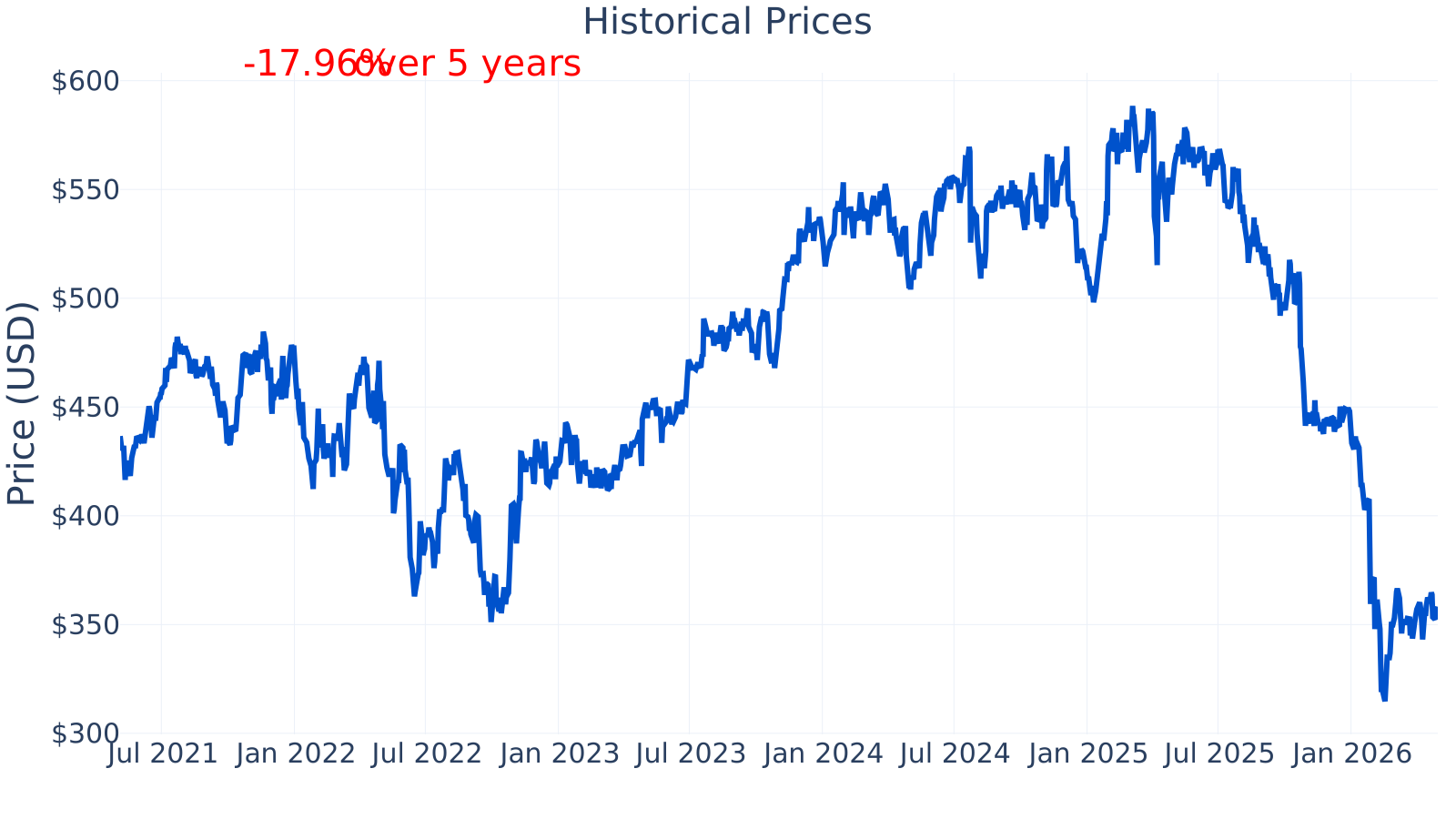
Roper’s market capitalization is about $36.9B and its stock has shown a beta of 0.89, which indicates it has historically been somewhat less volatile than the overall market. Profitability stands out: the company’s profit margin is ~21.1%, well above the industry median of ~8.0% for its peer group. Recent year-over-year revenue growth is ~11.3% (below the industry median of ~15.6%), suggesting Roper’s growth profile may be steadier rather than the fastest within the broader application software category. The P/E ratio is ~22.4 (below the industry median ~26.4), while the PEG ratio is ~1.47, a commonly used measure that relates valuation to expected growth. Trailing twelve-month free cash flow is about $2.55B, indicating meaningful cash generation after operating costs and capital spending.
Growth (Medium)
Roper’s core orientation toward software and software-like business models aligns with long-running trends: organizations continue to digitize operations, automate workflows, strengthen compliance, and rely more on specialized tools that are embedded in day-to-day processes. In niche vertical markets, switching costs can be meaningful (changing systems can disrupt operations), which can support longer customer relationships and more predictable renewal patterns.
Revenue growth has been consistently positive in recent quarters, generally in the low-to-mid teens year over year. The latest reading is about 11.3%, which is solid but not the highest relative to the industry median shown. For a company like Roper, growth is often shaped by a combination of steady expansion inside existing businesses (such as customer additions, product upgrades, and pricing) and acquisitions over time (as described in company filings).
Free cash flow has been substantial, with the latest trailing twelve-month figure around $2.55B. Over the last few years shown, free cash flow increased from roughly $1.87B (2022) to $2.55B (2026) despite a notable dip in 2023. For long-term business compounding, cash generation matters because it can support reinvestment in products, debt reduction, acquisitions, and returns of capital, depending on management’s priorities as disclosed in filings.
Potential catalysts discussed in filings and investor materials typically include continued expansion of recurring revenue in software-oriented businesses, operational improvements within acquired companies, and disciplined capital deployment (including acquisitions) into asset-light, high-margin niches.
Risks (Medium)
A key risk with a portfolio business model is execution across many subsidiaries. Performance depends on maintaining product quality, customer retention, and effective leadership across a wide set of operating companies. Another important risk is acquisition integration and capital allocation: if acquisitions are done at overly high prices or integration does not go as planned, returns can be pressured over time. As a technology-oriented company, Roper is also exposed to cybersecurity, data protection, and system reliability expectations, particularly where products support essential customer workflows.
Roper’s debt-to-equity is ~55.6%, compared with an industry median of ~27.1%. The multi-year trend shows leverage moving lower earlier in the period and then rising more recently, ending above the peer median. Higher leverage can increase sensitivity to interest rates and refinancing conditions, and it can reduce flexibility during downturns, even for businesses with strong margins.
Profitability has been consistently strong versus peers. The latest profit margin is about 21.1%, while the industry median is about 8.4% on the most recent point shown. Margins dipped into the high teens in late 2025 before returning above 20% by the latest period, which may reflect normal variation across operating companies, cost structures, and timing effects (the detailed drivers are typically discussed in quarterly and annual filings).
In terms of competition, Roper tends to compete at the operating-company level rather than against a single, direct “Roper-sized” rival. Competitors often include:
- Vertical market software providers that sell specialized applications to the same industries
- Broader enterprise software vendors when customers consider consolidating tools
- In-house solutions built by larger customers for narrowly defined workflows
Roper’s competitive positioning is typically built around specialization, embedded workflows, and long customer relationships. Whether it is the “leader” depends on each niche; in many cases, leadership is measured by depth in a vertical market rather than overall size.
Valuation
Roper’s current P/E ratio (~22.4) is below the industry median (~26.4) shown in the latest metrics, and the historical chart indicates the company’s P/E has trended downward from much higher levels earlier in the period (around the mid‑40s in 2021) to the mid‑20s more recently. The industry median P/E shown on the chart also declines over time, suggesting broader sector-level multiple compression rather than something unique to one company.
How to interpret that valuation contextually: Roper combines high profitability (margins well above peers) with moderate growth (recent growth below the peer median) and higher leverage than the median. In descriptive terms, a lower-than-median P/E can be consistent with the market assigning value to cash generation and stability while still accounting for growth that is not at the top of the peer set and for balance-sheet leverage that sits above the median.
Conclusion
Roper Technologies is a technology-focused owner of multiple specialized businesses, with a notable tilt toward software and recurring, workflow-embedded offerings. Financially, it shows a combination of strong profitability and material free cash flow generation, alongside mid-range revenue growth compared with the broader application software peer group.
The main long-term questions to track are whether Roper can sustain its margin advantage while continuing to grow organically and through acquisitions, and whether leverage remains at a level that preserves flexibility across economic cycles. From the available fundamentals shown here, the company’s profile is best described as high-margin, cash-generative, and acquisition-influenced, with valuation metrics that currently sit below the industry median P/E while carrying above-median leverage.
Sources:
- SEC EDGAR — Roper Technologies Inc — Form 10-K (Annual Report)
- SEC EDGAR — Roper Technologies Inc — Form 10-Q (Quarterly Reports)
- Roper Technologies — Investor Relations materials (segment descriptions and company presentations, when posted by the company)
- Wikipedia — “Roper Technologies” (basic company background)
This article is for informational purposes only and does not constitute financial advice. Some content is AI-generated. See Disclaimer


