Stock Analysis · Rogers Corporation (ROG)
Overview
Rogers Corporation is a specialty materials company that develops engineered materials used inside electronic and industrial products. In simple terms, it makes advanced “building block” materials that help customers manage heat, electricity, and signals in demanding applications. The company’s materials are typically designed into customers’ products and manufacturing processes, which can create longer product cycles and repeat business when designs are refreshed.
Based on the company’s business description in its SEC filings, Rogers’ end markets include areas like electric vehicles and other transportation applications, renewable energy and industrial equipment, and high-frequency electronics used in communication-related hardware. The common theme is that Rogers tends to sell into applications where performance and reliability matter and where materials are a meaningful part of the final product’s functionality.
In its filings, Rogers reports revenue by operating segments (rather than a simple “product A / product B” breakdown). Percentages can change by year, and the most reliable split is the one shown in the company’s latest Form 10-K or Form 10-Q.
Over the 2021–2025 period shown, total revenue moved from about $933M (2021) to $811M (2025). Profitability also weakened: operating income went from about $127M (2021) to about -$45M (2025), and net income fell from about $108M to about -$62M. That combination (lower revenue and lower operating profit) is important context for the rest of the analysis because it affects how the market tends to value the business and how much internal cash is available for reinvestment.
Key Figures
| Metric | Value | Industry ⓘ |
|---|---|---|
| Date | Apr 27, 2026 | |
| Context | ||
| Sector | Technology | |
| Industry | Electronic Components | |
| Market Cap ⓘ | $2.34B | |
| Beta ⓘ | 0.35 | |
| Fundamental | ||
| P/E Ratio ⓘ | N/A | 45.47 |
| Profit Margin ⓘ | -7.62% | 6.11% |
| Revenue Growth ⓘ | 4.80% | 17.40% |
| Debt to Equity ⓘ | 1.82% | 41.32% |
| PEG ⓘ | 0.77 | |
| Free Cash Flow ⓘ | $101.20M | |
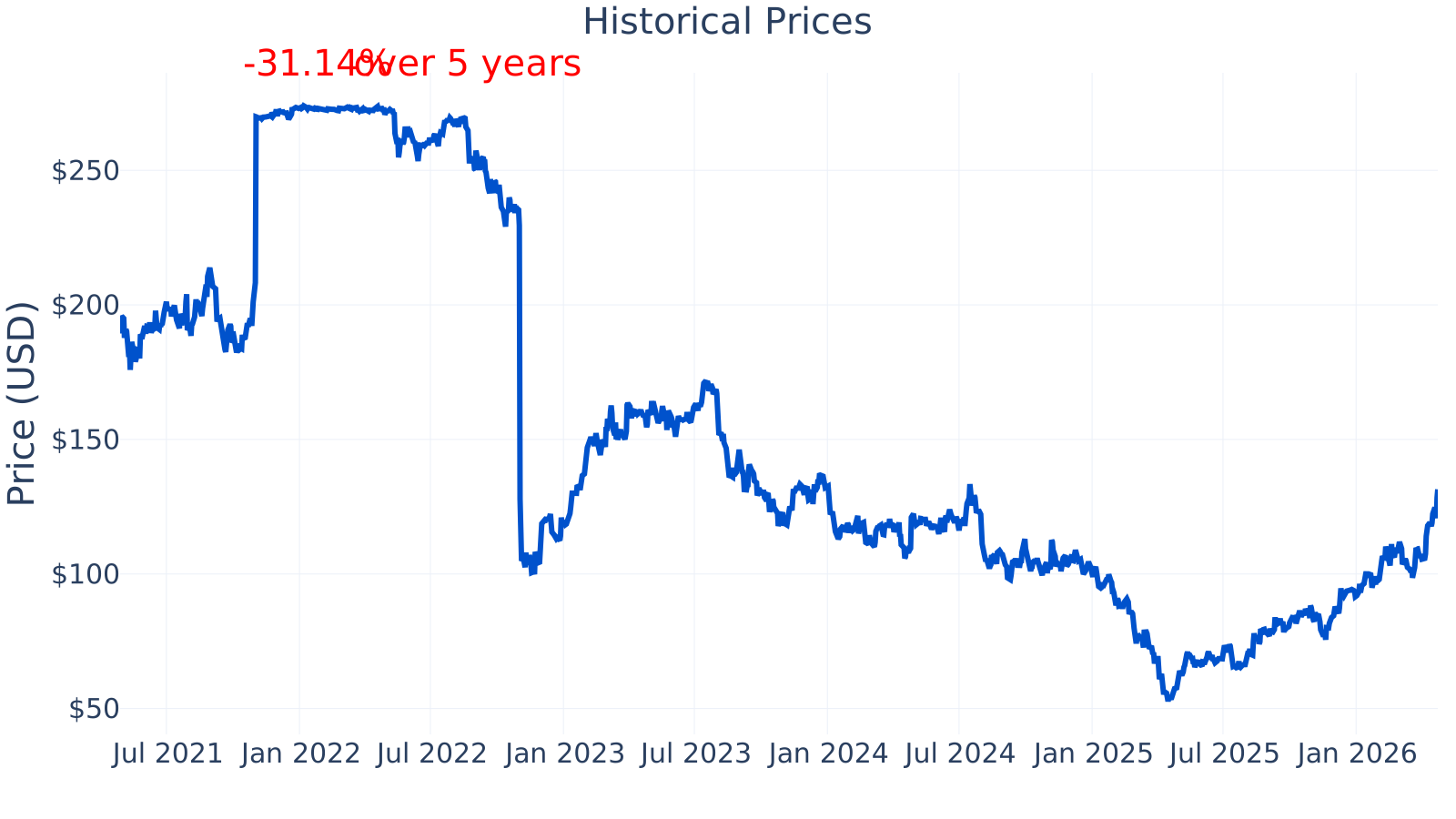
Rogers’ market capitalization is about $2.34B, placing it in the small-to-mid cap range. The stock’s beta of ~0.35 suggests it has historically moved less than the broader market, though company-specific events can still cause large swings. Recent profitability is a key weak spot: the latest profit margin is about -7.6%, compared with an industry median near +6.1%. Recent growth has also lagged peers: year-over-year revenue growth is about +4.8% versus an industry median around +17.4%.
On the balance-sheet side, debt looks limited: debt-to-equity is roughly 1.8% versus an industry median near 41.3%. Free cash flow over the trailing twelve months is about $101M, which indicates that despite weak accounting earnings recently, the business has still been able to generate cash in the latest period shown (free cash flow can diverge from net income due to working capital movements, non-cash charges, and capital spending timing).
Growth (medium)
Rogers operates in end markets that are often associated with long-term electrification and digitization trends (for example, electrified transportation, industrial power systems, and high-frequency electronics). These areas can be structurally supportive over time because they require advanced thermal and electrical materials to improve efficiency, reliability, and size/weight constraints.
That said, the company’s recent revenue pattern has been uneven. After strong growth earlier in the period, year-over-year revenue growth turned negative for multiple quarters before returning to a modest positive reading most recently. This kind of pattern is often consistent with cyclical customer demand, inventory adjustments in the supply chain, and program timing where large projects can shift between quarters.
The chart shows a move from strong positive growth in 2021 to a prolonged stretch of negative year-over-year comparisons through 2023–2025, followed by a return to about +4.8% at the end of 2025. Relative to the industry median shown in the latest metrics, Rogers’ most recent growth rate appears below many peers, which may signal that either end markets were softer for the company’s mix or that competitive and product-cycle factors played a role.
A practical “growth catalyst” framework for Rogers is whether it can (1) recover volume in key end markets, and (2) translate that into improved profitability. Cash generation is relevant here because it can fund R&D and capacity investments during down cycles.
Free cash flow improved significantly from negative ~$22M (TTM ended 2022-03-31) to about $108M (TTM ended 2024-03-31), then moderated to about $54M (TTM ended 2025-03-31). The most recent trailing free cash flow level in the key figures section is about $101M. For long-term business health, sustained positive free cash flow can provide flexibility even when reported earnings are under pressure.
Risks (high)
The most visible risk today is profitability volatility. The profit margin trend shows a shift from healthy positive margins earlier in the period to negative margins in 2025. When margins compress this sharply, it can reflect weaker demand, underutilized manufacturing capacity, pricing pressure, unfavorable product mix, higher input costs, restructuring costs, or a combination. Regardless of the cause, weaker margins reduce the margin of safety in the business model and can lead to more variable results.
From mid-2021 through 2024, profit margins were generally positive and often above the industry median in the chart. In 2025, margins turned negative (around -8% in the last quarters shown), while the industry median stayed positive. This widening gap suggests company-specific operational or market challenges (or both) during that period.
Another important risk is customer and end-market concentration. Specialty materials businesses can be sensitive to a handful of large programs or customers; if a major program ramps down, changes suppliers, or is delayed, results can be affected. In addition, many electronic and industrial markets are cyclical, and order patterns can change quickly when customers manage inventory levels.
On financial risk, Rogers appears conservatively financed compared with many peers. Low debt can reduce the risk of forced refinancing or constrained investment during downturns.
Debt-to-equity declined from higher levels in 2022 (peaking in the high teens to mid-20% range) to around ~1.8% most recently, well below the industry median (roughly in the 33%–45% range across the period). This does not eliminate business risk, but it can lower balance-sheet pressure when operating performance is weak.
Competitive positioning is another key consideration. Rogers participates in the “engineered materials for electronics/industrial uses” space, where competition can come from other specialty material suppliers and large diversified chemical/materials companies. Competitors may have greater scale, broader product portfolios, or different cost structures. Rogers’ typical competitive advantages are tied to application-specific know-how, qualification requirements, and long customer design cycles; however, these advantages are strongest when the company consistently executes on quality, innovation, and on-time supply.
Valuation
The price-to-earnings (P/E) ratio is most useful when earnings are stable and positive. Historically, Rogers’ P/E fluctuated widely (roughly from the low 20s into the 60–70 range during 2021–mid 2025 in the chart), often above the industry median shown. In late 2025 and early 2026, the chart stops showing a meaningful company P/E (displayed as 0), which typically happens when earnings are very low or negative and the P/E becomes less informative.
Because recent net income has turned negative (as reflected in the overview figures for 2025), valuation discussions usually shift toward other anchors such as revenue, cash flow generation, and the credibility/timing of margin recovery. The company’s ability to return to consistent profitability is likely to be a major driver of how the market values it over time. At the same time, the balance sheet leverage appears low, which can be a supportive factor when comparing valuation across companies with different debt loads.
Conclusion
Rogers Corporation operates in specialized materials with exposure to long-term themes like electrification and high-performance electronics, and it shows a relatively low debt profile. However, the recent financial picture includes weakening revenue over the multi-year window and a pronounced deterioration in profitability that culminated in negative net income and negative profit margins in 2025.
For a long-term, fundamentals-focused view, the central questions are whether revenue growth can stabilize and whether margins can return to levels more in line with the company’s earlier history and with industry norms. The historical valuation range also indicates that the market has often assigned a higher earnings multiple than the industry median during profitable periods, but P/E becomes difficult to interpret when earnings are depressed. In practice, the company’s long-term narrative depends heavily on operational execution and the timing/strength of demand recovery in its end markets.
Sources:
- SEC EDGAR — Rogers Corporation Form 10-K (Annual Report)
- SEC EDGAR — Rogers Corporation Form 10-Q (Quarterly Report)
- Rogers Corporation Investor Relations — SEC Filings (company-hosted access page)
- Wikipedia — “Rogers Corporation” (basic company background)
This article is for informational purposes only and does not constitute financial advice. Some content is AI-generated. See Disclaimer


