Stock Analysis · Roblox Corp (RBLX)
Overview
Roblox Corp. operates an online entertainment platform where people play games and experiences made mostly by a community of independent creators. The company provides the core technology (the Roblox app, game engine tools, servers, safety systems, and discovery features) and shares economics with creators through payouts tied to engagement and spending on the platform.
Roblox’s business model is built around a virtual economy. Users can get virtual currency (“Robux”) and spend it on digital items and within experiences. The company then recognizes revenue over time as users consume services on the platform (a common approach for companies selling digital currencies and subscriptions).
In its filings, Roblox primarily reports revenue as a single line rather than as multiple separately quantified product lines. At a high level, revenue is largely connected to:
- Virtual economy transactions (spending of Robux within experiences and on avatar items), net of amounts shared with creators and app store fees
- Other platform-related revenue (smaller in comparison, and not broken out in detail in the provided financial figures)
Roblox has one operating segment and tends to emphasize platform health indicators (such as engagement and spending) alongside traditional financial statements.
Across recent years, total revenue has increased meaningfully (about $1.9B in 2021 to about $4.9B in 2025), while the company has continued to spend heavily on operating costs—especially research and development. This has contributed to continued operating losses and net losses even as gross profit dollars expanded in the latest years shown.
Key Figures
| Metric | Value | Industry ⓘ |
|---|---|---|
| Date | May 04, 2026 | |
| Context | ||
| Sector | Communication Services | |
| Industry | Electronic Gaming & Multimedia | |
| Market Cap ⓘ | $32.30B | |
| Beta ⓘ | 1.50 | |
| Fundamental | ||
| P/E Ratio ⓘ | N/A | |
| Profit Margin ⓘ | -20.69% | -7.49% |
| Revenue Growth ⓘ | 39.30% | 4.40% |
| Debt to Equity ⓘ | 144.68% | 31.70% |
| PEG ⓘ | 8.18 | |
| Free Cash Flow ⓘ | $1.64B | |
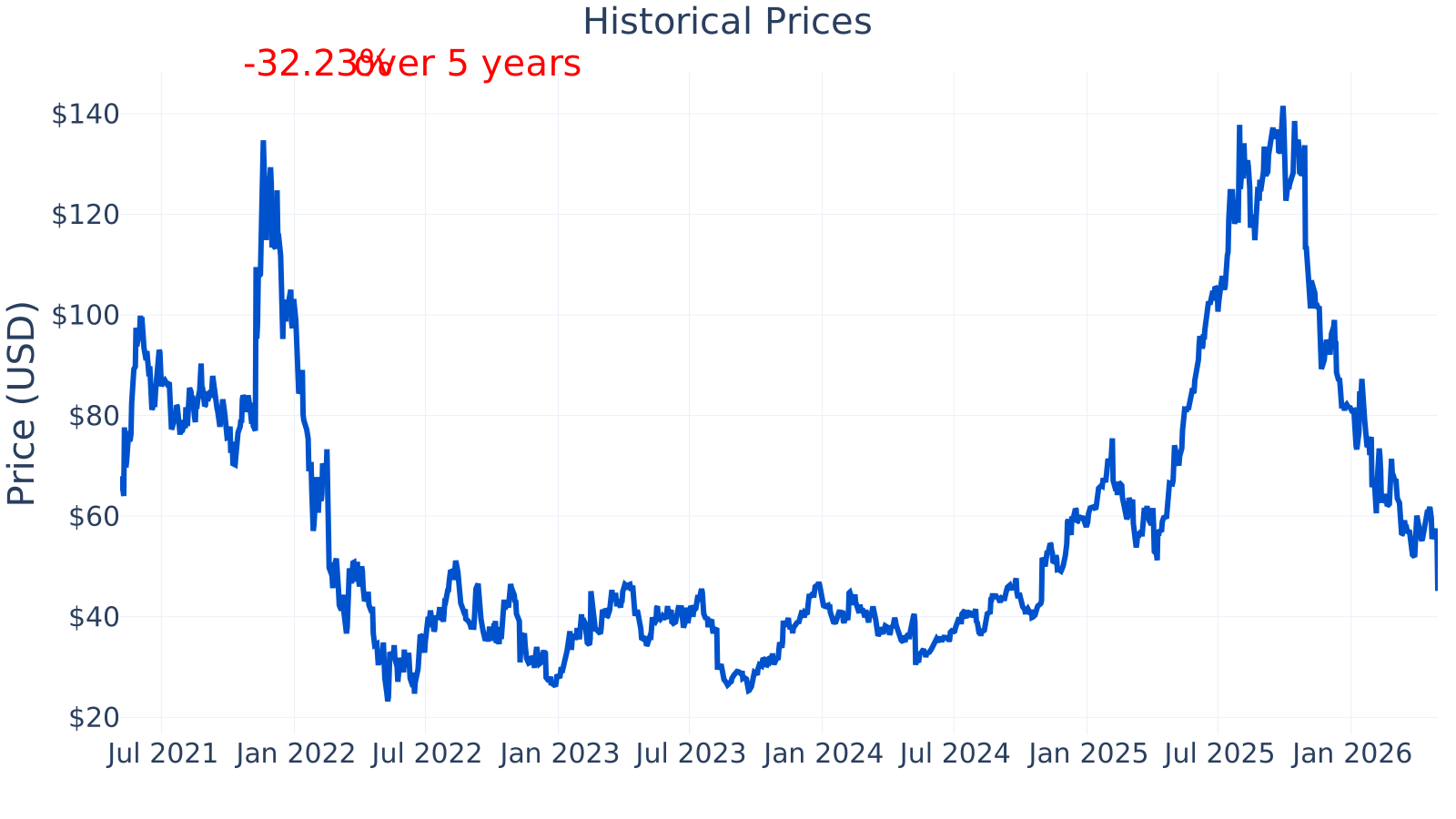
Roblox’s market capitalization is about $32.3B, and the stock’s beta of 1.5 suggests it has historically moved more than the overall market. The company shows a negative profit margin of about -20.7% (industry median about -7.5%), meaning it is still unprofitable on a net income basis. At the same time, year-over-year revenue growth is about 39.3% (industry median about 4.4%), indicating faster top-line growth than peers in its listed industry group. Roblox also reports positive trailing twelve-month free cash flow of about $1.64B. The debt-to-equity ratio is about 145% versus an industry median around 31.7%, which implies a more leveraged capital structure than the typical peer in the comparison set.
Growth (Medium)
Roblox participates in digital gaming and interactive entertainment, where long-term demand is influenced by factors like time spent online, social interaction through digital experiences, and ongoing monetization of virtual goods. The company’s strategy centers on expanding its ecosystem: improving creation tools, scaling infrastructure, and growing the catalog of experiences so that more users spend more time on the platform.
Revenue growth has been volatile but notably positive in the most recent periods shown. After a sharp slowdown around late 2022, growth re-accelerated and reached roughly 39% in the latest quarter shown. For long-term observers, the key question is whether Roblox can sustain higher growth as the platform scales and competition for entertainment time remains intense.
Free cash flow has improved substantially over time, moving from positive levels in 2021–2022, dipping negative in 2023, and then rising strongly to about $1.64B in the latest period. For a platform business, stronger free cash flow can matter because it may provide more flexibility to invest in infrastructure, developer tooling, safety systems, and international expansion without relying as heavily on external financing.
Potential catalysts that can influence long-term growth (in either direction) include changes in platform engagement, effectiveness of discovery and monetization systems for creators, and the company’s ability to broaden its audience while maintaining trust and safety standards.
Risks (High)
A central risk is that Roblox remains unprofitable on a net income basis, which means the company must balance growth investments with a path toward improved margins over time. Continued losses can also increase sensitivity to shifts in investor sentiment and capital market conditions.
Profit margins have been negative for years, though they have improved from worse levels seen around 2023. The latest value shown is approximately -20.7%, which is still weaker than the industry median (about -7.5%). A sustained improvement would generally require either faster revenue growth relative to operating expense growth, better infrastructure efficiency, or a change in the mix of costs (including moderation, safety, and developer-related payouts).
Roblox’s debt-to-equity ratio is about 145% in the latest period shown. While the ratio has come down sharply from very elevated levels in 2023–2024, it remains above the industry median (~31.7%). A higher leverage profile can reduce flexibility during downturns and may increase the importance of maintaining strong liquidity and cash generation.
Competitive pressure is another important risk. Roblox competes for user attention with a wide range of entertainment options (other gaming platforms, game publishers, and social/video platforms). Its competitive advantages are tied to its large creator ecosystem, user-generated content scale, and the social nature of the platform; however, these advantages depend on continued user engagement, strong creator economics, and effective trust-and-safety execution. Because many users are younger, regulatory and reputational risks related to safety, privacy, and content moderation can be especially consequential.
Platform concentration risk also matters: distribution through mobile app stores and major operating systems can expose Roblox to policy changes, fees, and enforcement actions that may affect monetization or user acquisition.
Valuation
A traditional price-to-earnings (P/E) ratio is not meaningful here because Roblox has been reporting net losses, which typically results in an undefined or non-comparable P/E. In cases like this, valuation discussions often lean more on revenue growth, cash flow generation, and expectations for eventual profitability rather than current earnings.
With a market capitalization around $32.3B and recent revenue growth near 39%, the market appears to be assigning substantial value to continued expansion and improved long-term economics. At the same time, the company’s negative profit margin and above-median debt-to-equity highlight that execution and financial discipline remain key variables for how the business is valued over time.
Conclusion
Roblox is a large-scale interactive entertainment platform built on user-generated experiences and a virtual economy, with revenue that has grown substantially over recent years. The company’s recent acceleration in year-over-year revenue growth and the improvement in trailing free cash flow point to stronger operating momentum than the period of slower growth and weaker cash generation seen around 2022–2023.
At the same time, Roblox continues to report net losses and negative profit margins, and it shows a higher debt-to-equity ratio than the industry median despite meaningful improvement from prior peaks. The long-term outlook therefore depends heavily on whether the platform can sustain engagement-driven growth while gradually improving efficiency and profitability, all while managing competition and heightened trust-and-safety responsibilities.
Sources:
- U.S. SEC EDGAR — Roblox Corp. Form 10-K (Annual Report)
- U.S. SEC EDGAR — Roblox Corp. Form 10-Q (Quarterly Report)
- Roblox Investor Relations — Shareholder letters / quarterly results materials (company-hosted)
- Wikipedia — “Roblox” (general background only)
This article is for informational purposes only and does not constitute financial advice. Some content is AI-generated. See Disclaimer


