Stock Analysis · Ringcentral Inc (RNG)
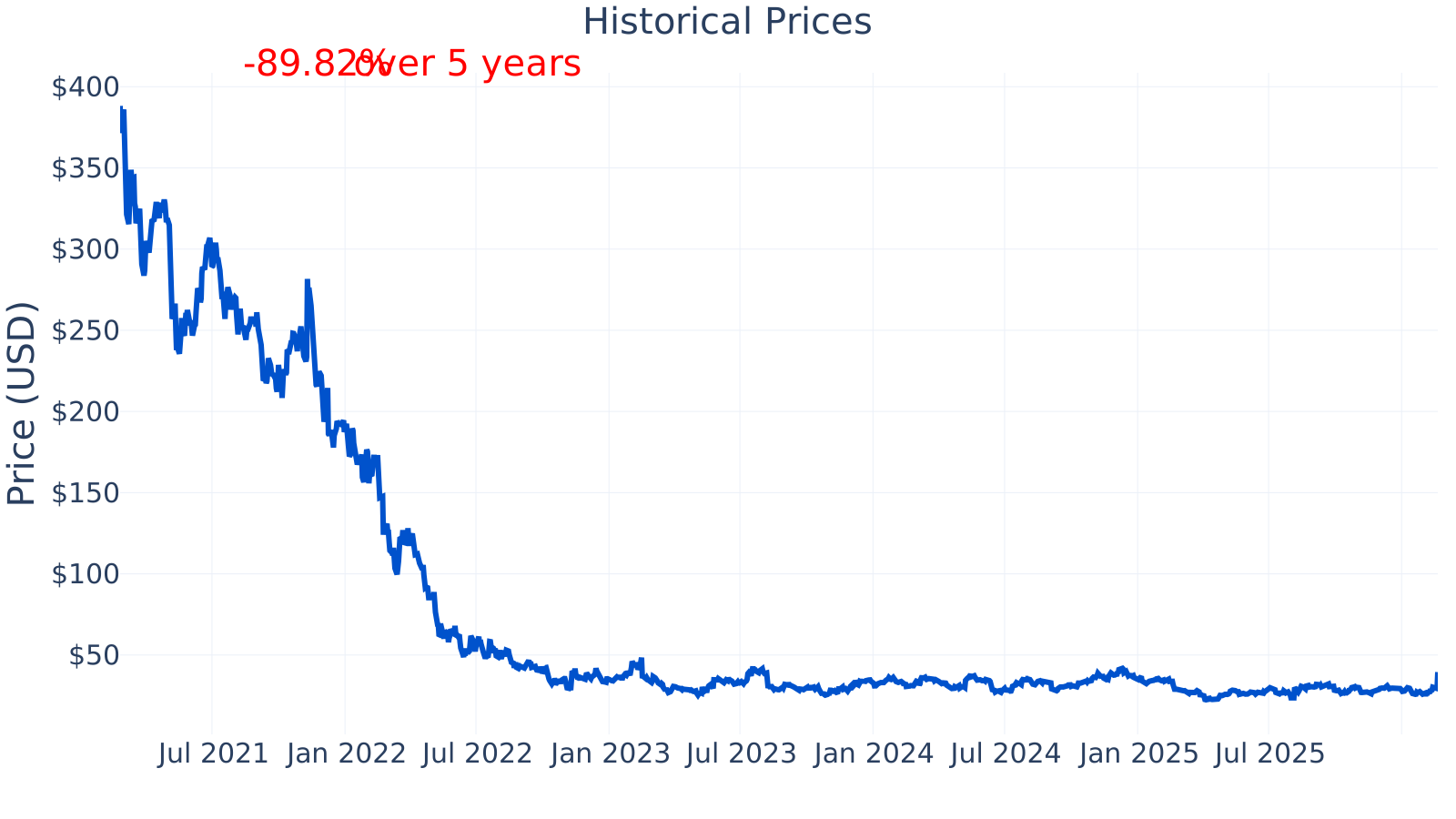
Overview
RingCentral, Inc. (RNG) provides cloud-based communications software for businesses. In simple terms, it helps companies run phone calls, video meetings, messaging, and customer support communications through internet-based tools rather than traditional on-premise phone systems. This category is often described as “unified communications” delivered as a subscription service.
The company mainly generates revenue through recurring subscriptions sold to businesses, with additional revenue from usage-based services and professional services tied to deployments and support. In its SEC filings, RingCentral describes revenue primarily as subscription revenue and other revenue (such as usage and services), with subscription revenue being the dominant portion.
Main revenue streams (as described in company filings):
- Subscriptions (recurring contracts for cloud communications and related capabilities)
- Other revenue (usage-based fees and services such as implementation and support)
Over recent years, the company’s financial profile has shown improving operating results: total revenue has increased, while operating income and net income have moved from sizable losses toward profitability (and turned positive in the most recent year shown below).
The path from revenue to profit shows a notable shift: operating income moved from negative territory in earlier years to positive by 2024–2025, alongside a swing to positive net income in 2025. Selling, general, and administrative costs appear to have declined versus prior peaks while revenue continued to grow, which is consistent with tighter expense control.
Key Figures
| Metric | Value | Industry ⓘ |
|---|---|---|
| Date | Feb 23, 2026 | |
| Context | ||
| Sector | Technology | |
| Industry | Software - Application | |
| Market Cap ⓘ | $3.42B | |
| Beta ⓘ | 1.23 | |
| Fundamental | ||
| P/E Ratio ⓘ | 282.14 | 25.48 |
| Profit Margin ⓘ | 1.73% | 7.23% |
| Revenue Growth ⓘ | 4.80% | 15.70% |
| Debt to Equity ⓘ | -251.99% | 25.08% |
| PEG ⓘ | 0.40 | |
| Free Cash Flow ⓘ | $636.20M | |
RingCentral’s market capitalization is about $3.4B. The stock’s beta (~1.23) suggests it has tended to move more than the overall market. The company shows a profit margin of ~1.7%, below the industry median (~7.2%), indicating profitability is present but still relatively thin compared with many peers. Year-over-year revenue growth is about 4.8%, also below the industry median (~15.7%), pointing to a slower growth phase than the typical company in its software peer set. Free cash flow over the trailing twelve months is about $636M, which is a meaningful source of financial flexibility. The P/E ratio (~282) is far above the industry median (~25), which usually reflects that earnings are currently small relative to the company’s market value (even if cash flow is stronger). The debt-to-equity ratio is negative, which commonly happens when accounting equity is negative; in that situation, the ratio is less intuitive and balance-sheet details in filings become especially important.
Growth (Medium)
RingCentral operates in the broader shift from legacy business phone systems to cloud communications. The long-term direction of this market is supported by ongoing workplace distribution (hybrid work), multi-location operations, and the push to integrate communications into everyday business software. While the category is not new, it is still shaped by product consolidation (one platform for calling, meetings, messaging, and customer interactions) and by demand for reliability, security, and compliance—areas where established vendors can compete.
Strategically, RingCentral’s model is designed around recurring subscriptions, which can create predictable revenue when customer retention is strong. A key element for future growth is whether the company can expand within existing customers (more seats, more products, higher tiers) while sustaining retention in a competitive market.
The revenue growth trend shows a clear slowdown from high growth rates in 2021 (above 30% year-over-year) to mid-single-digit growth by 2025 (around 5%). This pattern often indicates a business moving from rapid expansion to a more mature phase, where execution may depend more on share gains, pricing/packaging, and operational efficiency than on overall market growth alone.
Free cash flow has improved substantially over time, moving from negative levels in 2021–2022 to positive and rising levels by 2023–2025. This matters for long-term durability because it can support ongoing product investment, debt servicing, and other corporate needs without relying as heavily on external financing.
Risks (High)
Competition is a central risk. Business communications software is crowded, and many customers can evaluate alternatives without changing their core business model. RingCentral competes with large platform companies and specialized communications providers. Major competitive pressures can include bundling (communications bundled with other enterprise software), pricing, switching incentives, and the ability of rivals to integrate communications into productivity and customer support workflows.
Another important risk is growth deceleration. With revenue growth now in the mid-single digits, future results may rely more on retaining customers, increasing revenue per customer, and expanding adjacent products. If customer churn rises or seat expansion slows, overall growth can remain constrained even if the market itself continues to expand.
Profitability also remains a watch point. While the company reached positive net income in the most recent year shown, profitability is still relatively low compared with typical software industry medians.
The profit margin trend shows a multi-year recovery from significant losses (2021–2023) toward small positive profitability by late 2025 (about 1.7%). Even with this improvement, the level is still below the industry median (about 7.6% at the latest point shown), which highlights that maintaining and expanding profitability is still an execution challenge.
Balance-sheet structure is another area that can require extra attention for long-term assessments, especially because the debt-to-equity metric is negative (often linked to negative accounting equity, which can occur after accumulated losses, share repurchases, or other accounting effects).
The debt-to-equity series swings from very high positive values earlier to negative values more recently, while the industry median remains positive and relatively stable. Because negative equity can make this ratio hard to interpret, it can be more informative to review the company’s filings for details such as total debt, lease obligations, cash balances, and the specific drivers of equity changes.
Competitive position and potential advantages are mixed. RingCentral is a recognized brand in cloud business communications and has developed a broad product suite. However, the company is not operating in a category with a single dominant provider, and some of its largest competitors have very large ecosystems and distribution channels.
Main competitor groups include:
- Unified communications platforms (other cloud calling/meetings/messaging vendors)
- Large enterprise software suites that bundle communications into broader productivity offerings
- Contact center and customer engagement providers where communications are part of a wider customer service platform
Valuation
Valuation is challenging to summarize with a single metric for a company that has only recently reached small positive profitability. The latest P/E ratio (~282) is far above the industry median (~25), which typically means earnings are currently low relative to the company’s market value. In that situation, the P/E can look “stretched” even when cash flow is improving, because accounting earnings and free cash flow may not move in lockstep.
The P/E history shown is limited (many earlier periods are not meaningful or not displayed), but the most recent visible value remains well above the industry median line. With revenue growth now materially lower than earlier years, a high earnings multiple generally places more weight on continued margin expansion and sustained cash generation rather than rapid top-line growth.
Conclusion
RingCentral is a cloud communications software company built around recurring subscriptions, operating in a category that benefits from long-term migration away from legacy phone systems. Financially, the company shows a clear improvement in cash generation and a move toward profitability, culminating in positive net income in the most recent year shown.
At the same time, the business is now in a slower growth phase, operates in a highly competitive environment, and shows profitability that is still modest relative to industry medians. The current valuation signals that market expectations may depend heavily on continued margin improvement and steady execution, especially given the high P/E alongside mid-single-digit revenue growth.
Sources:
- U.S. SEC EDGAR — RingCentral, Inc. filings (Form 10-K, Form 10-Q)
- RingCentral, Inc. Investor Relations — SEC filings and shareholder materials
- Wikipedia — “RingCentral” (basic company background)
This article is for informational purposes only and does not constitute financial advice. Some content is AI-generated. See Disclaimer


