Stock Analysis · Reynolds Consumer Products Inc (REYN)
Overview
Reynolds Consumer Products Inc. (REYN) makes everyday household items used mainly in kitchens and around the home. Its products are typically “consumables” (items that are used up and repurchased), such as aluminum foil, trash bags, food storage, and other disposable or semi-disposable items. The company sells primarily through large retailers, grocery chains, and other distribution channels, which tends to make demand more tied to household usage than to big-ticket discretionary spending.
In its SEC filings, Reynolds Consumer Products generally describes its business through product categories rather than one single product line. The largest sources of revenue are typically aligned to these categories:
- Waste & storage (for example: trash bags and storage products)
- Cooking & baking (for example: aluminum foil and baking-related products)
- Tableware (for example: disposable plates/cups and related items)
The exact percentages by category can change year to year based on pricing, promotional activity, and consumer demand. For a precise split, the company’s latest annual report (Form 10‑K) is the most reliable reference.
Across the years shown, revenue appears relatively stable (roughly in the mid-$3 billions), while profitability moves more with costs (materials, freight, and manufacturing) and operating expenses. Operating income and net income fluctuate meaningfully from year to year even when revenue is fairly steady, which is common in packaging/consumer products where input costs and pricing power can shift.
Key Figures
| Metric | Value | Industry ⓘ |
|---|---|---|
| Date | Feb 16, 2026 | |
| Context | ||
| Sector | Consumer Cyclical | |
| Industry | Packaging & Containers | |
| Market Cap ⓘ | $4.99B | |
| Beta ⓘ | 0.57 | |
| Fundamental | ||
| P/E Ratio ⓘ | 16.59 | 22.22 |
| Profit Margin ⓘ | 8.09% | 5.56% |
| Revenue Growth ⓘ | 1.40% | 5.90% |
| Debt to Equity ⓘ | 78.34% | 137.29% |
| PEG ⓘ | N/A | |
| Free Cash Flow ⓘ | $316.00M | |
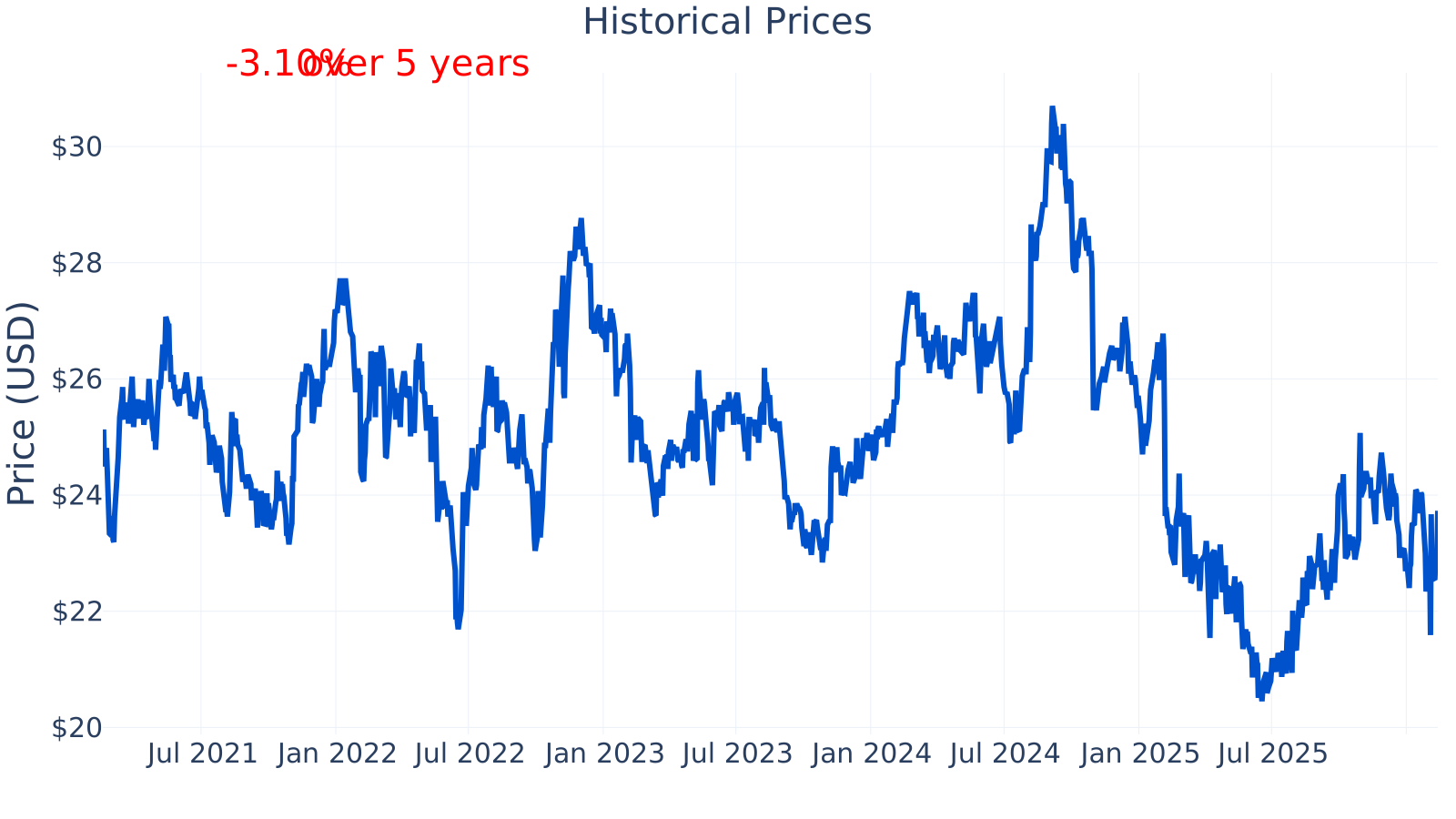
Reynolds Consumer Products has a market capitalization of about $5.0B and a relatively low beta (~0.57), which means the stock has historically moved less than the broader market. The company’s latest P/E ratio is ~16.6, below the industry median (~22.2) in the Packaging & Containers peer set provided. Profitability (net profit margin) is about 8.1%, above the industry median (~5.6%). Revenue growth year-over-year is about 1.4%, below the industry median (~5.9%). Leverage is moderate: debt-to-equity ~78%, lower than the industry median (~137%). Trailing twelve-month free cash flow is about $316M.
Growth (Low)
Reynolds Consumer Products operates in a mature, everyday-necessities part of the consumer market. Over long periods, this kind of business often grows more slowly than high-growth industries because household penetration is already high and many categories are mature. That said, demand can be relatively resilient because people continue to buy trash bags, foil, and storage products in many economic environments.
The revenue growth pattern shown is mixed: stronger growth in 2021–2022, followed by several quarters of declines in 2023–2024, and then a return to low single-digit growth more recently (around ~1% to ~2% in the latest periods shown). This profile suggests that long-term expansion may rely more on pricing, product mix, distribution execution, and selective innovation than on rapid category growth.
Free cash flow can matter a lot for a business like this because it helps fund dividends, debt reduction, and reinvestment. The chart shows that trailing free cash flow has varied substantially (from roughly $166M to $544M across the periods shown), with the latest level around $316M. This variability can reflect working-capital swings, changes in profitability, and the timing of capital spending.
Potential catalysts in this type of business are usually practical rather than transformational: improved pricing versus input costs, operational efficiency (manufacturing productivity), and steady brand/distribution execution. M&A can also be a catalyst in consumer packaging, but it is inherently uncertain and depends on valuation and integration outcomes.
Risks (Medium)
Leverage has trended down notably over time, from well above 100% earlier in the series to about 78% most recently, and it is also below the industry median shown. Lower leverage can reduce financial risk, but debt still matters because interest costs can pressure earnings when rates are higher or when refinancing is needed.
Net profit margin has fluctuated over the period shown, falling into the mid-single digits at its weaker points and improving to around 8%–10% in stronger periods, with the latest at about 8.1%. It is also above the industry median in the peer set provided. Even so, margin pressure remains a key risk because many costs (resins, aluminum, paper inputs, freight, labor) can move quickly, while price increases can lag due to retailer negotiations and competitive dynamics.
Competitive positioning in household consumables is shaped by brand strength, shelf space, scale in manufacturing, and the ability to deliver consistent quality at a competitive cost. Reynolds Consumer Products is well-known in several categories, but it competes with:
- Large branded consumer companies (with competing household and kitchen brands)
- Private label/store brands, which can pressure pricing and shelf space, especially when consumers trade down
- Other packaging and household product manufacturers with overlapping categories
Competitive advantages in this space tend to be incremental rather than absolute: trusted brands, long-term retailer relationships, and efficient production. A key risk is that if private label gains share or promotions intensify, it can reduce pricing power and compress margins.
Other notable risks include execution (manufacturing disruptions, supply chain constraints), commodity/input volatility, and the possibility that category volumes soften if consumers reduce discretionary usage of certain disposable items. Regulatory or consumer preference shifts around disposable products and sustainability expectations may also affect product design, materials, and costs over time.
Valuation
The P/E ratio shown for REYN has generally moved through a mid-teens to low-20s range over the period displayed, and the latest reading is about 16.6. Compared with the industry median shown (about 22.2), the company is trading at a lower earnings multiple in this peer context.
Whether that lower multiple is “justified” depends mainly on fundamentals visible in the rest of the profile: revenue growth has been relatively low recently (latest about 1.4% year-over-year, below the industry median shown), while profitability has been comparatively solid (profit margin above the industry median) and leverage has declined (debt-to-equity below the industry median). In other words, the valuation signals a business that the market may be viewing as steady but not fast-growing, with meaningful sensitivity to costs and pricing cycles.
Conclusion
Reynolds Consumer Products is a household staples-style business within the Packaging & Containers space: everyday products, typically repeat purchases, and demand that can be more stable than many consumer discretionary categories. The company shows comparatively solid profitability versus the industry median provided and a clear downward trend in leverage over time, both of which can support resilience.
At the same time, recent revenue growth has been modest and has experienced periods of decline, indicating that long-term results may depend more on operational discipline, pricing execution, and input-cost management than on broad market expansion. The stock’s valuation (P/E around the mid-teens and below the industry median shown) is consistent with a mature company profile where steady cash generation and margin stability tend to matter as much as headline growth.
Sources:
- U.S. SEC EDGAR — Reynolds Consumer Products Inc. filings (Form 10‑K, 10‑Q)
- Reynolds Consumer Products — Investor Relations materials (company-hosted reports and releases)
- Wikipedia — “Reynolds Consumer Products” (basic company background)
This article is for informational purposes only and does not constitute financial advice. Some content is AI-generated. See Disclaimer


