Stock Analysis · Revolve Group LLC (RVLV)
Overview
Revolve Group LLC is an online fashion retailer focused on a curated assortment of apparel, footwear, accessories, and beauty. The company primarily sells directly to consumers through its digital storefronts and also operates a second concept, FWRD, which is positioned more toward luxury fashion. A core part of Revolve’s business model is combining e-commerce with brand marketing, including social-media-driven campaigns and events designed to keep its brands visible to its target audience.
From a revenue perspective, Revolve’s sales are largely generated by product sales through its owned websites and apps. In its SEC filings, the company typically discusses revenue in terms of “net sales” (product revenue) across its two brand segments:
- REVOLVE segment (core assortment, trend-focused fashion)
- FWRD segment (higher-end/luxury positioning)
Percentages by segment can vary by year and are disclosed in the company’s filings; this article keeps the structure simple and focuses on the main drivers rather than a single-period mix that can shift.
Looking at the company’s recent income structure, Revolve has produced over $1B in annual revenue in recent years, with costs of revenue and operating expenses absorbing most of that amount. Net income declined after 2021 and then improved again by 2024, showing how profitability can fluctuate with demand, promotions, shipping/fulfillment costs, and marketing intensity.
Across 2021–2024, revenue stayed around the ~$0.9B to ~$1.13B range, while net income moved more sharply (from about $99.8M in 2021 down to about $28.1M in 2023, then back up to about $49.6M in 2024). This pattern highlights that changes in operating costs and merchandising conditions can have an outsized impact on bottom-line results.
Key Figures
| Metric | Value | Industry ⓘ |
|---|---|---|
| Date | Feb 23, 2026 | |
| Context | ||
| Sector | Consumer Cyclical | |
| Industry | Internet Retail | |
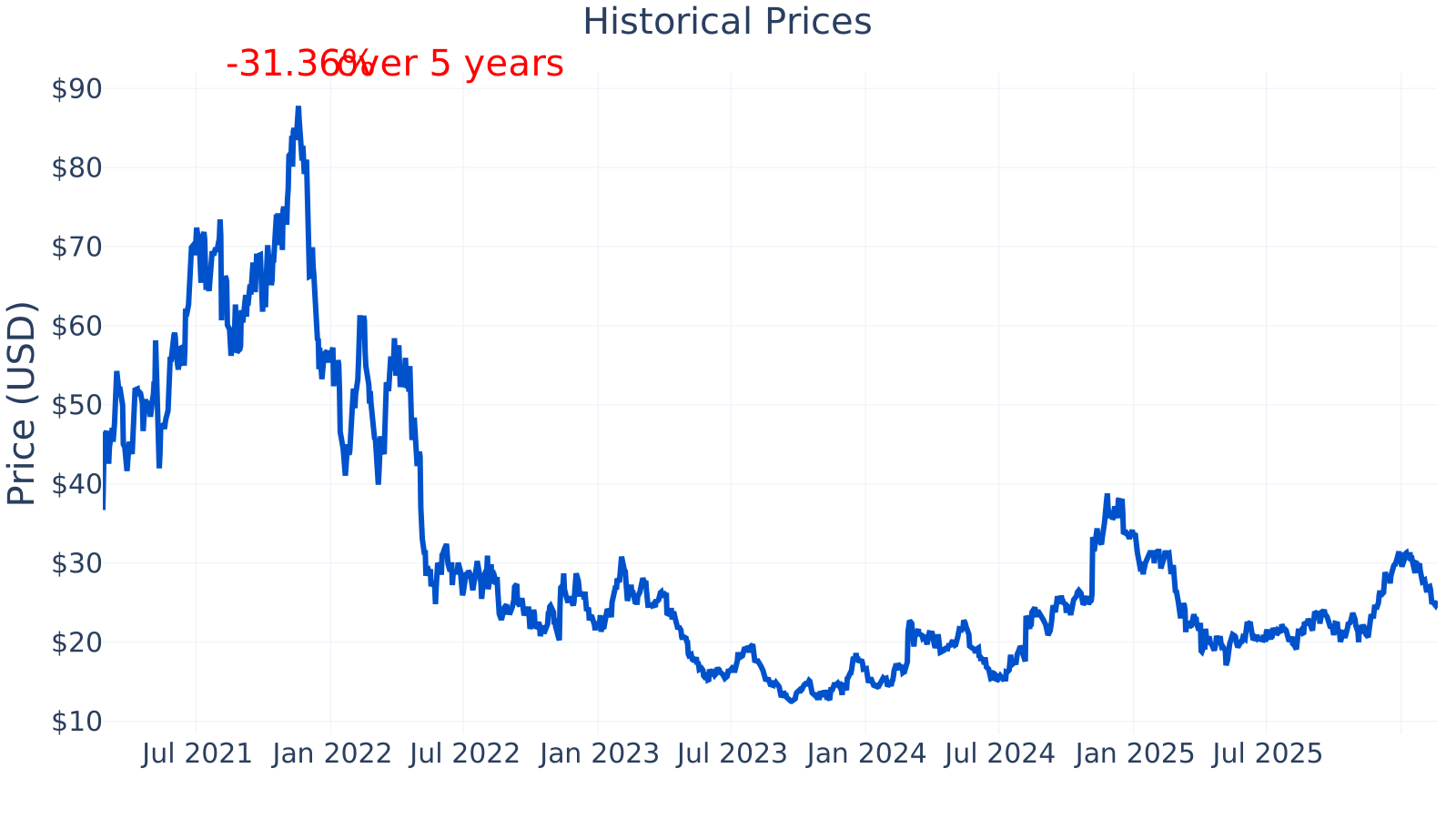
| Market Cap ⓘ | $1.80B | |
| Beta ⓘ | 1.77 | |
| Fundamental | ||
| P/E Ratio ⓘ | 32.71 | 32.68 |
| Profit Margin ⓘ | 4.64% | 6.46% |
| Revenue Growth ⓘ | 4.40% | 13.05% |
| Debt to Equity ⓘ | 7.20% | 32.25% |
| PEG ⓘ | 1.20 | |
| Free Cash Flow ⓘ | $61.16M | |
Revolve’s market capitalization is about $1.80B, and its beta of 1.77 indicates the stock has historically moved more than the broader market (both up and down). The P/E ratio is ~32.7, close to the industry median (~32.7), suggesting the market is valuing Revolve broadly in line with peers on this simple earnings-based measure. Profitability and growth are currently below the industry median in these snapshots: profit margin is ~4.64% vs. ~6.46% for the industry median, and year-over-year revenue growth is ~4.40% vs. ~13.05% for the industry median. Balance-sheet leverage looks lower than many peers, with debt-to-equity of ~7.2% vs. an industry median of ~32.2%. The company also shows positive trailing twelve-month free cash flow of ~$61.2M, which can help support operations and investments without relying as much on external financing.
Growth (Medium)
Revolve operates in online retail, where long-term demand is influenced by continued consumer adoption of e-commerce, changing shopping habits on mobile, and the role of social platforms in discovery. However, online fashion is also a highly competitive category where growth can be uneven, especially when consumers shift spending between “needs” and “wants.” In that context, Revolve’s strategy is built around curated product selection, frequent newness, and marketing designed to create brand awareness and drive repeat purchases.
One visible feature in recent quarters is that growth has not been linear. After very high year-over-year growth rates in 2021 and early 2022, the company went through a period of negative year-over-year growth in 2023 and early 2024, then returned to positive territory later in 2024 and into 2025 (based on the quarterly pattern shown).
The shift from negative growth in 2023 to positive growth more recently can be interpreted as stabilization after a tougher demand environment. Even so, the latest year-over-year growth rate shown (about 4.4%) is modest relative to the industry median in the same snapshot, which suggests Revolve may be expanding more slowly than many peers at the moment.
Cash generation is another lens on growth quality. Revolve has remained free-cash-flow positive over the periods shown, but the level has varied widely, falling substantially from 2021 to 2023 and then partially recovering.
Free cash flow was about $96.4M (TTM) in 2021, dropped to about $13.2M in 2023, and was about $27.8M by 2025-03-31 in the time series shown (with the latest metrics table showing a higher current TTM value of about $61.2M). This variability matters because marketing, inventory, and fulfillment decisions can change cash needs quickly in fashion retail.
Potential catalysts (in a neutral, factual sense) typically include stronger product cycles, improved conversion and repeat rates, better inventory positioning (less discounting), international expansion progress, and scaling of the FWRD concept. The company discusses its strategic priorities and performance drivers in its periodic SEC filings and investor materials.
Risks (High)
Revolve’s main risks are typical of online fashion retail, but they are important for long-term context. Demand can be sensitive to consumer confidence and discretionary spending. Fashion risk (buying the “wrong” inventory) can lead to higher promotions and margin pressure. Customer acquisition costs can rise as digital advertising markets evolve. In addition, operational execution in fulfillment, returns, and delivery experience can influence repeat purchasing and brand perception.
Competition is intense. Revolve competes with a wide set of companies, including large e-commerce marketplaces, department stores and their websites, brand-owned direct-to-consumer sites, and other online fashion specialists. In filings, companies in this space often cite competition based on price, selection, speed of delivery, brand strength, and marketing effectiveness. Revolve’s differentiation is often described around merchandising curation and brand marketing, but it is not the only company investing heavily in those capabilities.
From a balance-sheet standpoint, Revolve appears to be using less financial leverage than many peers in its industry group, which can reduce financial strain during weaker demand periods. At the same time, low debt does not eliminate operating risks tied to inventory and margins.
Debt-to-equity has been in the single digits to low teens in most of the period shown and is about 7.2% at the latest point, below the industry median (about 35.3% at the latest point shown). This suggests Revolve has relied less on borrowing than many peers, which can provide flexibility if conditions worsen.
Profitability is another major risk area because small margin changes can materially affect earnings. Revolve’s net profit margin was much higher in 2021 and then compressed meaningfully before improving again, but it remains below the industry median in the latest snapshot.
Net profit margin fell from roughly 11%–13% in 2021 to the low single digits in 2023–2024, and is about 4.64% at the latest point shown. The industry median in the latest snapshot is higher (about 5.89%). This history shows that Revolve can be profitable, but profitability has been sensitive to the operating environment and cost structure.
Valuation
Valuation is often discussed using multiples such as the price-to-earnings (P/E) ratio, especially for companies with positive earnings. Revolve’s current P/E is about 32.7, essentially in line with the industry median in the latest snapshot. On its own, that indicates the market is valuing Revolve similarly to peers on an earnings basis, rather than applying a large premium or discount at this moment.
Historically, Revolve’s P/E ratio has moved substantially over time (from the high teens to above 60 in the periods displayed). Those swings can reflect changing expectations for growth and margins, as well as changes in the company’s earnings level (since P/E can rise quickly when earnings fall). In the most recent points shown, Revolve’s P/E is in the low 30s, and it has often been below the industry median during several periods since 2022, though there were also times when it traded above the median.
A P/E around the low 30s typically implies the market expects some combination of continued profitability and future improvement (growth, margins, or both). Whether that pricing proves “high” or “low” over time depends heavily on factors already discussed: the durability of demand, the company’s ability to manage promotions and inventory, marketing efficiency, and whether revenue growth can accelerate while maintaining or improving margins.
Conclusion
Revolve is a digitally native fashion retailer with a brand-driven marketing approach and a business that has shown the ability to generate profits and free cash flow, but with meaningful variability across cycles. Revenue has been relatively steady around the $1B+ level in recent years, while net income and margins have moved more dramatically, indicating sensitivity to the operating environment and cost structure.
From a financial positioning standpoint, leverage appears relatively low versus the industry median, which can support flexibility. At the same time, growth has recently been positive but modest compared with the industry median in the latest snapshot, and profitability is also below the median, which frames the company as currently more “stabilizing” than “outperforming” on those two measures.
On valuation, Revolve’s P/E is currently close to the industry median, suggesting the market is pricing it similarly to peers. The long-term outcome for shareholders is likely to be driven less by today’s peer-relative multiple and more by how consistently the company can expand revenue while maintaining healthy margins in a highly competitive, trend-sensitive category.
Sources:
- U.S. SEC EDGAR — Revolve Group, Inc. filings (Form 10-K, Form 10-Q)
- Revolve Group, Inc. Investor Relations — SEC filings and investor materials
- Wikipedia — “Revolve Group” (basic company background)
This article is for informational purposes only and does not constitute financial advice. Some content is AI-generated. See Disclaimer