Stock Analysis · Quantum Computing Inc (QUBT)
Overview
Quantum Computing Inc. (QUBT) is a small technology company focused on making quantum computing more usable for commercial and government customers. In simple terms, quantum computing is an emerging type of computing that aims to solve certain problems much faster than traditional computers, but the technology is still early and often difficult to use in real-world settings. QUBT’s positioning, based on its public filings, centers on offering software and services that help users run quantum-ready workflows, as well as pursuing quantum-related hardware and photonics-oriented approaches.
Based on its SEC filings, the company’s revenue has been small in absolute dollars and has typically come from early-stage commercial activity (rather than large, recurring product revenue). Where disclosed, revenue is generally associated with delivering services, licenses, or contract work tied to its offerings, along with other smaller components that can include grants or similar arrangements depending on the period.
Main revenue sources (with limited segmentation detail publicly available in the figures shown here):
- Customer-related revenue (services/software/contract work) — appears to be the primary source, but percentages by category are not consistently disclosed in the information summarized here.
- Other/ancillary items (when applicable) — may appear in some periods, but not enough detail is available here to break out reliably by percentage.
The company’s income profile in recent years reflects a business that is still investing heavily and has not yet reached consistent profitability. Operating expenses—particularly R&D and selling/general/administrative costs—have been much larger than revenue in the periods shown.
Across the years shown, revenue remains very small (hundreds of thousands of dollars), while operating expenses are in the tens of millions. Research and development spending rises notably by 2025, and the company continues to report net losses, which is consistent with an early-stage technology company still building products and attempting to scale.
Key Figures
| Metric | Value | Industry ⓘ |
|---|---|---|
| Date | Apr 06, 2026 | |
| Context | ||
| Sector | Technology | |
| Industry | Computer Hardware | |
| Market Cap ⓘ | $1.54B | |
| Beta ⓘ | 3.67 | |
| Fundamental | ||
| P/E Ratio ⓘ | N/A | 24.00 |
| Profit Margin ⓘ | N/A | 4.46% |
| Revenue Growth ⓘ | 219.40% | 25.20% |
| Debt to Equity ⓘ | 0.11% | 5.95% |
| PEG ⓘ | N/A | |
| Free Cash Flow ⓘ | -$36.98M | |
At the latest point shown, QUBT’s market capitalization is about $1.54B and the stock’s beta is ~3.67, which indicates price moves have been much more volatile than the overall market. Profitability metrics also highlight the early-stage nature of the business: the latest profit margin shown for the company is not positive, while the industry median profit margin is about 4.46%. Revenue growth year-over-year is shown as ~219% versus an industry median of ~25%, but that growth is occurring from a very small revenue base. Debt-to-equity is shown as ~0.11% versus an industry median of ~5.95%, indicating very low leverage by that measure. Free cash flow over the trailing twelve months is -$36.98M, reflecting ongoing cash use.
Growth (High)
Quantum computing is widely discussed as a potentially important long-term computing platform, but commercialization timelines remain uncertain across the industry. In that context, QUBT operates in a space that can be described as structurally “growing” in attention and research activity, yet still early in terms of broad, scaled customer spending. For long-term business growth, the key question is whether QUBT can convert technical development and pilots into repeatable, higher-volume revenue streams.
From the quarterly pattern shown for year-over-year revenue growth, results have been uneven—periods of very high growth are mixed with declines—again consistent with small numbers where a single contract can materially change the growth rate.
Cash generation is also a central part of the growth story. A company can grow revenue and still need frequent external funding if it consistently spends much more cash than it brings in. The trailing twelve-month free cash flow values shown are negative and have worsened versus earlier periods, which implies the business has required ongoing funding (through cash reserves, financing, or equity issuance) to sustain operations and investment.
Potential catalysts, as typically discussed in company filings for early-stage technology businesses, can include: new customer wins, expansion of partnerships, progress in product commercialization, and any step-change in the ability to deliver repeatable deployments. However, the timing and magnitude of these potential catalysts are inherently uncertain in quantum computing, where adoption can be slower than anticipated.
Risks (Very High)
The largest risk is the gap between QUBT’s current scale and what would typically be needed to support a multi-billion-dollar valuation over time. The figures shown indicate revenue is still well under $1M annually in the periods listed, while operating expenses are far higher. That means execution risk is substantial: the company must both grow revenue dramatically and improve unit economics to reach sustainable profitability.
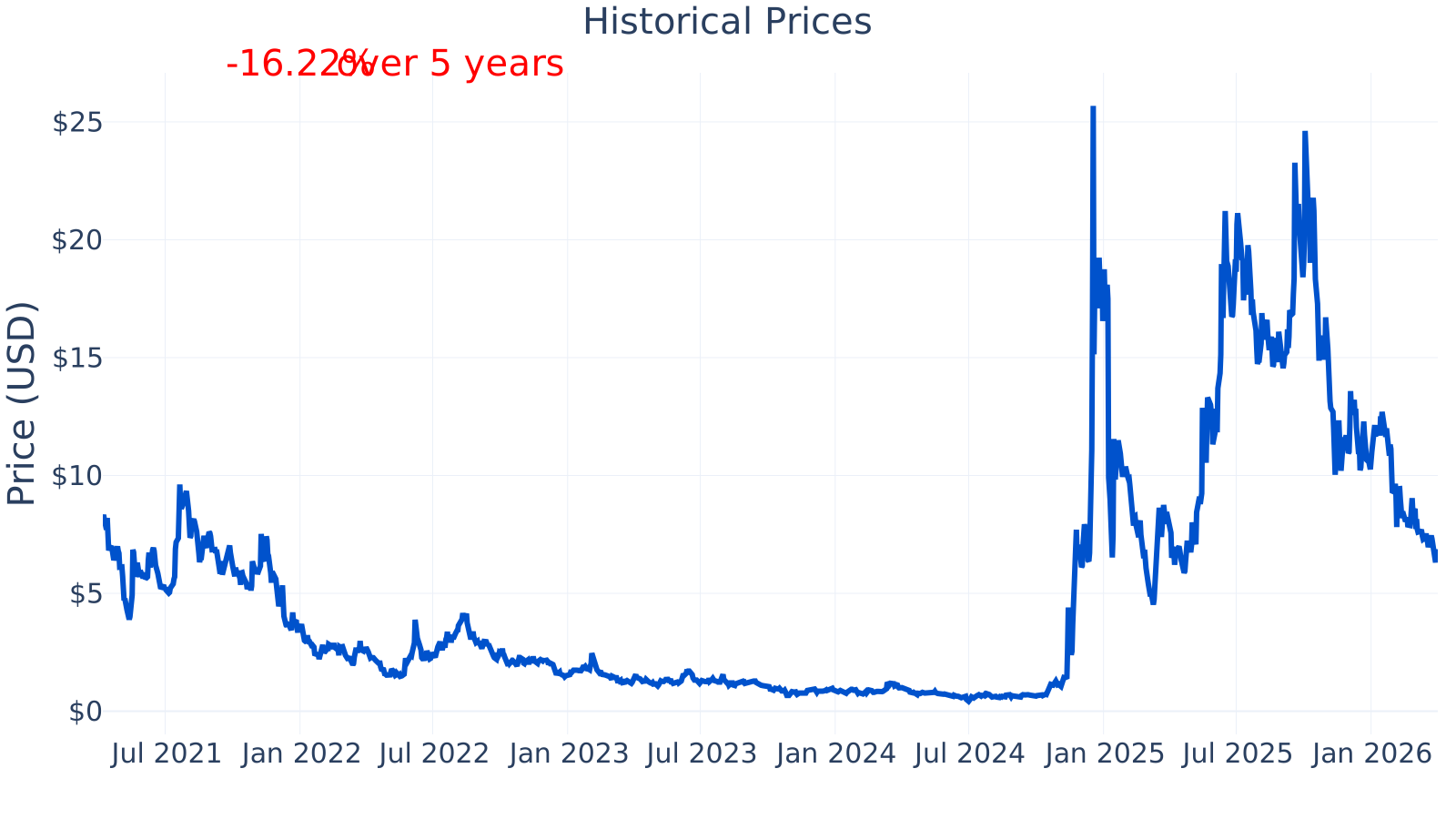
Another major risk is volatility. The stock price history shown includes long periods at low single-digit prices followed by a sharp increase and then large swings, which aligns with the high beta. This can make long-term outcomes highly sensitive to sentiment, funding events, and milestone announcements.
Financial leverage (traditional balance-sheet debt) appears low by the debt-to-equity metric, which can reduce one type of financial risk. Still, low debt does not eliminate funding risk; persistent negative cash flow can lead to dilution if the company issues new shares to raise cash.
Profitability is a key risk signal. The profit margin series is deeply negative across the periods shown, while the industry median is modestly positive in many quarters. Even allowing for the fact that early-stage companies often operate at a loss, the magnitude of negative margins indicates that the business model has not yet demonstrated scalable economics.
On competitive advantages and market position, QUBT is not generally described (in public filings) as the clear leader of the quantum computing industry, which includes much larger and better-capitalized companies as well as well-funded private firms. Competition can come from multiple directions:
- Large technology companies building quantum hardware, software platforms, and cloud access.
- Specialized quantum hardware companies (various technical approaches) competing for enterprise and government budgets.
- Quantum software and algorithm firms offering tools to help users run quantum and hybrid workloads.
In practice, QUBT’s positioning depends on whether its approach and products can show clear performance, usability, cost, or integration benefits that are meaningful to customers. Without durable differentiation, the risk is that larger platforms or competing tools become the default choices.
Valuation
Valuation for QUBT is difficult to assess using traditional earnings-based methods because the company has reported losses and the P/E ratio is not meaningful in the periods shown (the company P/E values are displayed as 0 in the history provided, which commonly occurs when earnings are negative or otherwise make the metric non-interpretable). For context, the industry median P/E shown fluctuates around the teens to 30s depending on the date, and the latest industry median listed is about 24.0.
In cases like this, the market price tends to reflect expectations about future commercialization rather than current profitability. With a market capitalization around $1.54B alongside revenue that has been very small in absolute terms (hundreds of thousands of dollars in the annual figures shown), the implied expectations embedded in the stock price can be substantial. This does not determine whether the price is “right” or “wrong,” but it does mean valuation is highly sensitive to future execution milestones such as meaningful revenue scale-up, improved margins, and reduced cash burn.
Conclusion
Quantum Computing Inc. is operating in a field that could expand significantly over the long run, but the company’s current financial profile (very small revenue, large operating losses, and negative free cash flow) indicates an early-stage business still working toward product-market fit and scalable commercialization. The stock has also exhibited high volatility, which can amplify both positive and negative outcomes over time.
From a purely factual perspective, the long-term question is whether QUBT can translate ongoing R&D and commercialization efforts into sustained revenue growth at a scale that materially narrows losses and ultimately supports self-funded operations. Until that transition becomes visible in financial statements over multiple periods, uncertainty remains a defining feature of the company’s risk/return profile.
Sources:
- U.S. Securities and Exchange Commission (SEC) EDGAR — “Quantum Computing Inc. periodic reports (10-K, 10-Q) and current reports (8-K)”
- Quantum Computing Inc. Investor Relations — “Press releases and investor materials”
- Wikipedia — “Quantum Computing Inc.”
This article is for informational purposes only and does not constitute financial advice. Some content is AI-generated. See Disclaimer


