Stock Analysis · Qualys Inc (QLYS)
Overview
Qualys, Inc. is a cybersecurity software company that helps organizations find and fix weaknesses in their IT systems. In simple terms, its tools continuously check computers, servers, cloud environments, and applications for security gaps (like missing updates or risky settings), then help teams prioritize what to address first. The company delivers its products as cloud-based software, which typically means customers pay recurring fees to keep using the service and receiving updates.
Qualys primarily generates revenue from subscriptions to its cloud security platform and related applications (for example, vulnerability management and other security/compliance capabilities). The company’s filings generally describe revenue in broad categories rather than giving a detailed public breakdown by individual product line; as a result, precise percentage splits by module are often not provided in a way that is consistent year to year.
Main sources of revenue (high-level)
- Subscription revenue (recurring) — the core of the business (typically the vast majority of total revenue)
- Professional services and other — generally a smaller portion (such as onboarding/help implementing)
Business scale and recent direction (from annual financials): Qualys’ total revenue increased from about $411M (2021) to about $669M (2025), while net income increased from about $71M (2021) to about $198M (2025). Over the same period, the gap between revenue and cost of revenue remained large, which is typical for software businesses with high gross margins.
Across 2021–2025, revenue rose steadily while cost of revenue grew much more slowly in absolute terms, leaving a large gross profit base. Operating expenses grew as the company invested in areas like research and development and sales/marketing, but net income still expanded over time.
Key Figures
| Metric | Value | Industry ⓘ |
|---|---|---|
| Date | Feb 08, 2026 | |
| Context | ||
| Sector | Technology | |
| Industry | Software - Infrastructure | |
| Market Cap ⓘ | $4.00B | |
| Beta ⓘ | 0.57 | |
| Fundamental | ||
| P/E Ratio ⓘ | 20.37 | 25.66 |
| Profit Margin ⓘ | 29.64% | 6.68% |
| Revenue Growth ⓘ | 10.10% | 15.20% |
| Debt to Equity ⓘ | 9.32% | 19.82% |
| PEG ⓘ | 3.03 | |
| Free Cash Flow ⓘ | $271.36M | |
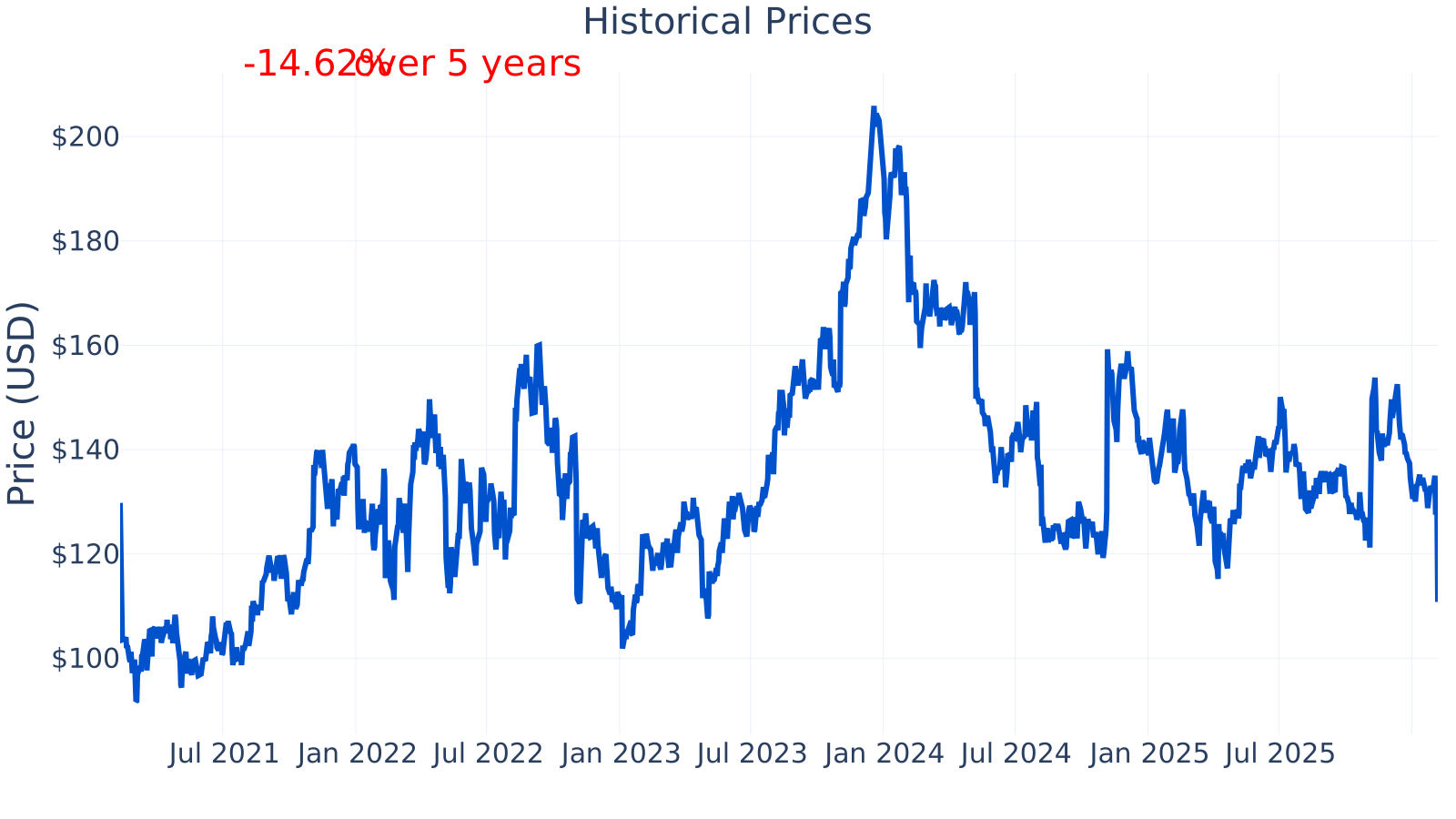
Qualys’ market capitalization is about $4.0B, placing it in the mid-cap range. The stock’s beta (~0.57) suggests it has historically moved less than the broader market on average (though this can change over time). Profitability stands out: the latest profit margin is ~29.6%, which is well above the industry median (~6.7%) shown in the table. Growth is positive but more moderate, with year-over-year revenue growth around 10.1% versus an industry median ~15.2%. Balance-sheet leverage appears modest: debt-to-equity ~9.3% versus an industry median ~19.8%. Free cash flow over the trailing twelve months is about $271M, indicating the business has recently produced meaningful cash after operating needs and capital spending.
Growth (medium)
Cybersecurity is a long-running demand area because organizations keep expanding their digital footprint (more cloud usage, more connected devices, and more software dependencies). This tends to create ongoing needs for visibility into risks and for tools that help security teams keep systems hardened and compliant. In that sense, Qualys operates in an industry with persistent, structural demand rather than a one-time technology cycle.
Qualys’ strategy centers on a cloud platform model that can be expanded with additional applications over time. This approach can support growth in two main ways: (1) new customer wins for core security monitoring and (2) broader adoption within existing customers as they add more modules. A recurring subscription model can also help smooth revenue compared with one-time license sales, although it can still be sensitive to enterprise IT spending cycles.
The year-over-year revenue growth trend shows a step-down from the higher growth rates seen in 2022 (around the high teens to ~20%) to a more stable, mid-single to low-double-digit pace more recently (roughly ~8% to ~12% across 2024–2025). That pattern can be consistent with a company maturing from earlier expansion into a steadier growth phase.
Free cash flow over the trailing twelve months has been substantial in recent years, rising from about $155M (2021) to roughly $256M–$271M in the 2024–2025 period. Consistent cash generation can matter for long-term resilience, because it can fund product development and operations without relying heavily on borrowing or issuing new shares.
Risks (medium)
A key risk for Qualys is competitive intensity. Cybersecurity is crowded, with both platform-style vendors and specialists competing for enterprise budgets. Even with strong products, pricing pressure or “platform consolidation” (customers trying to reduce the number of security vendors) can affect growth rates. Large vendors that bundle security tools with broader IT offerings can also have an advantage in distribution.
Another risk is that growth has moderated compared with earlier periods. If the company’s expansion depends heavily on upselling additional modules, it must keep products compelling enough to win incremental spending. If customer purchasing cycles lengthen or IT budgets tighten, subscription growth can decelerate.
There is also execution and technology risk. Security tools must remain accurate and reliable as technology changes (cloud services, operating systems, and attack techniques evolve). Any meaningful product issues, service outages, or trust events could weigh on renewals and new sales, particularly in security where reputation is critical.
Financial leverage looks relatively low. Debt-to-equity has generally stayed around the ~8%–15% range over recent years, and the latest value is about 9.3%, below the industry median shown (~19.8%). Lower leverage can reduce financial risk, though it does not remove business risk from competition or slowing demand.
Profitability has been a notable strength. Qualys’ profit margin improved over time (roughly from the high teens/low 20s in 2021–2022 to the high 20s by 2024–2025), and the latest value of about 29.6% is well above the industry median displayed. High margins can be a competitive advantage when they reflect efficient operations and a product set customers consistently renew, but margins can also come under pressure if the company must spend more to compete.
Competitive position and competitors: Qualys is a well-established vendor in vulnerability management and related security/compliance workflows, with a long operating history in cloud-delivered security services. It competes with large cybersecurity and IT management providers as well as focused security specialists. Commonly cited competitors in company filings and industry discussions include major platform vendors and security-focused firms (for example, large endpoint and cloud security providers). In practice, competitive positioning often comes down to product breadth, ease of deployment, integration with other security tools, and total cost for customers.
Valuation
At the latest point in the table, Qualys has a P/E ratio of ~20.4, which is below the industry median of ~25.7 shown. Historically in the chart, Qualys’ P/E was much higher earlier in the period (often above 40–70 in 2021–2022) and has generally moved lower into the mid-to-high 20s range more recently. This compression can happen when the stock price changes, when earnings rise, or both.
Valuation context matters because Qualys combines high profitability with moderate growth. One way to view this balance is the PEG ratio (~3.0) shown in the table, which informally relates valuation to growth expectations. A higher PEG can indicate that the valuation is less supported by fast growth, while a lower PEG can indicate the opposite; however, PEG depends heavily on how growth is measured and what time period is used, so it is best treated as a rough signal rather than a decision rule.
Overall, the current valuation metrics suggest the market is not pricing Qualys like a high-growth software company (as it may have earlier in the period), but it is still pricing it as a profitable software business with ongoing security relevance.
Conclusion
Qualys is a cybersecurity software company built around recurring subscriptions, with a business profile characterized by steady revenue expansion, strong and improving profitability, meaningful free cash flow, and modest leverage. Those qualities can support durability over long time horizons, especially in an industry where security needs tend to persist.
At the same time, the growth trend appears to have shifted from faster expansion earlier in the period to a more moderate pace recently, which makes competitive dynamics and product execution central factors to monitor. The valuation picture, including a P/E below the industry median in the table and a lower P/E versus earlier years, suggests the market is weighing Qualys more as a mature, profitable operator than a rapid grower. Whether that remains consistent will depend on the company’s ability to sustain renewals, expand product adoption, and navigate a competitive cybersecurity landscape.
Sources:
- U.S. SEC EDGAR — Qualys, Inc. filings (Form 10-K, Form 10-Q)
- Qualys Investor Relations — SEC filings and shareholder materials (as hosted by the company)
- Wikipedia — “Qualys” (basic company background)
This article is for informational purposes only and does not constitute financial advice. Some content is AI-generated. See Disclaimer