Stock Analysis · Q2 Holdings (QTWO)
Overview
Q2 Holdings (QTWO) is a software company focused on digital banking. In simple terms, it provides the technology that banks and credit unions use to offer online and mobile banking to their customers. That can include everyday consumer banking features (like viewing balances, transferring money, paying bills, and using digital wallets) as well as tools aimed at business customers (such as cash management capabilities for small and mid-sized businesses).
The company generally earns money by selling software access and related services to financial institutions. Like many software businesses, a meaningful part of revenue is typically recurring (subscription-style) rather than one-time.
Based on how the business is described in company filings, revenue is commonly discussed in these categories (exact percentages can vary by period and should be confirmed in the most recent annual report):
- Subscription revenue (recurring access to the platform and modules)
- Services and other revenue (implementation, professional services, support, and related items)
Over the last several years, total revenue has increased (from about $499M in 2021 to about $795M in 2025). Over the same period, operating results improved substantially, moving from operating losses to operating income in 2025, which suggests the cost structure has been scaling better as the company grew.
Key Figures
| Metric | Value | Industry ⓘ |
|---|---|---|
| Date | Feb 23, 2026 | |
| Context | ||
| Sector | Technology | |
| Industry | Software - Application | |
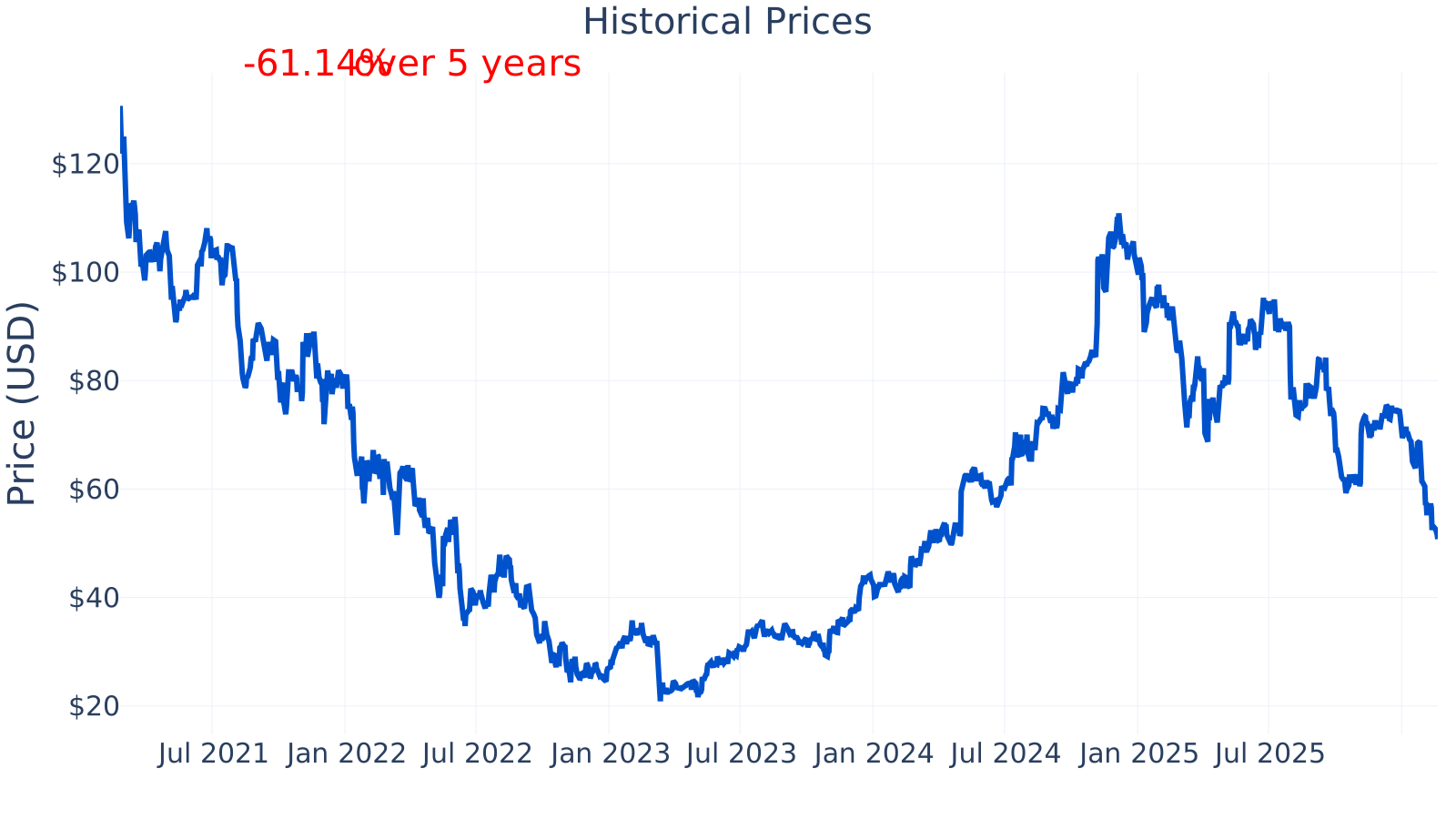
| Market Cap ⓘ | $3.17B | |
| Beta ⓘ | 1.37 | |
| Fundamental | ||
| P/E Ratio ⓘ | 63.48 | 25.48 |
| Profit Margin ⓘ | 6.54% | 7.23% |
| Revenue Growth ⓘ | 13.80% | 15.70% |
| Debt to Equity ⓘ | 52.30% | 25.08% |
| PEG ⓘ | 8.94 | |
| Free Cash Flow ⓘ | $183.92M | |
QTWO’s market capitalization is about $3.17B. The stock’s beta of 1.37 indicates it has historically moved more than the overall market (higher volatility). The company’s profit margin is about 6.54% versus an industry median around 7.23%, and its year-over-year revenue growth is about 13.8% versus an industry median around 15.7%. Leverage is higher than the industry median: debt-to-equity is about 52% versus roughly 25% for the industry median. Free cash flow over the trailing twelve months is about $184M.
Growth (Medium)
Q2 operates in digital banking software, an area supported by long-term consumer behavior changes: more banking activity happens on phones, customers expect smooth digital experiences, and financial institutions invest to keep pace with large national banks and fintech apps. For community and regional institutions in particular, third-party platforms can be a practical way to deliver modern digital capabilities without building everything internally.
From a strategy standpoint, Q2’s approach—selling a platform with multiple modules—can support growth through both adding new financial institution customers and expanding product usage within existing customers. This “land and expand” pattern is common in software, where deeper adoption can raise recurring revenue per customer over time.
Recent year-over-year revenue growth has been positive and generally in the low-to-mid teens in the most recent period shown (about 13.8% most recently). Compared with earlier periods above 20%, the pattern suggests growth moderated after the 2021 period, then stabilized in a more consistent range.
Free cash flow has improved materially over time, moving from negative in 2021 to meaningfully positive in more recent periods (about $139M by 2025-03-31 in the series shown, and about $184M on the latest trailing twelve-month figure). For long-term business durability, this matters because it indicates the company is increasingly generating cash after operating needs and capital spending.
Potential catalysts discussed broadly in company materials for a business like this typically include signing new financial institutions, increased adoption of additional software modules by existing clients, and sustained improvement in operating leverage (keeping expense growth below revenue growth). Any specific catalyst should be verified in the most recent quarterly filing and earnings materials.
Risks (High)
A core risk for Q2 is that it serves banks and credit unions, whose technology spending can vary with the economic environment, interest-rate conditions, and profitability in the banking sector. Large projects can also take time to implement, and deployment complexity can create delays or cost overruns that affect near-term results.
Competition is another major risk. Q2 competes with a range of providers in digital banking and broader bank technology. Depending on the product area, competitors can include large, established core banking vendors and other digital banking platform providers. In addition, some large financial institutions may build parts of their digital stack internally. Competitive pressure can show up as pricing pressure, higher sales and marketing costs, or the need for sustained R&D investment to keep features current.
Q2’s competitive advantages, as described in filings for a platform business, can include specialized focus on digital banking, a mature product suite, and switching costs once a platform is embedded into a financial institution’s digital channels. However, the market is crowded and innovation cycles are fast, so advantages need to be continuously reinforced through product execution, security, and reliability.
Debt-to-equity has trended down significantly from earlier levels above 100% to about 52% most recently, which is an improvement. Even so, it remains above the industry median (about 25%), meaning the company is still more leveraged than many peers in the same broad software category.
Profitability has improved sharply. Profit margin moved from deeply negative levels in 2021 to positive in the most recent period (about 6.54%). That said, it is still slightly below the industry median (about 7.23%), which suggests there may be less margin buffer than some peers if growth slows or costs rise.
As with any company handling sensitive financial data and online banking activity, cybersecurity, uptime, regulatory expectations, and reputational risk are important. A major service disruption or security incident could affect customer retention and lead to remediation costs.
Valuation
Valuation is often discussed using the price-to-earnings (P/E) ratio, which compares the stock price to earnings. For QTWO, the latest P/E ratio shown is about 63.5, which is higher than the industry median around 25.5. A higher P/E can reflect expectations of continued growth and improving profitability, but it can also mean the stock price is more sensitive to disappointments in revenue growth, margins, or forward guidance.
The P/E history shown is limited for much of the period (often not meaningful when earnings are negative). With profitability improving recently, the P/E becomes usable again, and the latest value appears well above the typical software peer median. In practical terms, this places more weight on execution: maintaining growth, keeping churn low, expanding margins, and sustaining cash generation.
Conclusion
Q2 Holdings is a digital banking software provider whose business profile reflects a common long-term software pattern: recurring revenue, ongoing R&D investment, and the potential for operating leverage as the company scales. Over the period shown, revenue rose steadily and profitability improved substantially, with recent positive profit margin and strong free cash flow relative to earlier years.
At the same time, the company operates in a competitive market tied to banking clients, where sales cycles, implementation complexity, and technology expectations can create volatility. Leverage has improved but remains above the industry median, and the stock’s valuation metrics (including a P/E above the industry median) indicate that the market may already be assigning meaningful value to continued growth and margin progress.
Sources:
- SEC EDGAR — Q2 Holdings, Inc. — Annual Report (Form 10-K)
- SEC EDGAR — Q2 Holdings, Inc. — Quarterly Report (Form 10-Q)
- Q2 Holdings Investor Relations — Press Releases & SEC Filings (company-hosted)
- Wikipedia — “Q2 Holdings”
This article is for informational purposes only and does not constitute financial advice. Some content is AI-generated. See Disclaimer