Stock Analysis · Qorvo Inc (QRVO)
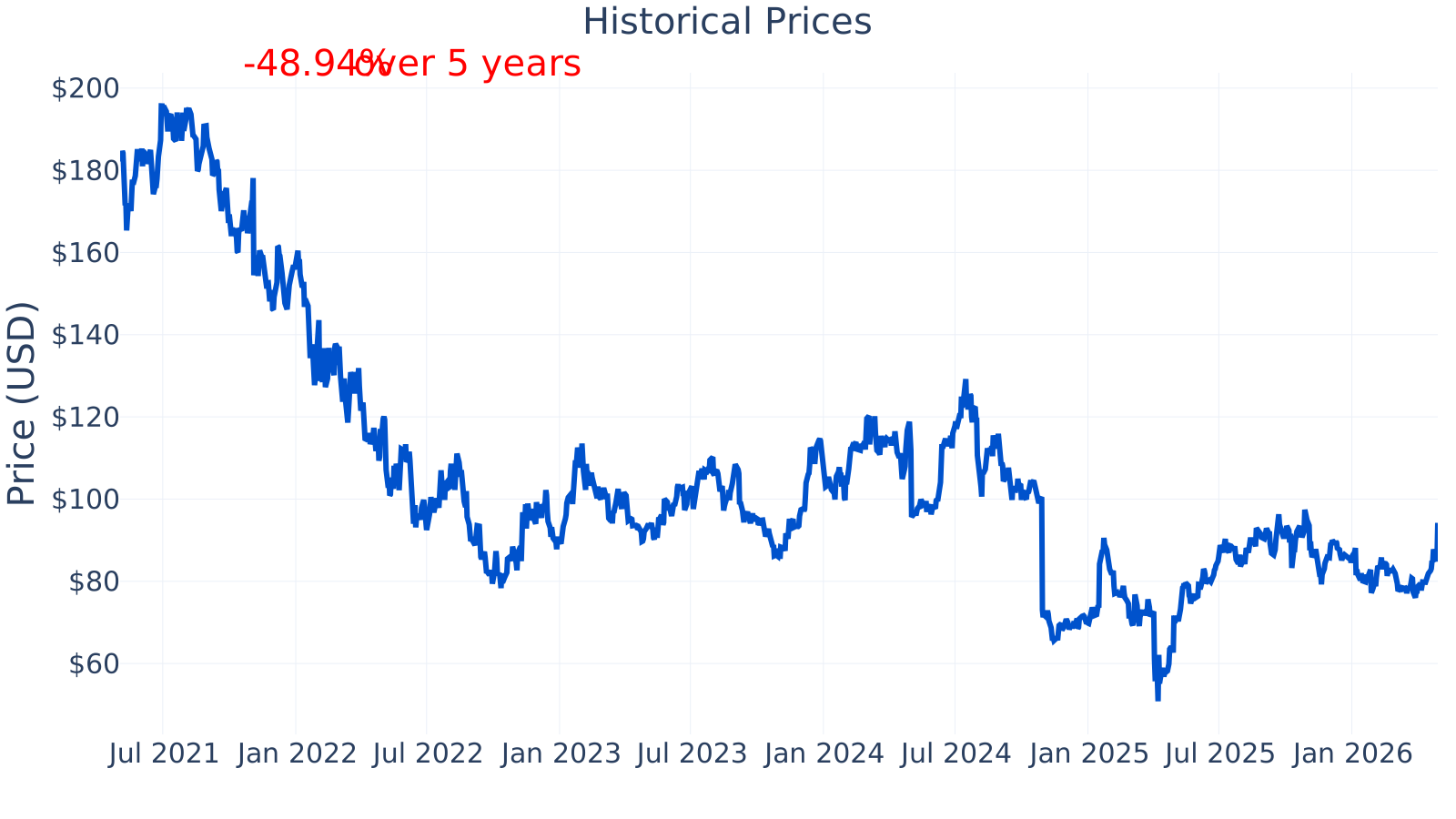
Overview
Qorvo Inc (QRVO) is a U.S.-based semiconductor company that designs and sells chips that help devices send, receive, and manage wireless signals. In simple terms, its products help smartphones and other connected devices “talk” to cellular networks, Wi‑Fi routers, satellites, and other radios. The company’s technology is used in everyday consumer electronics as well as in more specialized markets like defense and aerospace.
Qorvo reports its business in two main segments, which are also its main revenue streams:
- High Performance Analog (HPA): Products used in areas such as defense/aerospace, networking infrastructure, and other advanced radio applications.
- Connectivity & Sensors Group (CSG): Products focused on mobile devices and consumer/industrial connectivity (for example, radio-frequency solutions used in smartphones, and connectivity chips for Wi‑Fi and related uses).
Percentages by segment can vary year to year depending on smartphone demand and customer product cycles. The company provides the exact breakdown in its annual report.
The recent profit-and-loss flow highlights a business where research and development is a major ongoing cost (typical for chip designers). It also shows that profitability can swing meaningfully from year to year as revenue changes and fixed costs are spread across more (or fewer) sales.
Key Figures
| Metric | Value | Industry ⓘ |
|---|---|---|
| Date | May 01, 2026 | |
| Context | ||
| Sector | Technology | |
| Industry | Semiconductors | |
| Market Cap ⓘ | $8.73B | |
| Beta ⓘ | 1.34 | |
| Fundamental | ||
| P/E Ratio ⓘ | 25.96 | 54.64 |
| Profit Margin ⓘ | 9.11% | 7.71% |
| Revenue Growth ⓘ | 8.40% | 19.70% |
| Debt to Equity ⓘ | 41.89% | 20.71% |
| PEG ⓘ | 0.22 | |
| Free Cash Flow ⓘ | $595.20M | |
Qorvo’s market capitalization is about $8.7B, placing it among mid-sized public semiconductor companies. The stock’s beta of ~1.34 indicates it has tended to move more than the broader market, which is common for cyclical chip names.
On profitability, the latest profit margin is ~9.1%, above the industry median shown here (~7.7%). On growth, the latest year-over-year revenue growth is ~8.4%, which is below the industry median displayed (~19.7%). Debt levels are also higher than the industry median in this comparison: debt-to-equity ~41.9% versus an industry median near 20.7%. Free cash flow over the trailing twelve months is about $595M, which is an important measure because it represents cash generated that can support reinvestment, debt reduction, or share repurchases.
Growth (Medium)
Qorvo operates in the semiconductor industry, which is tied to long-term trends such as increasing connectivity, higher data usage, and the continuing expansion of wireless standards (including advanced 4G/5G deployments and Wi‑Fi evolution). However, within that long-term backdrop, demand can be highly cyclical—especially in smartphones, where sales volumes and upgrade cycles can rise and fall.
The year-over-year revenue growth pattern shows large swings: strong growth in some periods and sharp declines in others, followed by recovery. This type of “ups and downs” is typical for companies exposed to consumer electronics cycles and customer inventory corrections. The most recent reading in the series (about 8.4% growth) suggests a return to growth, though not as fast as the industry median shown in the comparison.
Free cash flow has remained positive across the periods shown, but it has declined from earlier highs (from about $836M in 2022 to about $485M in 2025, with the most recent trailing figure around $595M). For long-term fundamentals, consistent positive free cash flow can help a company navigate down cycles, but the downward drift also reflects that recent years have been more challenging than the earlier peak period.
From a strategy standpoint, Qorvo’s mix of smartphone-related business plus higher-performance markets (such as defense/aerospace and networking-related applications) can be viewed as an attempt to balance volume-driven consumer demand with end-markets that may have different cycle patterns. Potential catalysts typically come from new device launches, changes in content per device (how many radio components a device needs), and design wins in higher-performance segments—though the timing and magnitude are not fully controllable by the company.
Risks (High)
Qorvo’s results can be heavily influenced by demand patterns in end markets, especially smartphones and consumer electronics. If phone makers reduce production, work through excess inventory, or shift to different component suppliers, Qorvo’s revenue and margins can be affected quickly. This cyclicality is visible in the company’s historical profitability and revenue growth swings.
The debt-to-equity trend has generally been above the industry median shown. The latest value is around 41.9% versus an industry median near 18.3% in the most recent period displayed. Higher leverage is not automatically negative, but it can reduce flexibility during downturns because interest costs and repayment obligations are less discretionary than research spending or hiring.
Profitability has also been volatile. After very strong margins earlier in the period shown (above 20% in 2021), margins fell and turned negative through parts of 2023 and 2024, before recovering to about 9.1% most recently—slightly above the industry median shown (~7.2%). This pattern underlines an important risk: when revenue drops, fixed costs (including R&D) can weigh heavily on earnings.
Competition is intense. Qorvo competes with other radio-frequency and connectivity semiconductor suppliers, including large diversified chipmakers and specialized RF players. In smartphones and connectivity, competitors can include companies such as Broadcom, Skyworks Solutions, Qualcomm, and Analog Devices (competition varies by product category). No single company “wins” all sockets in RF; design wins depend on performance, size, power efficiency, cost, and customer qualification timelines.
Qorvo’s competitive strengths generally come from specialized RF engineering, manufacturing/process know-how for certain materials and components, and long qualification cycles in higher-reliability markets. At the same time, it is not positioned as the dominant leader across every part of wireless semiconductors; competitive standing tends to be strongest in specific product areas and customer relationships rather than across the entire field.
Valuation
The current price-to-earnings (P/E) ratio shown in the key metrics is about 26.0, which is below the industry median in the table (about 54.6). Historically, Qorvo’s P/E in the chart ranged from the low teens to higher levels in certain periods, with some points set to zero on the chart when earnings made the ratio not meaningful. In cyclical semiconductor businesses, P/E ratios can move sharply because earnings can drop quickly in downturns and rebound in upcycles.
Interpreting valuation here depends heavily on how stable future earnings and cash flow turn out to be. The company’s recent return to a positive profit margin, plus sustained positive free cash flow, can support earnings-based valuation metrics. On the other hand, below-industry revenue growth in the latest period and the historically volatile margin profile can justify a discount versus faster-growing or more consistently profitable peers. The higher-than-median leverage shown also matters because it can increase sensitivity to weaker operating periods.
Conclusion
Qorvo is a semiconductor company focused on wireless and connectivity, with products used in large consumer categories (notably smartphones) as well as in performance-driven markets such as defense/aerospace and networking. The long-term demand drivers for wireless connectivity remain in place, but the company’s results have shown clear cyclicality, with significant swings in revenue growth and profitability over the past several years.
The current snapshot shows a company with positive free cash flow and a profit margin that has recovered to a mid-single-digit-to-high-single-digit level, while operating with leverage above the industry median shown. Valuation metrics like the P/E ratio are below the displayed industry median, but the usefulness of those comparisons depends on how durable earnings are across a full cycle. Overall, the main long-term question is how consistently Qorvo can translate its engineering strengths and product portfolio into steadier growth and margins despite competitive and end-market volatility.
Sources:
- SEC EDGAR — Qorvo Inc filings (Form 10-K, Form 10-Q)
- Qorvo Investor Relations — Annual Report materials and shareholder resources
- Qorvo Investor Relations — Earnings call materials and prepared remarks (company-hosted)
- Wikipedia — “Qorvo” (company overview/background)
This article is for informational purposes only and does not constitute financial advice. Some content is AI-generated. See Disclaimer


