Stock Analysis · Procore Technologies Inc (PCOR)
Overview
Procore Technologies Inc (PCOR) is a software company focused on the construction industry. Its platform is designed to help construction owners, general contractors, and specialty contractors manage projects in one place—covering areas such as project management workflows, coordination, financial management, and analytics. In simple terms, Procore sells cloud software meant to reduce paperwork and improve visibility across complex construction projects.
Procore primarily generates revenue by selling subscriptions to its software platform and by providing related services. In its filings, the company generally describes revenue in two main buckets:
- Subscription revenue (typically the largest portion): recurring fees customers pay to access the platform.
- Professional services and other revenue: onboarding, implementation, training, and other services tied to customer adoption.
In practice, subscriptions tend to matter most because they are recurring and scale as customers expand usage across more projects, users, or modules.
Over the 2021–2025 period, total revenue increased from about $515M (2021) to about $1.32B (2025). Gross profit also rose (about $417M to about $1.04B), showing that the core software delivery economics expanded with scale. At the same time, operating income remained negative each year in this view, reflecting continued high spending—especially in areas like product development and go-to-market—relative to current revenue.
Key Figures
| Metric | Value | Industry ⓘ |
|---|---|---|
| Date | Feb 16, 2026 | |
| Context | ||
| Sector | Technology | |
| Industry | Software - Application | |
| Market Cap ⓘ | $8.14B | |
| Beta ⓘ | 0.90 | |
| Fundamental | ||
| P/E Ratio ⓘ | N/A | 27.48 |
| Profit Margin ⓘ | -7.62% | 7.66% |
| Revenue Growth ⓘ | 15.60% | 15.80% |
| Debt to Equity ⓘ | 9.37% | 24.71% |
| PEG ⓘ | N/A | |
| Free Cash Flow ⓘ | $263.01M | |
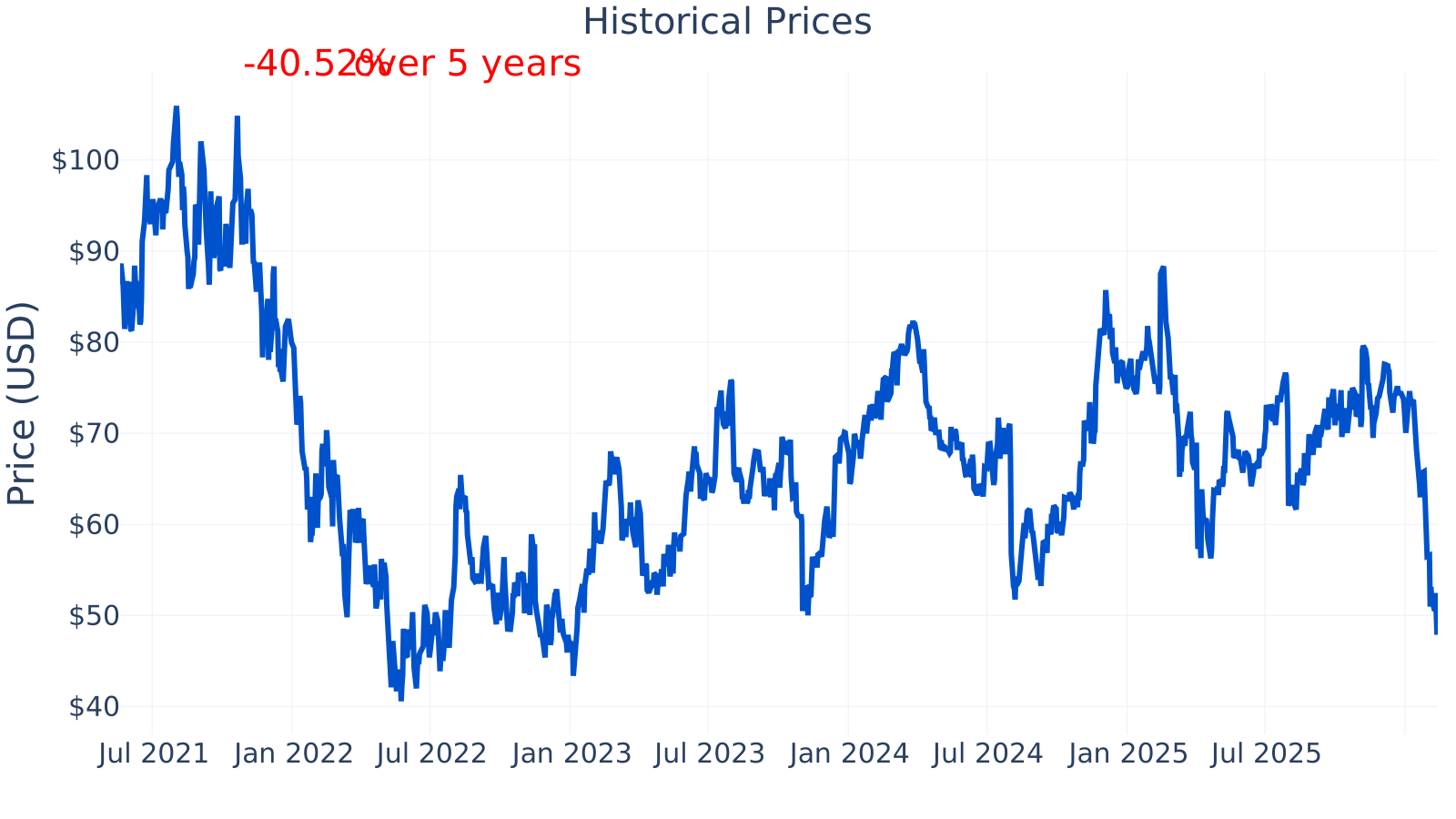
Procore’s market capitalization is about $8.14B, and the stock’s beta is about 0.90, which indicates it has historically moved somewhat less than the broader market on average (though this can change over time). The company’s profit margin is -7.62%, compared with an industry median around +7.66%, meaning profitability is still a key gap versus many peers. On growth, revenue growth year-over-year is ~15.6%, roughly in line with the industry median (~15.8%). Balance-sheet leverage appears relatively low, with debt-to-equity ~9.37% versus an industry median around 24.7%. Free cash flow (TTM) is about $263.0M, which is notable given the company’s net losses.
Growth (medium)
Procore operates in construction software, a segment tied to a very large global construction market that has historically been slower to digitize than many other industries. This creates a long runway for modern cloud tools that standardize workflows, connect participants (owners, contractors, subcontractors), and improve cost control. Procore’s strategy—building a broad platform used across multiple construction roles—fits this “system of record” approach, where adoption can deepen over time as customers expand usage to more teams and projects.
The year-over-year growth trend shows a meaningful slowdown from very high growth rates earlier (above 30–40% during parts of 2021–2022) toward the mid-teens more recently (around 15–16% by late 2024–2025). This pattern can be consistent with a business scaling to a larger revenue base, but it also raises the importance of execution: sustaining mid-teens growth in a large customer base typically depends on expansion within existing customers, new customer wins, and continued product relevance.
Free cash flow improved materially over time—from near breakeven/negative periods (including negative values in 2022–2023) to positive levels, reaching about $132.0M by March 2025 and about $263.0M on a trailing-twelve-month basis in the latest table. For a software company, sustained positive free cash flow can increase flexibility (for example, investing in product, supporting customers, or absorbing demand swings), even if accounting earnings remain negative.
Potential catalysts described in company materials often relate to continued platform expansion (new modules and integrations), increasing adoption of cloud-based collaboration across construction stakeholders, and larger customers standardizing on fewer software systems. Another practical catalyst is operating leverage: if revenue continues to grow while expense growth moderates, profitability can improve even without a return to very high revenue growth rates.
Risks (high)
This article is for informational purposes only and does not constitute financial advice. Some content is AI-generated. See Disclaimer