Stock Analysis · Power Integrations Inc (POWI)
Overview
Power Integrations Inc. is a semiconductor company that designs and sells power-conversion chips and related software/tools. In everyday terms, its products help electronic devices safely and efficiently convert electricity from one form to another (for example, turning high-voltage power from a wall outlet into the lower, stable power needed inside chargers, appliances, industrial equipment, and other electronics).
The company typically sells its products into a wide range of end markets through electronics distribution channels and directly to some customers. Because these chips are designed into devices, demand can move in cycles: when customers build more electronics (or rebuild inventory), chip orders tend to rise; when they slow production or work through stock, chip orders can fall.
Public filings commonly describe revenue largely by product families rather than simple “customer subscription” style categories. In general, revenue is driven by sales of:
- Power-conversion integrated circuits (ICs) used in consumer and industrial power supplies (the core business)
- Specialized power products supporting higher-power applications and specific architectures
- Other items (generally small compared with IC sales)
Percentages by category can vary by year and are best taken directly from the latest annual report’s revenue breakdown. (If you want, the most recent 10-K can be used to add exact percentages by product family and/or end market where disclosed.)
Across the last several years shown, total revenue declined from about $703M (2021) to about $444M (2025). Over the same period, research and development spending stayed high (roughly around $85M–$101M per year), which indicates the company kept investing in new products despite weaker sales. Net income also fell materially (from about $164M in 2021 to about $22M in 2025), reflecting both the revenue drop and pressure on profitability.
Key Figures
| Metric | Value | Industry ⓘ |
|---|---|---|
| Date | Apr 27, 2026 | |
| Context | ||
| Sector | Technology | |
| Industry | Semiconductors | |
| Market Cap ⓘ | $4.10B | |
| Beta ⓘ | 1.29 | |
| Fundamental | ||
| P/E Ratio ⓘ | 188.56 | 63.60 |
| Profit Margin ⓘ | 4.98% | 7.71% |
| Revenue Growth ⓘ | -1.90% | 19.70% |
| Debt to Equity ⓘ | N/A | 20.71% |
| PEG ⓘ | 1.51 | |
| Free Cash Flow ⓘ | $87.12M | |
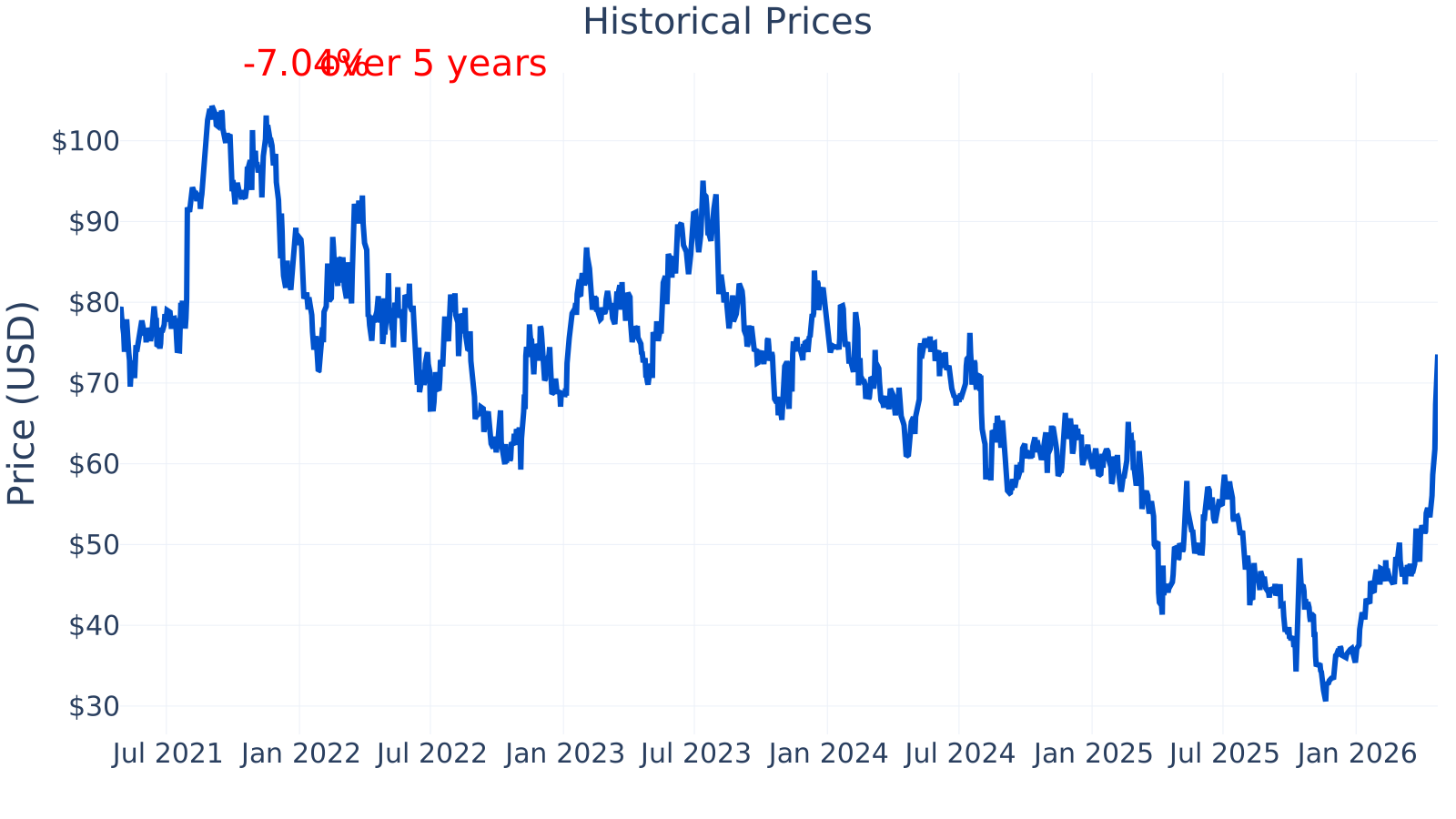
Power Integrations has a market capitalization of about $4.1B and a beta of about 1.29, which signals the share price has historically moved more than the broader market. Profitability and growth are currently below the semiconductor industry median values shown: profit margin ~5.0% vs. an industry median near 7.7%, and year-over-year revenue growth ~-1.9% vs. an industry median near 19.7%. The company’s balance sheet leverage appears low (see the debt section in Risks), while trailing free cash flow is positive at about $87M. The valuation multiples shown (notably P/E) are elevated versus the industry median, which becomes important when interpreting performance and expectations.
Growth (Medium)
Power Integrations operates in power semiconductors, a segment supported over the long run by structural demand drivers: increasing electrification, energy-efficiency standards, growth in fast-charging and adapter ecosystems, industrial automation, and power management needs across many categories of electronics. In that sense, the company participates in an industry with long-term tailwinds.
At the same time, the company’s recent results highlight how cyclical this demand can be. Revenue growth has swung from very strong positive growth (for example, +68.6% year-over-year in mid-2021) to deep contractions (reaching roughly -41.6% year-over-year in early 2023), then improving through parts of 2024 and 2025 before turning slightly negative again by late 2025.
The pattern above is consistent with a business that can be affected by customer inventory cycles and broader electronics demand. For long-term monitoring, it can be helpful to watch whether revenue growth stabilizes into sustained positive territory (rather than short rebounds).
Cash generation remains a meaningful support for long-term flexibility, but it has also weakened from prior peaks. Trailing twelve-month free cash flow fell from about $196M (early 2022) to about $44M (early 2024), then improved to about $73M (early 2025) and sits around $87M most recently shown.
A simple way to interpret this is that the business has remained cash-flow positive through a downturn, but it is currently producing less cash than it did during stronger parts of the cycle. Potential catalysts (in a neutral, factual sense) generally come from: (1) normalization of customer inventories, (2) new product ramps gaining adoption in end equipment, and (3) an upswing in broader electronics/industrial demand.
Risks (High)
The largest risk is that Power Integrations’ revenue and earnings can be highly sensitive to industry cycles. The financial history shown indicates that when revenue drops, profit can compress quickly. Profit margin declined substantially from levels above 20% in 2021–2022 to around 5% most recently shown, which is also below the industry median in the table.
Another key risk is competitive pressure. Power-conversion chips are a large and competitive part of the semiconductor industry, with rivals ranging from broad-line analog/power companies to specialists. Well-known competitors in power management and related areas include Texas Instruments, Analog Devices, Infineon Technologies, STMicroelectronics, onsemi, Renesas, and other power-IC suppliers. Many competitors have larger scale, broader manufacturing and packaging ecosystems, and wide product catalogs that can bundle solutions for customers.
Competitive advantages in this space typically come from a mix of proven chip performance, reliability, energy efficiency, reference designs, customer support, and the friction of redesigning an existing product (once a chip is designed into a device, switching can require engineering work and requalification). Power Integrations has historically emphasized innovation in power-conversion architectures and sustained R&D investment; however, the recent margin pressure suggests that differentiation and pricing power should be evaluated through ongoing results rather than assumed.
From a financial-risk standpoint, leverage appears low. Debt-to-equity remains far below the industry median across the years shown, even after rising modestly in 2024.
Low leverage can reduce the risk of financial distress during downturns, but it does not remove the operational risks tied to demand swings, pricing, and product transitions.
Valuation
The valuation picture is notable. The latest P/E ratio shown is about 188.6, which is well above the industry median of about 63.6 in the table. The historical P/E series also shows that the company’s multiple expanded sharply during periods when earnings fell—because P/E can rise mechanically when profits decline, even if the stock price is flat or down.
In practical terms, a high P/E alongside lower current profit margins and modest/negative recent revenue growth implies that the market price embeds expectations of a meaningful recovery in earnings over time. If margins and growth recover, the multiple can normalize through higher earnings; if profitability stays depressed, the valuation can remain difficult to justify based on near-term fundamentals alone. This makes it especially important to track operating margin and revenue trajectory (not just sales levels) when interpreting valuation.
Conclusion
Power Integrations is a focused power-semiconductor designer with products used across many everyday and industrial electronics applications. The long-term industry backdrop—more electrification and more demand for efficient power conversion—supports the relevance of its product category.
However, the company’s recent multi-year financial trend shows a significant revenue decline from 2021 levels and a large compression in profit margins, even while R&D spending stayed elevated. The balance sheet leverage shown is low, which can help resilience, but the business still faces meaningful cycle risk and intense competition from larger semiconductor suppliers. Valuation metrics shown (particularly P/E) are elevated versus the industry median and appear tied to expectations of an earnings rebound. A fact-based long-term view therefore tends to rely on whether revenue growth becomes consistently positive again and whether margins recover toward prior levels.
Sources:
- SEC EDGAR — Power Integrations Inc. Form 10-K (Annual Report): “Power Integrations, Inc. Annual Report on Form 10-K”
- SEC EDGAR — Power Integrations Inc. Form 10-Q (Quarterly Reports): “Power Integrations, Inc. Quarterly Report on Form 10-Q”
- Power Integrations Investor Relations — Press Releases: “Power Integrations Press Releases”
- Power Integrations Investor Relations — Financial Information: “Quarterly Results and SEC Filings”
- Wikipedia — “Power Integrations”
This article is for informational purposes only and does not constitute financial advice. Some content is AI-generated. See Disclaimer


