Stock Analysis · Pony AI Inc (PONY)
Overview
Pony AI Inc is a technology company focused on autonomous driving (self-driving) systems. In simple terms, it develops software and integrated systems that can drive a vehicle with limited or no human input, with the long-term goal of enabling commercial services such as robotaxis and autonomous logistics. This type of business typically spends heavily on research, testing, safety validation, and building partnerships to run pilots and prepare for broader commercialization.
Based on the company’s public financial reporting, Pony AI’s revenue base is still relatively small compared with its operating cost structure. The overall pattern in recent years shows the company generating tens of millions of dollars of annual revenue while investing hundreds of millions of dollars into operating expenses, particularly research and development (R&D). This profile is common for companies that are still in the “build and prove” stage rather than the “scale and harvest profits” stage.
Main revenue sources are not broken out here into specific product lines with percentages because a detailed segment mix is not provided in the materials included. At a high level, the company’s revenue generally reflects commercialization efforts tied to its autonomous driving technology and related services/arrangements, rather than mature, recurring software subscription revenue.
The multi-year income and spending picture shows revenue increasing from about $8.1M (2021) to about $90.2M (2025), but with substantial operating losses throughout the period. R&D is the largest operating cost line each year (for example, about $218.0M in 2025), indicating the company continues to prioritize product development and deployment readiness over near-term profitability.
Key Figures
| Metric | Value | Industry ⓘ |
|---|---|---|
| Date | May 04, 2026 | |
| Context | ||
| Sector | Technology | |
| Industry | Information Technology Services | |
| Market Cap ⓘ | $4.29B | |
| Beta ⓘ | N/A | |
| Fundamental | ||
| P/E Ratio ⓘ | N/A | 16.84 |
| Profit Margin ⓘ | -148.85% | 5.39% |
| Revenue Growth ⓘ | -18.00% | 7.15% |
| Debt to Equity ⓘ | 0.92% | 56.46% |
| PEG ⓘ | N/A | |
| Free Cash Flow ⓘ | -$306.71M | |
Pony AI’s market capitalization is about $4.29B. The company is currently unprofitable: profit margin is about -148.9% versus an industry median around +5.4%, which means the company is losing significantly more than it earns in revenue (a sign of heavy ongoing investment and/or limited scale). Revenue growth has been volatile: the latest year-over-year revenue growth shown is about -18.0% versus an industry median around +7.2% (though the quarterly trend later shows a sharp rebound). Leverage looks low: debt-to-equity is about 0.9% versus an industry median near 56.5%, suggesting the balance sheet is not heavily reliant on debt. Free cash flow over the trailing twelve months is about -$306.7M, meaning the business has been consuming cash rather than generating it.
Growth (Medium)
Autonomous driving is widely viewed as a large potential market over time because it could reshape ride-hailing, trucking, delivery, and fleet operations. However, growth in this industry is not purely a matter of consumer demand—it is also constrained by safety performance, regulation, operational readiness, and the ability to deploy at scale. For long-term shareholders, the key question tends to be whether a company can move from pilots and limited rollouts to durable, repeatable commercial operations with improving unit economics.
The most recent year-over-year revenue growth series illustrates that growth can swing sharply. After a negative year-over-year comparison (about -17.6% at 2025-12-31), the next point shown moves to a very high positive rate (about +109.3% at 2026-03-31). For early-stage commercialization, this kind of volatility can happen when revenue depends on the timing of deployments, milestones, or partner-related activity rather than a broad base of recurring contracts.
Cash generation remains a central issue for the growth story. Trailing twelve-month free cash flow became more negative in the period shown (from about -$178.8M to about -$306.7M). In practical terms, that indicates the company likely needs either (1) meaningfully higher revenue and gross profit, (2) lower operating spend, and/or (3) additional financing over time to sustain operations while pursuing growth.
Potential catalysts in the autonomous driving industry generally include expansion of commercial operations (more vehicles, more service areas, more paid rides or deliveries), clearer regulatory pathways, and technology milestones that reduce the cost of deployment and supervision. The extent to which Pony AI can translate technical progress into repeatable commercial revenue is the key factor that would typically determine whether growth becomes more predictable and scalable.
Risks (High)
The largest risk is that commercialization may take longer than expected or may not reach profitable scale. Even if the technology works well, deploying autonomous driving services requires high operational discipline, safety processes, local approvals, and ongoing costs for monitoring, maintenance, mapping, and customer support. If revenue ramps slowly while costs remain high, losses and cash outflows can persist.
Profitability is currently a major weakness relative to the broader industry. The profit margin series remains deeply negative, improving from about -351.0% (2025-09-30) to about -63.9% (2026-03-31), while the industry median is around +4.2% in the same period. The direction is better, but the company would still need significant improvement to reach sustainable profitability.
Financial leverage is not the primary near-term risk based on the debt-to-equity levels shown. Debt-to-equity is around 0.9% at the latest point, far below the industry median (roughly 64.8% at the latest point shown). That said, low debt does not remove funding risk: a company can still face pressure if it continues to burn cash and needs additional capital.
Competition is another major risk. The autonomous driving space includes well-funded technology companies, vehicle manufacturers, and platform operators. Competing systems may have advantages in data scale, distribution, manufacturing integration, capital access, or regulatory relationships. Without relying on non-permitted sources, it is still reasonable to frame the competitive question simply: Pony AI is operating in a field where multiple players are pursuing similar end markets, and leadership tends to be demonstrated through demonstrated safety, consistent service uptime, cost per mile, and the ability to expand commercially.
Finally, because the company’s business depends on complex real-world operation, it also faces execution risk (deployment quality, incident management, operational cost control), regulatory risk (local permissions and changing rules), and reputational risk (setbacks can slow adoption and partnerships).
Valuation
For many companies, a price-to-earnings (P/E) ratio is a simple valuation anchor. In Pony AI’s case, the P/E ratio is not meaningful in the period shown (displayed as 0.0), which typically happens when earnings are negative or the metric is otherwise not informative. The industry median P/E is shown in a normal range (roughly 16.9 to 23.4 in the dates displayed), highlighting a key point: traditional earnings-based valuation comparisons are difficult when a company is still reporting losses.
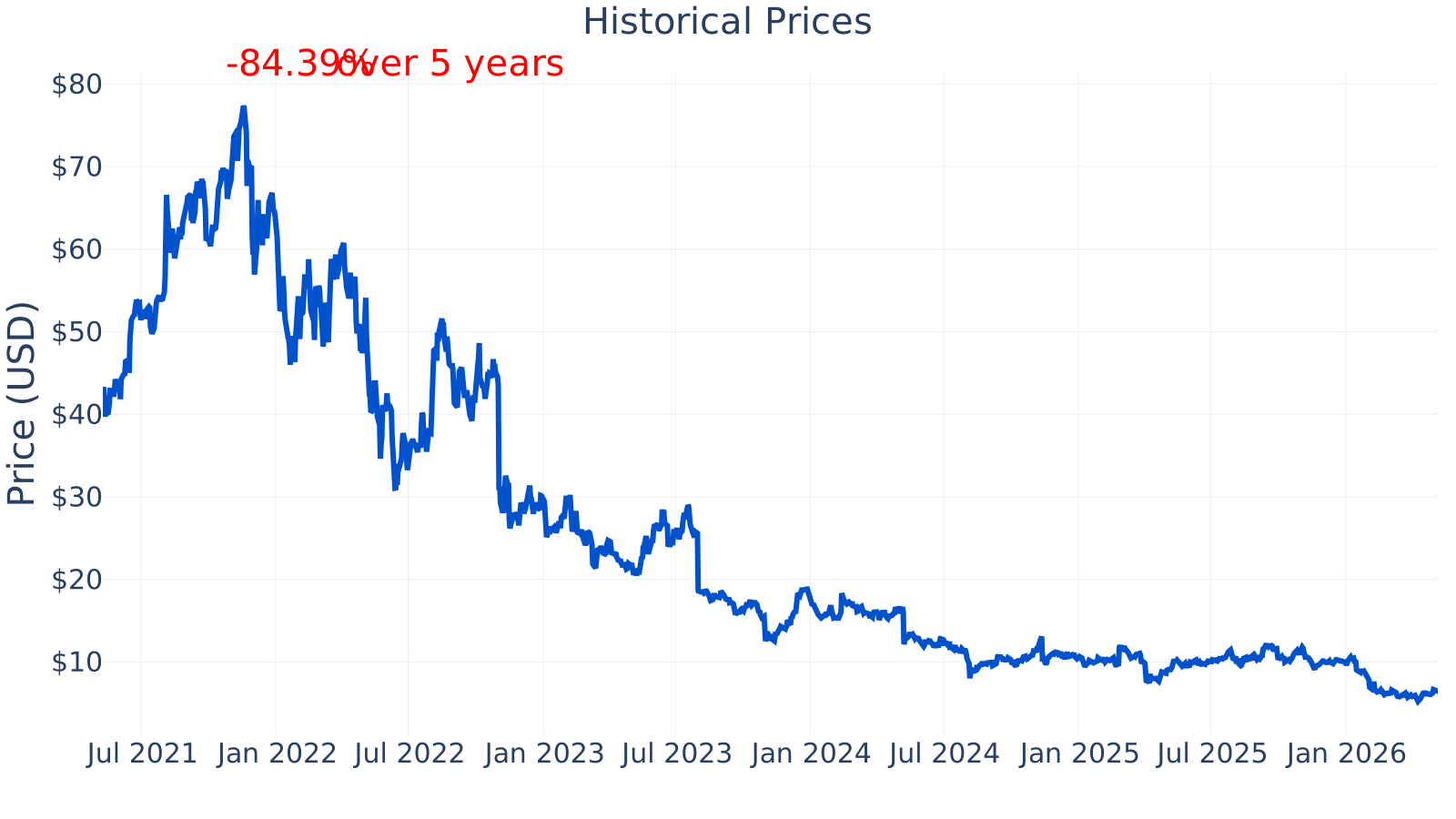
Because earnings are negative and free cash flow is negative, valuation discussions often shift toward questions such as: how large could the future revenue base become, what might long-run margins look like if the company scales, and how much additional capital might be required before reaching self-funding operations. With a market capitalization around $4.29B and continuing cash burn, the market’s valuation is largely tied to expectations of future commercialization success rather than current profitability.
Conclusion
Pony AI is positioned in an industry with potentially large long-term demand, but also high uncertainty and high execution requirements. Financially, the company shows meaningful revenue growth over the multi-year horizon (revenue rising to about $90.2M in 2025), very heavy ongoing R&D investment, negative margins that have improved recently but remain far below industry medians, and substantial negative free cash flow.
From a long-term ownership perspective, the central facts to track are whether revenue growth becomes more consistent, whether gross profit and operating losses improve in a way that suggests scalable economics, and whether cash outflows moderate enough to reduce dependence on future financing. Until profitability and cash generation become clearer, the company’s long-term outcome remains more dependent on successful commercialization milestones than on established financial stability.
Sources:
- SEC EDGAR — Pony AI Inc filings (Annual Reports / Form 10-K; Quarterly Reports / Form 10-Q)
- Pony AI Inc — Investor Relations materials and press releases (company-hosted)
- Wikipedia — “Pony.ai” (basic company background)
This article is for informational purposes only and does not constitute financial advice. Some content is AI-generated. See Disclaimer