Stock Analysis · Polaris Industries Inc (PII)
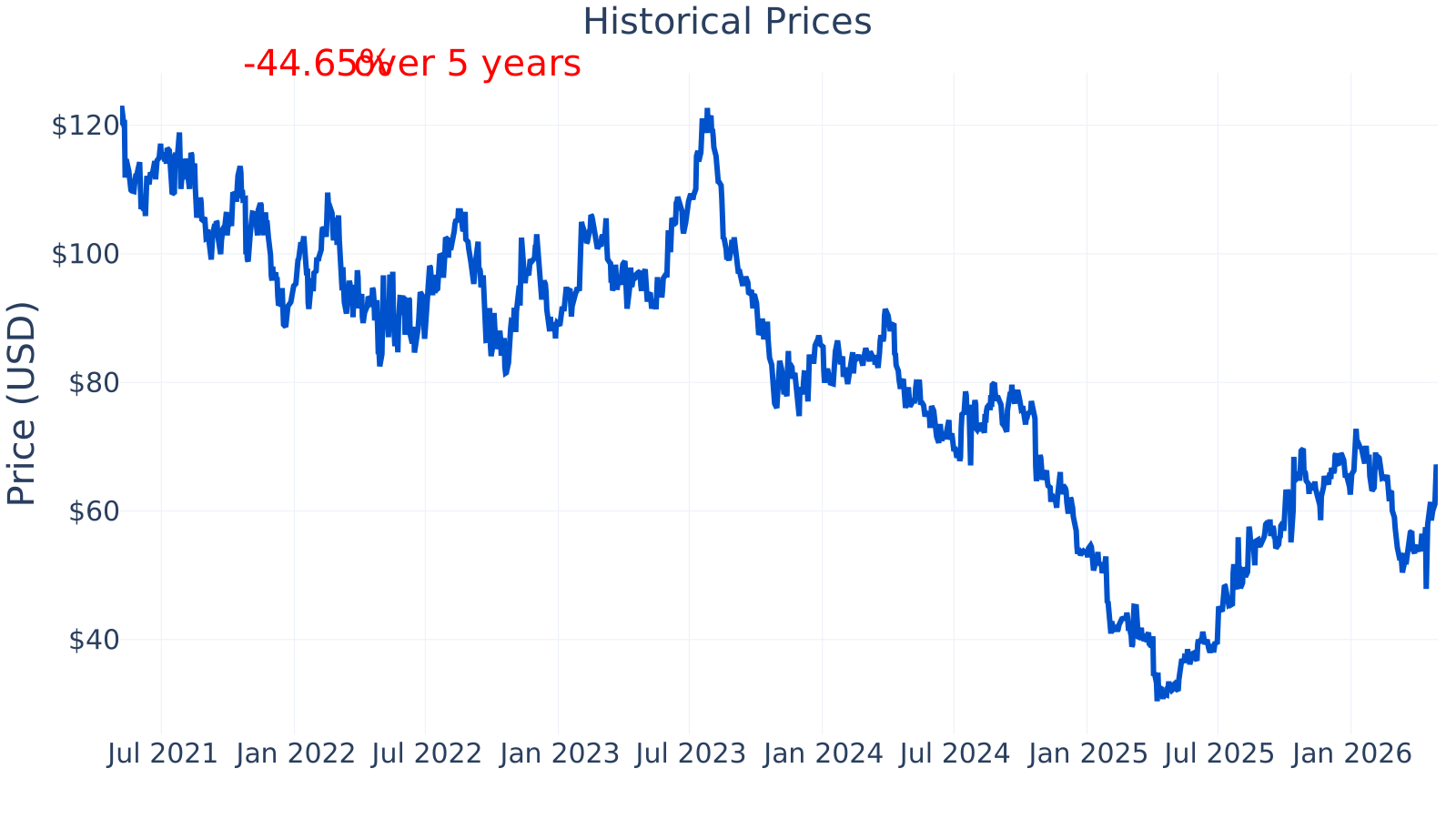
Overview
Polaris Industries Inc. designs, manufactures, and sells powersports vehicles and related parts, garments, and accessories. Its portfolio includes off-road vehicles (such as side-by-sides and ATVs), on-road vehicles (notably motorcycles), and marine products (boats and pontoons). The company primarily sells through a network of independent dealers, with some direct-to-consumer elements in parts and accessories depending on the brand and channel structure described in its filings.
In simple terms, Polaris operates in discretionary spending categories: many of its products are “wants” rather than “needs.” That tends to make demand more sensitive to consumer confidence, financing costs, and dealer inventory conditions. Over time, the company has emphasized product innovation (new models and features), brand building, and expanding higher-margin aftermarket sales such as parts, garments, and accessories (often called PG&A in company reporting).
Polaris reports revenue by business segments in its annual report (10-K). The exact segment mix and the most recent percentages can vary year to year, but the typical structure includes:
- Off Road (side-by-sides and ATVs, plus related parts/accessories)
- On Road (motorcycles and related parts/accessories)
- Marine (boats/pontoons and related parts/accessories)
For precise, up-to-date segment revenue shares, the company’s latest Form 10-K segment footnote is the most reliable reference.
From 2021 to 2025, the company’s revenue rose into 2023 (about $8.93B in 2023) and then declined (about $7.18B in 2024 and $7.15B in 2025). Profitability also weakened materially across this period: operating income moved from positive levels in 2021–2024 to a negative level in 2025, and net income turned negative in 2025. Interest expense increased versus earlier years, which can matter more when operating results are under pressure.
Key Figures
| Metric | Value | Industry ⓘ |
|---|---|---|
| Date | May 04, 2026 | |
| Context | ||
| Sector | Consumer Cyclical | |
| Industry | Recreational Vehicles | |
| Market Cap ⓘ | $3.78B | |
| Beta ⓘ | 1.18 | |
| Fundamental | ||
| P/E Ratio ⓘ | N/A | 16.13 |
| Profit Margin ⓘ | -6.07% | 3.22% |
| Revenue Growth ⓘ | 7.50% | 8.35% |
| Debt to Equity ⓘ | 293.92% | 64.75% |
| PEG ⓘ | 3.34 | |
| Free Cash Flow ⓘ | $160.60M | |
Polaris has a market capitalization of about $3.78B and a beta of ~1.18, which indicates the stock has historically moved somewhat more than the broader market.
On recent fundamentals versus the recreational vehicles peer median shown in the table: profit margin is negative (about -6.07%) compared with an industry median of roughly +3.22%. Meanwhile, year-over-year revenue growth is about +7.5%, close to the peer median of about +8.35%, suggesting that recent top-line performance has been nearer to peers even as bottom-line profitability has been weaker.
Balance-sheet leverage stands out: debt-to-equity is about 293.9%, well above the industry median of about 64.8%. The company also generated positive free cash flow (TTM) of about $160.6M, although that figure is down from the higher levels seen in prior periods shown later in the Growth section.
Growth (Medium)
Polaris participates in the recreational vehicles/powersports market, which is often shaped by product cycles, consumer discretionary budgets, interest rates (many vehicles are financed), and dealer inventory levels. Over the long run, demand is supported by outdoor recreation participation and replacement cycles, but the industry can be cyclical with sharp up-and-down periods.
The company’s strategy, as commonly described in its filings, centers on refreshing core vehicle lineups, developing new models, and expanding higher-margin aftermarket revenue (parts, accessories, and apparel). In general, aftermarket sales can be more resilient than whole-vehicle sales because they tie to an installed base of vehicles already in use.
Year-over-year revenue growth has been volatile over time. There were strong positive periods (for example, above +20% in several quarters in 2022–2023), followed by a notable contraction through much of 2024 (roughly -11% to -23% in multiple quarters). More recently, growth has turned positive again (about +6.9%, +9.5%, and +8.0% in the last three points shown), indicating a potential stabilization in the top line.
Free cash flow (a rough measure of cash generated after operating needs and capital spending) was negative at one point in 2022 (about -$110M), then improved significantly in 2023–2024 (around $337M–$343M), and has since decreased to about $160.6M most recently. This pattern matters for long-term business flexibility because cash generation helps fund new products, manage debt, and absorb downturns.
Potential “catalysts” for improved results, based on how this type of business typically works and what companies in this space discuss in filings, tend to include: normalizing dealer inventories, successful new product launches that lift volumes and pricing, and improved manufacturing efficiency or cost control that supports margins. Whether those materialize is usually visible over several quarters through segment sales, gross margin trends, and inventory commentary in periodic reports.
Risks (High)
Polaris faces meaningful cyclical risk because many products are discretionary and often financed. When borrowing costs rise or consumer confidence weakens, unit demand can fall, promotional activity can increase, and dealers may reduce orders to manage inventory. In addition, powersports and marine products can be seasonal, which can amplify swings in working capital and near-term results.
Leverage is a key point to monitor. Debt-to-equity increased over time and most recently reached about 293.9% (versus an industry median near 38.7% at the latest point shown). Higher leverage can reduce flexibility during downturns because interest expense becomes a larger fixed cost and refinancing can be more challenging if operating results are weak.
Profitability has deteriorated. The profit margin trend moved from mid-single-digit positive levels earlier in the series (roughly 6%–8%) to negative values recently (around -6.5% at one point and about -6.1% at the latest), while the peer median remained positive (around 2%–3% recently). Persistent margin pressure can reflect a mix of lower volumes, higher discounting, product mix shifts, manufacturing inefficiencies, input costs, warranty/recall exposure, or restructuring-related impacts (the specific drivers are typically detailed in management discussion sections of filings).
Competition is another structural risk. Polaris competes with large global manufacturers across categories:
- Off-road: BRP Inc. (Can-Am), Honda, Yamaha, Kawasaki, Suzuki, and others
- Motorcycles: Harley-Davidson, Honda, Yamaha, Kawasaki, Suzuki, BMW Motorrad, and others (depending on segment)
- Marine: multiple boat and pontoon manufacturers, with competitive intensity varying by price point and brand
Polaris’ competitive advantages typically relate to brand recognition in key segments (notably off-road), a broad product lineup, dealer relationships, and its installed base that can drive parts and accessories. At the same time, many competitors are well-capitalized and can pressure pricing, innovate quickly, and expand distribution.
Operational and product risks also matter. Like other vehicle manufacturers, Polaris is exposed to supply chain disruptions, commodity/input cost changes, quality issues, warranty costs, and recalls. Regulatory changes (emissions, safety standards, and noise requirements) can increase compliance costs and influence product development priorities.
Valuation
For valuation, a common metric is the price-to-earnings (P/E) ratio, which compares the stock price to earnings. Historically, Polaris’ P/E in the chart moved mostly in a range roughly from the high single digits to the high teens for long stretches, with a spike to higher levels in 2025 (around 48.7 at one point). The industry median P/E values shown have often been in the low-to-mid teens, with a median around 16.13 indicated in the table.
It is important to interpret P/E carefully when earnings are depressed or negative. When net income turns negative (as shown in the company’s 2025 net income in the Overview section and the negative recent profit margin in Risks), P/E can become less meaningful or not shown, because the “E” (earnings) is not a stable, positive number. In those situations, valuation discussions often shift toward other measures (such as normalized earnings over a cycle, free cash flow, or balance-sheet strength), and the credibility of a “normal” earnings recovery becomes central to how the market prices the business.
In context, Polaris’ recent valuation signals should be viewed alongside (1) the return to positive revenue growth in the most recent quarters shown, (2) weaker profitability, and (3) higher leverage than peers. These factors can pull in opposite directions when comparing the company to industry medians.
Conclusion
Polaris is a well-known manufacturer in powersports and recreational vehicles, selling through established dealer networks and operating across off-road, on-road, and marine categories. The company has demonstrated periods of solid scale and cash generation, and recent quarters show a return to positive year-over-year revenue growth.
At the same time, the current fundamental picture includes elevated risk signals: profitability has shifted from positive to negative on the margin measure shown, leverage is high relative to peers, and results appear consistent with a cyclical downturn/recovery pattern rather than steady compounding. For long-term assessment, the most decision-relevant variables to track in future filings are whether margins normalize, whether free cash flow rebuilds, and whether leverage trends down versus equity over time.
Sources:
- SEC EDGAR — Polaris Inc. Form 10-K (Annual Report)
- SEC EDGAR — Polaris Inc. Form 10-Q (Quarterly Reports)
- Polaris Investor Relations — SEC Filings and investor materials (company-hosted)
- Wikipedia — “Polaris Inc.” (basic company background)
This article is for informational purposes only and does not constitute financial advice. Some content is AI-generated. See Disclaimer


