Stock Analysis · Plexus Corp (PLXS)
Overview
Plexus Corp (PLXS) is a U.S.-based electronics manufacturing services (EMS) company. In simple terms, it helps other companies design, build, and support complex electronic products. Plexus typically works on products that require high reliability and strong quality controls, such as items used in healthcare, industrial equipment, communications, and aerospace/defense-related applications.
Its business model is often described as “low-to-medium volume, high-mix,” meaning it tends to produce many different types of products (high variety) rather than massive quantities of a single item. This positioning can make Plexus less dependent on any one consumer gadget cycle, but it also means execution matters: manufacturing many product types across multiple customers increases operational complexity.
In general, Plexus generates revenue by providing end-to-end services that can include product design and engineering support, manufacturing and assembly, supply chain management and component sourcing, and aftermarket services (such as repairs or sustaining support). In Plexus’ SEC filings, revenue is generally discussed as coming from customer programs across end markets rather than a single “product” the company sells under its own brand.
Over the years shown, total revenue moves in a range of roughly $3.4B to $4.2B, while cost of revenue represents the largest share of revenue (typical for contract manufacturing). Net income varies meaningfully by year in the sample, with a noticeable dip in fiscal 2024 (as shown) followed by a rebound in fiscal 2025.
Key Figures
| Metric | Value | Industry ⓘ |
|---|---|---|
| Date | May 04, 2026 | |
| Context | ||
| Sector | Technology | |
| Industry | Electronic Components | |
| Market Cap ⓘ | $7.09B | |
| Beta ⓘ | 0.75 | |
| Fundamental | ||
| P/E Ratio ⓘ | 38.80 | 46.65 |
| Profit Margin ⓘ | 4.35% | 6.29% |
| Revenue Growth ⓘ | 18.70% | 17.50% |
| Debt to Equity ⓘ | 17.45% | 37.71% |
| PEG ⓘ | 2.09 | |
| Free Cash Flow ⓘ | $75.79M | |
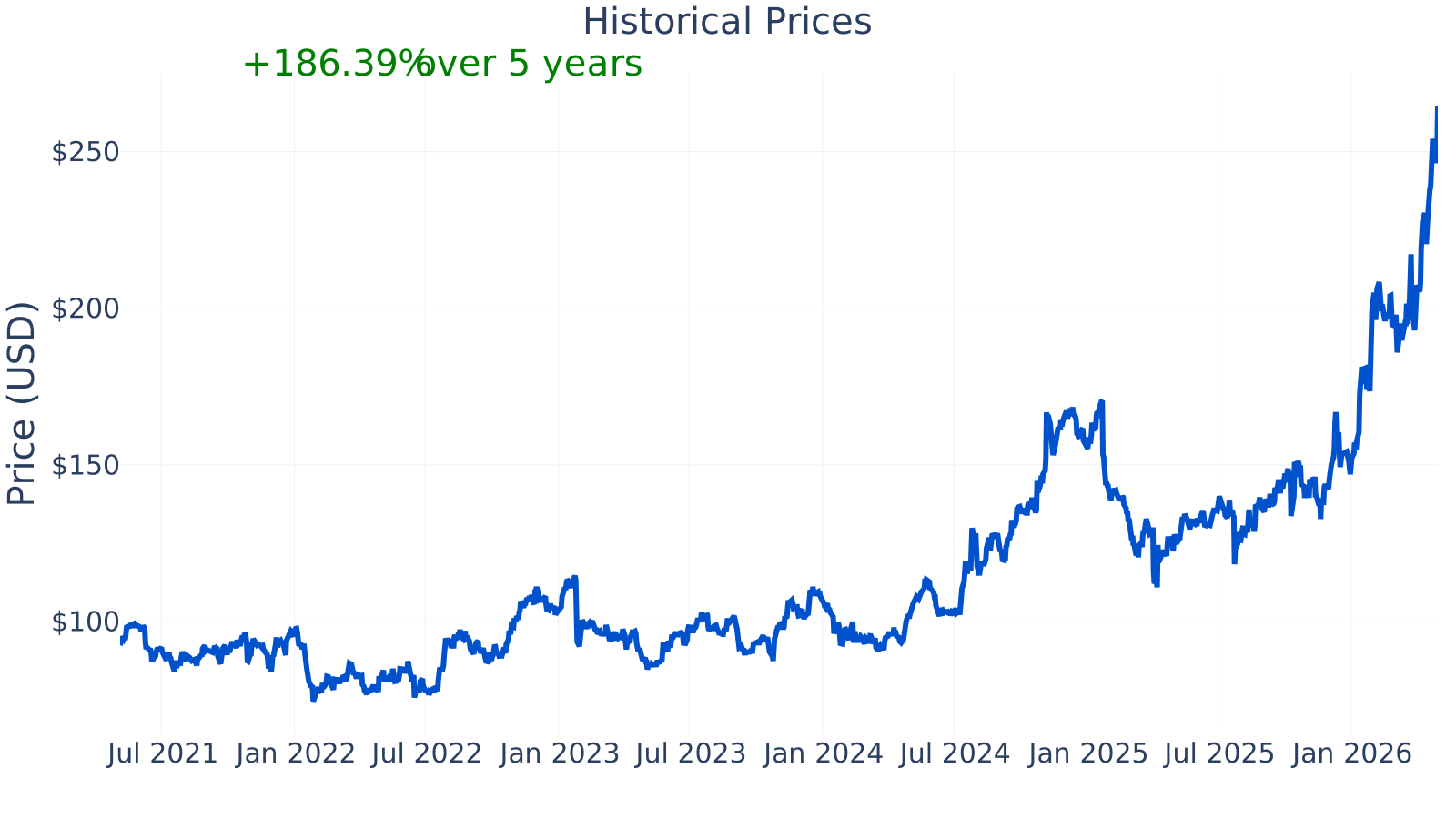
Plexus’ market capitalization is about $7.1B, and its beta of about 0.75 indicates the stock has historically moved less than the broader market on average (though any single stock can still be volatile). The P/E ratio is about 38.8 versus an industry median near 46.6, while the PEG ratio is about 2.09 (a common way investors summarize “price vs. growth,” where higher values often imply more growth is already priced in).
Profit margin is about 4.35% versus an industry median near 6.29%, suggesting Plexus is currently less profitable per dollar of sales than the median peer in its listed industry group. On the balance sheet, debt-to-equity is about 17% versus an industry median near 38%, indicating comparatively lower leverage. Free cash flow over the trailing twelve months is about $75.8M, which is positive, though the longer view shows it has fluctuated significantly over time.
Growth (Medium)
Plexus operates in outsourced electronics manufacturing, a space supported by long-term trends such as increasing electronic content in industrial and medical equipment, the need for more resilient supply chains, and ongoing product complexity that encourages OEMs (original equipment manufacturers) to rely on specialized partners. This is not a “straight-line” growth industry, however. Demand can be cyclical and tied to customer product cycles, inventory corrections, and capital spending patterns in industrial and communications markets.
Strategically, Plexus’ focus on complex, regulated, or high-reliability builds can make sense for long-run differentiation, because customers in these categories may value quality systems, traceability, and long product lifecycles. Potential catalysts typically come from new program wins, ramp-ups of existing customer programs, and improved factory utilization (better absorption of fixed costs) when demand strengthens.
Year-over-year revenue growth has been uneven. After strong growth periods (including peaks above 30% in parts of 2022), the company later experienced negative growth across several quarters in 2023–2024, before returning to positive territory more recently. The latest value shown is about 18.7% year-over-year, slightly above the industry median of about 17.5%, indicating a recent improvement versus peers—while also highlighting that results can change direction across cycles.
Free cash flow has also been volatile. It was negative in 2022 and 2023 (as shown), then turned strongly positive in 2024 and especially 2025, before settling at a lower but still positive level in the most recent period (about $75.8M). For a manufacturing-focused business, swings like this can reflect working capital changes (inventory and receivables), capital spending needs, and profitability shifts—so it can be helpful to watch whether positive free cash flow becomes more consistent over time.
Risks (Medium)
The biggest risks for an EMS company like Plexus tend to come from customer concentration and program timing (a few large programs can materially affect results), demand cyclicality (customers may pause orders during inventory corrections), and operational execution (quality issues, ramp delays, or inefficiencies can pressure margins). Another recurring risk in electronics supply chains is component availability and pricing; even when supply tightness eases, contract terms and customer arrangements can influence who bears which costs.
Competitive advantages in this industry usually come from manufacturing quality, the ability to handle complex builds, regulatory and compliance systems, long-standing customer relationships, global footprint, and disciplined capital allocation. Plexus is not generally described as the largest player in global EMS by scale; the industry includes much bigger competitors. Plexus’ positioning is more about specialization and execution in its chosen complexity tiers rather than being the volume leader.
Well-known EMS competitors include large global providers such as Jabil and Flex, along with other electronics manufacturing and supply chain service firms. Compared with very large peers, Plexus may have less scale leverage, but it may also avoid some ultra-competitive, lowest-margin mass-market programs by focusing on more specialized work.
Debt-to-equity has declined substantially from earlier periods shown (which reached roughly the mid-40% range in 2022–2023) to about 17% most recently. This is also below the industry median (about 38%). Lower leverage can reduce financial risk, especially in cyclical periods, although it does not remove operational or demand-related risk.
Profit margin has generally been in the 3%–4% range in the periods shown, with the latest near 4.35%. The industry median displayed alongside it is often higher, and the latest median is about 6.29%. This gap matters because small changes in margin can have an outsized effect on earnings in contract manufacturing, where cost of revenue is a very large part of sales.
Valuation
Plexus’ P/E ratio has risen over time from the high-teens/low-20s earlier in the timeline to levels that reached the high-30s in late 2024, and it sits around the low-30s in the most recent period shown. The industry median in the chart is higher in several recent points, and the latest industry median shown is about 42.1 versus Plexus around 32.0 at that time point.
Interpreting valuation in this type of business typically requires tying the multiple to (1) the durability of revenue growth, (2) the stability and direction of margins, and (3) the consistency of free cash flow. The recent combination of improved year-over-year revenue growth and positive free cash flow supports a higher valuation than periods with declining revenue and negative cash generation, while the company’s margins remaining below the displayed industry median can be a counterweight.
Conclusion
Plexus is an electronics manufacturing services company focused on complex and reliability-sensitive products. Its operating profile reflects the realities of the sector: revenue growth can swing from strong to negative and back again, while cash flow can fluctuate meaningfully due to working capital and cycle effects.
From the metrics shown, Plexus currently combines (1) improving recent year-over-year revenue growth, (2) positive trailing free cash flow, and (3) comparatively low leverage versus the industry median. At the same time, profit margins appear below the industry median, which keeps attention on execution, program mix, and the company’s ability to sustain margin improvements through cycles.
Sources:
- U.S. SEC EDGAR — Plexus Corp filings (Form 10-K, Form 10-Q)
- Plexus Corp Investor Relations — SEC filings and public materials
- Wikipedia — “Plexus Corp” (company background)
This article is for informational purposes only and does not constitute financial advice. Some content is AI-generated. See Disclaimer