Stock Analysis · Playtika Holding Corp (PLTK)
Overview
Playtika Holding Corp (PLTK) is a digital entertainment company focused on mobile games, especially “free-to-play” titles where the game is free to download and players can choose to spend money inside the app. The company operates a portfolio of long-running game brands and uses live operations (frequent updates, events, and content releases) to keep players engaged over time.
Playtika’s revenue is primarily generated from in-game purchases made by players (often called “in-app purchases”). The company’s games are typically distributed through major mobile platforms, and Playtika also spends on marketing to acquire and retain players. In practice, the business model depends heavily on (1) maintaining strong engagement in existing games and (2) efficiently turning that engagement into spending, while managing the cost of user acquisition and platform fees.
Public filings commonly describe revenue as coming largely from in-app purchases across its game portfolio (rather than subscriptions or hardware). Detailed, easy-to-compare percentages by title or product line can change over time and are typically disclosed in company filings as part of segment and concentration discussions when applicable.
From 2021 to 2025, revenue stayed in a relatively narrow band (about $2.55B–$2.76B), but profitability shifted noticeably. In 2025, operating income turned negative (about -$102M) and net income also moved negative (about -$206M). A major visible change in 2025 is a sharp increase in selling, general, and administrative expense (SG&A), rising to about $619M versus roughly $289M in 2024, while research and development stayed in a similar range (about $427M in 2025).
Key Figures
| Metric | Value | Industry ⓘ |
|---|---|---|
| Date | Mar 09, 2026 | |
| Context | ||
| Sector | Communication Services | |
| Industry | Electronic Gaming & Multimedia | |
| Market Cap ⓘ | $1.05B | |
| Beta ⓘ | 0.87 | |
| Fundamental | ||
| P/E Ratio ⓘ | 12.88 | |
| Profit Margin ⓘ | -7.49% | -7.49% |
| Revenue Growth ⓘ | 4.40% | 4.40% |
| Debt to Equity ⓘ | -643.51% | 31.70% |
| PEG ⓘ | N/A | |
| Free Cash Flow ⓘ | $551.92M | |
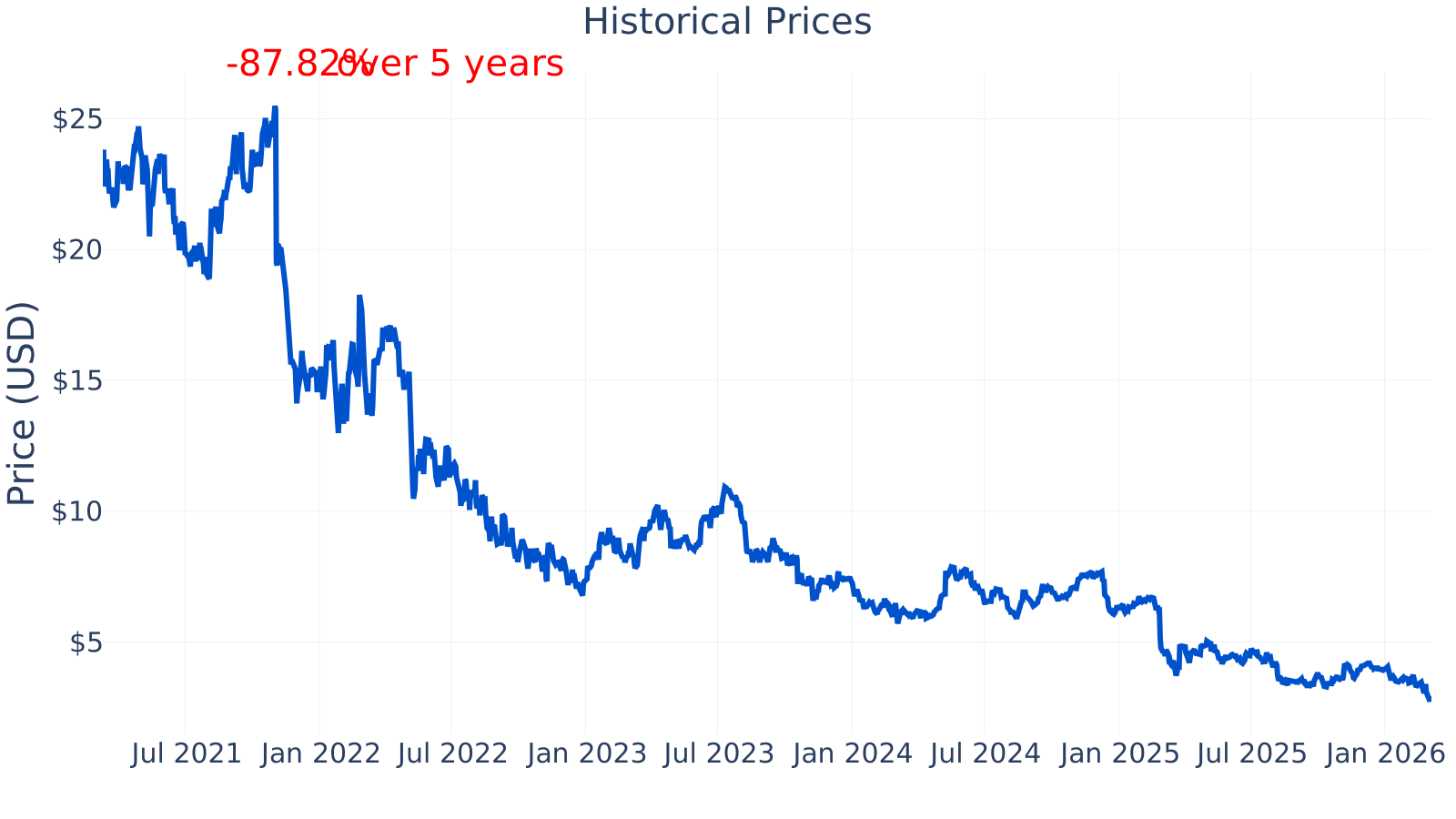
PLTK’s market capitalization is about $1.05B, and the stock’s beta is 0.87, which indicates price moves that have historically been somewhat less volatile than the broader market. The latest P/E ratio shown is 12.9, but it should be read alongside recent profitability pressure: the latest profit margin is about -7.5%. Revenue growth (year-over-year) is about 4.4%. Free cash flow over the trailing twelve months is about $552M, which suggests the business has recently been generating substantial cash even while reported net income is negative. Debt-to-equity is shown as -643%, which typically happens when accounting equity is negative; this can make leverage ratios harder to interpret using standard comparisons.
Growth (Medium)
The mobile gaming industry is large and mature, with growth often driven by live services, new content, better personalization, and efficient marketing rather than by one-time product launches. Playtika’s approach—operating established games for long periods and continually updating them—fits this “live operations” reality. This model can be durable when games maintain loyal player communities, but it can also become challenging if user acquisition costs rise or if older titles gradually lose engagement.
Revenue growth has been uneven over time, including several quarters of negative year-over-year growth in 2023 and parts of 2024, followed by stronger positive readings in 2025 (roughly mid-to-high single digits to low double digits in several quarters). This pattern can be consistent with a portfolio business where performance depends on content cycles, marketing intensity, and the relative strength of specific titles during the year.
Free cash flow has remained meaningfully positive across the periods shown (roughly $355M to $576M on a trailing basis). For a game publisher, sustained free cash flow can act as a practical “fuel source” for continued development, marketing, and potential acquisitions. A key question for long-term fundamentals is whether cash generation remains resilient if player acquisition costs increase or if the company needs to spend more to sustain engagement.
Potential catalysts in this type of business typically include successful new game launches, measurable improvement in monetization and retention in existing games, stronger marketing efficiency, and disciplined cost control—especially when profitability has recently weakened.
Risks (High)
Playtika’s results depend on player behavior and the economics of mobile distribution. Small changes in engagement, in-game spending patterns, or marketing efficiency can have outsized impacts on profit. Platform concentration is also a structural risk in mobile gaming: major app stores control distribution and take fees, and changes to platform policies can affect marketing and monetization.
The debt-to-equity ratio is negative (latest around -643%), which commonly indicates negative shareholder equity on the balance sheet. When equity is negative, traditional leverage ratios become less intuitive, and it raises the importance of reading the balance sheet details in filings (for example, the size and terms of debt, cash balances, and any constraints from credit agreements).
Profitability has deteriorated materially over time. Earlier periods show positive profit margins (often around the high single digits to low teens), but the latest margin is about -7.5%. This suggests that recent cost levels (including operating expenses) have outpaced the revenue base. In game publishing, this can happen when marketing ramps up, when player acquisition becomes more expensive, when older games require heavier promotion to sustain bookings, or when there are one-time charges; the specific drivers should be checked in the company’s MD&A and notes in its SEC filings.
Competition is intense and continuous. Playtika competes with other large mobile-focused publishers and diversified game companies, as well as many smaller studios. Competitive pressure shows up through advertising auctions (user acquisition), content innovation, and the ability to keep players engaged for years. In addition, many game companies compete for the same limited consumer time, not just the same genre.
As for competitive advantages, Playtika’s strengths are typically associated with running live-service games at scale: analytics-driven tuning, frequent content updates, and experience in monetization and retention for mature titles. Whether that translates into clear leadership depends on sustained performance of its top games and the company’s ability to keep its portfolio fresh without letting costs rise faster than revenue.
Valuation
The P/E ratio has moved substantially over time, falling from very high levels in 2021 to generally lower double-digit levels later, with the most recent shown near 12.9. Interpreting P/E needs extra care when earnings are volatile: when profits decline sharply or turn negative, P/E can become less informative or fluctuate for reasons unrelated to long-term earning power.
Given the mix of (1) modest recent revenue growth, (2) a recent swing to negative profit margin, and (3) strong trailing free cash flow, the market’s valuation can be seen as balancing cash-generation potential against profitability and balance-sheet complexity (including the negative equity signal implied by the leverage ratio). A clearer valuation picture typically comes from combining multiple lenses—profitability trend, cash flow durability, and the sustainability of marketing and operating costs—rather than relying on a single ratio.
Conclusion
Playtika is a mobile game operator built around long-lived, free-to-play titles monetized mainly through in-app purchases. The company has shown the ability to generate significant free cash flow, and recent quarters show improved year-over-year revenue growth compared with some weaker periods in 2023–2024.
At the same time, the latest profitability indicators show meaningful pressure, including a move to a negative profit margin and a negative operating result in 2025, alongside a large increase in operating expenses. The balance-sheet signal implied by a negative debt-to-equity ratio also indicates that standard leverage comparisons can be less straightforward, increasing the importance of reviewing debt terms and cash flow coverage in filings.
Overall, the long-term picture hinges on whether Playtika can sustain engagement and monetization in its game portfolio while bringing costs back in line with revenue—without sacrificing the product investment needed to keep games relevant in a highly competitive mobile gaming market.
Sources:
- SEC EDGAR — Playtika Holding Corp filings (Form 10-K, Form 10-Q)
- Playtika Holding Corp — Investor Relations materials (SEC filings and shareholder information)
- Wikipedia — “Playtika” (basic company background)
This article is for informational purposes only and does not constitute financial advice. Some content is AI-generated. See Disclaimer