Stock Analysis · Penske Automotive Group Inc (PAG)
Overview
Penske Automotive Group Inc. (PAG) is a large automotive retailer. In simple terms, it operates dealerships that sell new and used vehicles, provides parts and repair services, and offers financing- and insurance-related products to customers buying vehicles. The company also has a meaningful presence outside the U.S. and has expanded into additional automotive-related retail activities, which helps diversify what would otherwise be a very “car-sales-cycle” business.
Across the dealership model, vehicle sales tend to generate the largest share of revenue, while higher-margin contributions often come from services like parts, repairs, and customer financing/insurance products. In its annual report, the company breaks down revenue into operating segments and revenue categories (for example, new vehicles, used vehicles, parts and service, and finance & insurance), which is typically the clearest way to see what drives total sales.
Main sources of revenue usually include (largest to smallest, exact mix varies by year and market conditions):
- New vehicle sales (volume-driven, sensitive to inventory levels and pricing)
- Used vehicle sales (sensitive to used-car pricing and trade-in supply)
- Parts and service (repair and maintenance work; often steadier through the cycle)
- Finance and insurance (F&I) (products arranged at the time of sale; tied to vehicle sales activity)
- Other automotive-related operations (varies by the company’s footprint and acquisitions)
One practical way to think about PAG is as a combination of (1) a high-dollar retail sales business (vehicles) and (2) a recurring service business (maintenance and repairs), with (3) an add-on financial products component (F&I). The long-term stability of results often depends on how well the service side offsets the ups and downs in vehicle demand.
From 2021 to 2025, total revenue rose (about $25.6B to about $31.8B), but operating income and net income moved lower from the highs seen earlier in the period. This pattern is consistent with a normalization from unusually strong dealership conditions (such as tight inventories and elevated pricing) toward a more typical environment where costs and incentives can weigh more on profitability.
Key Figures
| Metric | Value | Industry ⓘ |
|---|---|---|
| Date | Feb 16, 2026 | |
| Context | ||
| Sector | Consumer Cyclical | |
| Industry | Auto & Truck Dealerships | |
| Market Cap ⓘ | $11.32B | |
| Beta ⓘ | 0.90 | |
| Fundamental | ||
| P/E Ratio ⓘ | 12.12 | 16.16 |
| Profit Margin ⓘ | 2.94% | 2.73% |
| Revenue Growth ⓘ | 0.60% | 3.80% |
| Debt to Equity ⓘ | 156.27% | 143.86% |
| PEG ⓘ | 2.10 | |
| Free Cash Flow ⓘ | $757.00M | |
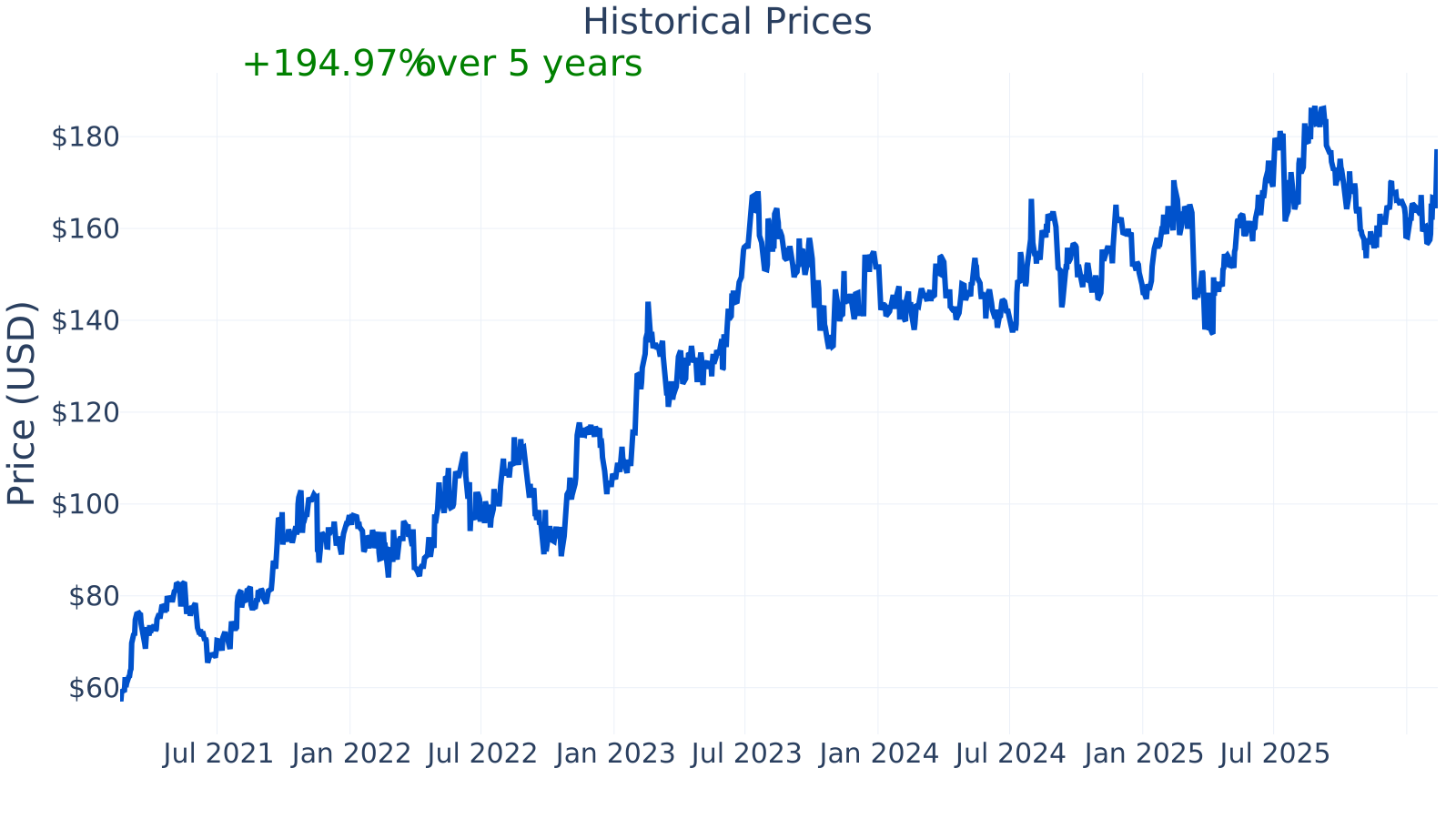
PAG’s market capitalization is about $11.3B, and its beta is ~0.90, which describes how volatile the stock has been versus the broader market (below 1.0 suggests somewhat less movement than the market on average). The company’s P/E ratio is ~12.1 versus an industry median of ~16.2. Net profit margin is ~2.94%, slightly above the industry median of ~2.73%, which reflects the thin-margin nature of auto retail even in solid years. Revenue growth year over year is ~0.6%, below the industry median of ~3.8%, indicating recent top-line growth has been modest. Debt-to-equity is ~156% (industry median ~144%), highlighting meaningful leverage, which is common in this industry due to inventory (“floorplan”) financing and real estate. Trailing twelve-month free cash flow is about $757M, a key measure of cash generation after operating needs and capital spending.
Growth (Medium)
PAG operates in the auto and truck dealership industry, which tends to grow over long periods with population, employment, and vehicle replacement needs—but it is also cyclical. Demand can slow when interest rates rise, credit tightens, or consumer confidence falls. At the same time, the car parc (the number of vehicles on the road) supports ongoing maintenance and repair demand, which can help steady results even when new vehicle sales soften.
A core growth lever for dealership groups is scale: adding rooftops (dealership locations), expanding geographically, and improving operating efficiency through shared systems and purchasing power. Another important driver is expanding “after-sales” activity (parts and service), which tends to be stickier and more recurring than vehicle sales. Over time, dealerships also adapt to changes in vehicles (including EVs) and retailing behavior (more online research and digital steps), which can shift where costs and profits sit in the customer journey.
Recent year-over-year revenue growth has slowed to low single digits, ending around 0.6% in the most recent period shown. Earlier quarters in 2021–2022 show much stronger growth rates, followed by a clear normalization. For long-term expectations, this highlights an important point: even when revenue rises over time, the path can be uneven because unit volumes, vehicle prices, and inventory availability change with the cycle.
Free cash flow has remained positive but has trended down from roughly $1.03B (2021) to about $737M (2025) on a trailing basis. For a dealership group, free cash flow can swing due to inventory movement, capital spending (including facilities), and acquisition activity, so it is typically more informative to observe multi-year patterns rather than a single year in isolation.
Risks (Medium-High)
This article is for informational purposes only and does not constitute financial advice. Some content is AI-generated. See Disclaimer