Stock Analysis · Penn National Gaming Inc (PENN)
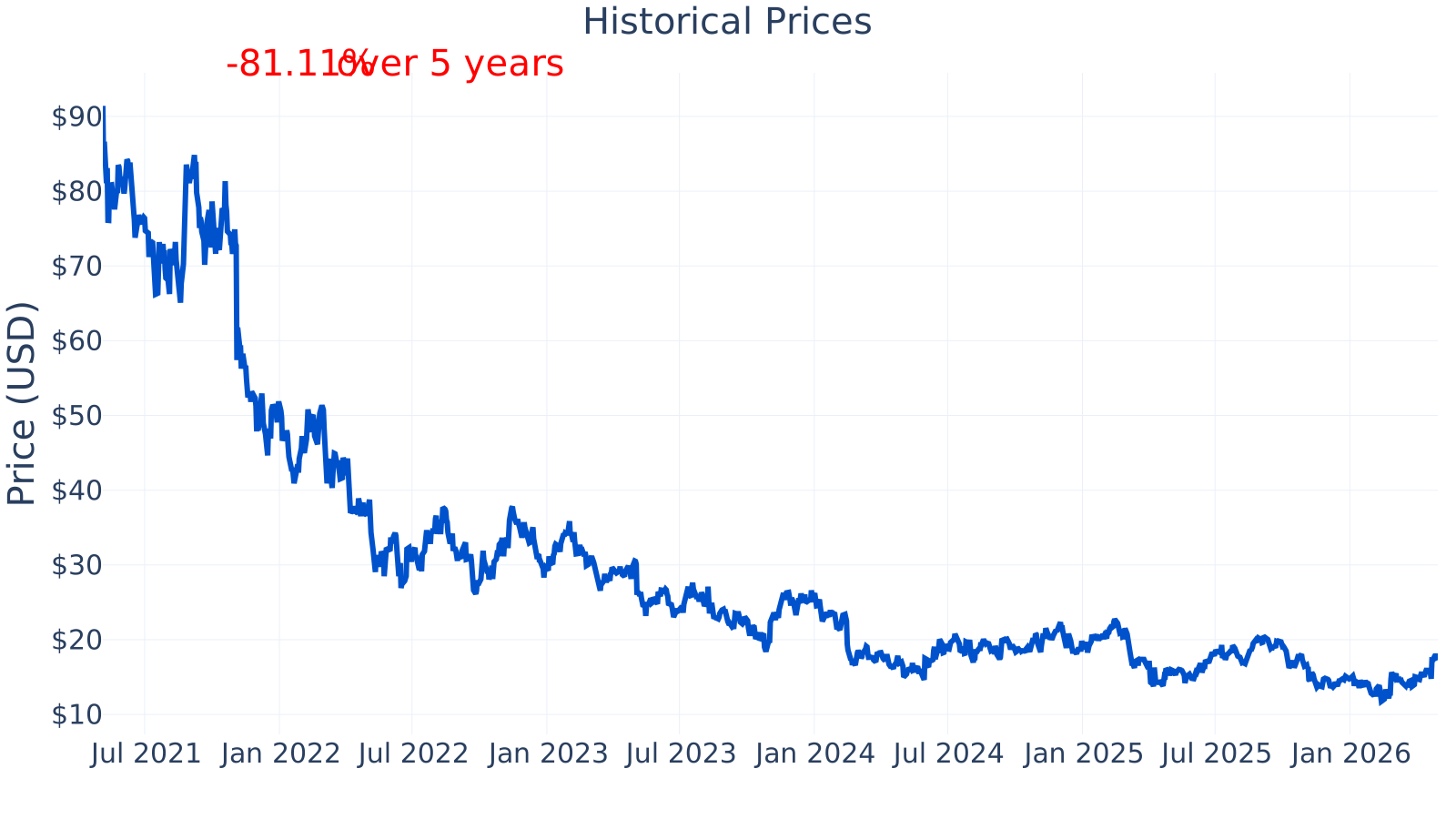
Overview
Penn National Gaming, Inc. (PENN) is a U.S.-based gaming and entertainment company. Its business centers on operating casinos and racetracks (often called “gaming properties”), along with an online sports betting and iCasino presence. In practice, the company earns money from people visiting its physical locations to play casino games and bet on races, while also serving customers through digital betting products in states where online wagering is legal.
In its reporting, PENN typically describes revenue through a mix of property-level gaming revenue (casino games and related activities), food & beverage and hotel offerings at properties, and interactive/digital gaming revenue. Exact percentages by source can shift from period to period and depend on state-by-state market conditions, seasonality, and the pace of online expansion.
Main revenue streams (typical structure):
- Gaming revenue at physical properties (casino play and related on-site wagering)
- Food, beverage, hotel, and other on-property spend
- Interactive/digital gaming (online sports betting and iCasino where permitted)
The company’s recent financial picture shows that revenue has generally held up, but profitability has been pressured. Over the last several years, total revenue increased (from about $5.9B in 2021 to about $7.0B in 2025), while net income moved from positive results in 2021–2022 to losses in 2023–2025. A key item to watch for a leveraged operator like PENN is interest expense, which has remained a meaningful cost (hundreds of millions per year), affecting bottom-line results.
Across 2021–2025, revenue rose from roughly $5.9B to $7.0B, but gross profit trended down (about $2.76B in 2021 to about $1.91B in 2025). Over the same period, profitability weakened and net income turned negative, highlighting that higher revenue has not translated into higher earnings.
Key Figures
| Metric | Value | Industry ⓘ |
|---|---|---|
| Date | May 04, 2026 | |
| Context | ||
| Sector | Consumer Cyclical | |
| Industry | Resorts & Casinos | |
| Market Cap ⓘ | $2.31B | |
| Beta ⓘ | 1.33 | |
| Fundamental | ||
| P/E Ratio ⓘ | N/A | 19.89 |
| Profit Margin ⓘ | -13.54% | 4.08% |
| Revenue Growth ⓘ | 6.40% | 3.45% |
| Debt to Equity ⓘ | 451.80% | 370.23% |
| PEG ⓘ | 1.01 | |
| Free Cash Flow ⓘ | -$57.70M | |
PENN’s market capitalization is about $2.31B, placing it in a mid/smaller-cap range within public gaming peers. The stock’s beta of 1.33 suggests it has tended to move more than the overall market, which is consistent with consumer-discretionary and gaming businesses that can be sensitive to the economic cycle.
On operating performance, the latest profit margin is -13.54%, while the industry median shown is about 4.09%. Revenue growth year over year is about 6.40%, above the industry median of about 3.45%. Debt relative to equity is about 452%, higher than the industry median of about 370%. The company’s free cash flow (TTM) is about -$57.7M, indicating that over the trailing twelve months it used more cash than it generated from operations after capital spending.
Growth (Medium)
PENN operates in a U.S. gaming market that has expanded over the past decade due to more states allowing various forms of wagering, along with continued demand for regional casino entertainment. In the long run, a supportive backdrop can come from (1) additional legalization of online sports betting and iCasino in new states and (2) the ability of established casino operators to cross-market loyalty programs from physical properties to digital products.
That said, the industry is also competitive and promotion-heavy (especially in online sports betting). For PENN, future growth generally depends on a mix of steady performance at regional casinos and execution in digital channels without sacrificing too much profitability.
The year-over-year revenue trend shows a return to moderate positive growth more recently (about 6.37% in the most recent point shown), after a softer patch that included negative readings in parts of 2023–2024. This pattern is consistent with a business that can grow, but not always in a straight line, especially when comparing periods with major market launches or changing promotional intensity.
Free cash flow has shifted from strongly positive levels in 2022–2023 (about $655M and $531M) to negative in 2024–2026 (most recently about -$57.7M). For a long-term business case, a key question is whether this decline reflects temporary investment/spending that can later normalize, or more persistent pressure from costs, competition, and required reinvestment.
Risks (High)
The largest risks for PENN are tied to profitability, leverage, and the regulatory environment. Gaming is highly regulated and state-by-state rules can change; licensing, compliance, and tax structures can materially affect results. In addition, consumer spending on gaming and entertainment can weaken during economic slowdowns, which may pressure revenue at regional casinos and reduce customer activity online.
Competition is another major factor. In physical casinos, PENN competes with other regional casino operators as well as destination markets in certain customer catchment areas. In online sports betting and iCasino, competition tends to be intense and driven by marketing and promotions, which can weigh on margins. As a result, advantages such as a large property footprint, customer database/loyalty program, and cross-channel marketing can help, but they do not remove the need to spend to maintain share.
Compared with the largest U.S. gaming companies, PENN is a meaningful operator but not the clear overall industry leader across all segments. Its positioning can be strongest where it has dense regional coverage, but it faces large, well-capitalized peers in both casino operations and digital betting.
Main competitors (examples):
- Caesars Entertainment
- MGM Resorts International
- Wynn Resorts / Las Vegas Sands (more destination-oriented exposure)
- Boyd Gaming / Churchill Downs (regional and/or specific niche overlap)
Debt-to-equity has often been elevated and in the most recent point is about 452%, above the peer median shown (about 370%). Higher leverage can amplify outcomes: it may help returns when conditions are favorable, but it also raises sensitivity to interest rates, refinancing conditions, and any downturn in operating results.
Profit margin moved from solidly positive levels earlier in the period (often mid-single digits to low double digits) to sustained negatives from late 2023 onward, reaching about -13.54% most recently, while the industry median remains positive (about 4.21%). This gap indicates PENN has recently underperformed peers on bottom-line profitability, which can limit flexibility for investment, debt reduction, or shareholder returns.
Valuation
Common valuation tools like the price-to-earnings (P/E) ratio work best when a company has stable, positive earnings. For PENN, the P/E ratio is not consistently meaningful in periods when net income is negative (in those cases, P/E may be shown as unavailable or not meaningful). When the company did have measurable P/E readings earlier in the timeline, it sometimes traded above and sometimes below the industry median, reflecting changing expectations about growth and profitability.
The chart shows PENN’s P/E was measurable in parts of 2021–2023, with readings that ranged from mid-single digits to above 30 at times, compared with an industry median often in the mid-teens to low-30s. More recently, as earnings turned negative, the P/E is not displayed as a meaningful number, shifting attention toward other measures (such as operating income, cash flow, and balance-sheet leverage) to evaluate whether the current market value is supported by business fundamentals.
At a high level, assessing whether the current price is “expensive” or “cheap” depends heavily on whether profitability and free cash flow recover while keeping leverage manageable. With negative profit margins and slightly negative trailing free cash flow, valuation tends to be driven more by a turnaround/recovery narrative and less by steady compounding earnings.
Conclusion
PENN is a large regional gaming operator with a meaningful digital presence in a U.S. industry that can grow as legalization expands and as operators integrate online and on-property customer relationships. Revenue has been trending upward overall in recent years, and the latest year-over-year growth rate is modestly positive.
However, recent fundamentals show notable pressure: profitability has been negative for an extended period, free cash flow has turned negative compared with earlier strong levels, and leverage is high relative to the peer median shown. In long-term terms, the company’s outlook is closely tied to whether it can convert revenue growth into durable profits and cash generation while managing debt and competing effectively in both physical and online wagering markets.
Sources:
- Penn Entertainment, Inc. (formerly Penn National Gaming) — Form 10-K (Annual Report) — “Annual Report Pursuant to Section 13 or 15(d) of the Securities Exchange Act of 1934”
- Penn Entertainment, Inc. — Form 10-Q (Quarterly Report) — “Quarterly Report Pursuant to Section 13 or 15(d) of the Securities Exchange Act of 1934”
- SEC EDGAR — “Company Filings: PENN”
- Penn Entertainment, Inc. Investor Relations — “Press Releases”
- Wikipedia — “PENN Entertainment”
This article is for informational purposes only and does not constitute financial advice. Some content is AI-generated. See Disclaimer


