Stock Analysis · Pegasystems Inc (PEGA)
Overview
Pegasystems Inc. (PEGA) is a software company that helps large organizations manage and automate complex work. In simple terms, its products are used to design digital “workflows” (the steps needed to complete a process), make customer service and sales interactions more consistent, and improve decision-making using data-driven recommendations. The company sells these capabilities mainly to enterprises in industries such as financial services, insurance, healthcare, communications, and the public sector.
Pegasystems’ revenue is primarily tied to software delivered through cloud subscriptions and term licenses, along with related support and professional services. In its SEC filings, the company commonly groups revenue into broad categories rather than highly granular “product-by-product” lines. The typical major sources include:
- Subscription services (cloud) (generally recurring)
- Software licenses (including term-based arrangements)
- Maintenance and support
- Professional services (implementation and advisory work)
Across recent years, total revenue increased from about $1.21B (2021) to about $1.50B (2024), based on the company’s annual results.
From 2021 to 2024, revenue rose steadily (about $1.21B to about $1.50B), while operating income moved from a loss to a profit (about -$124M in 2021 to about $149M in 2024). Over the same period, research and development spending stayed relatively consistent (roughly $261M–$298M), suggesting continued investment in the product while overall profitability improved.
Key Figures
| Metric | Value | Industry ⓘ |
|---|---|---|
| Date | Feb 07, 2026 | |
| Context | ||
| Sector | Technology | |
| Industry | Software - Application | |
| Market Cap ⓘ | $6.86B | |
| Beta ⓘ | 1.07 | |
| Fundamental | ||
| P/E Ratio ⓘ | 26.05 | 27.79 |
| Profit Margin ⓘ | 16.05% | 6.02% |
| Revenue Growth ⓘ | 17.30% | 15.80% |
| Debt to Equity ⓘ | 12.87% | 25.15% |
| PEG ⓘ | 0.61 | |
| Free Cash Flow ⓘ | $439.23M | |
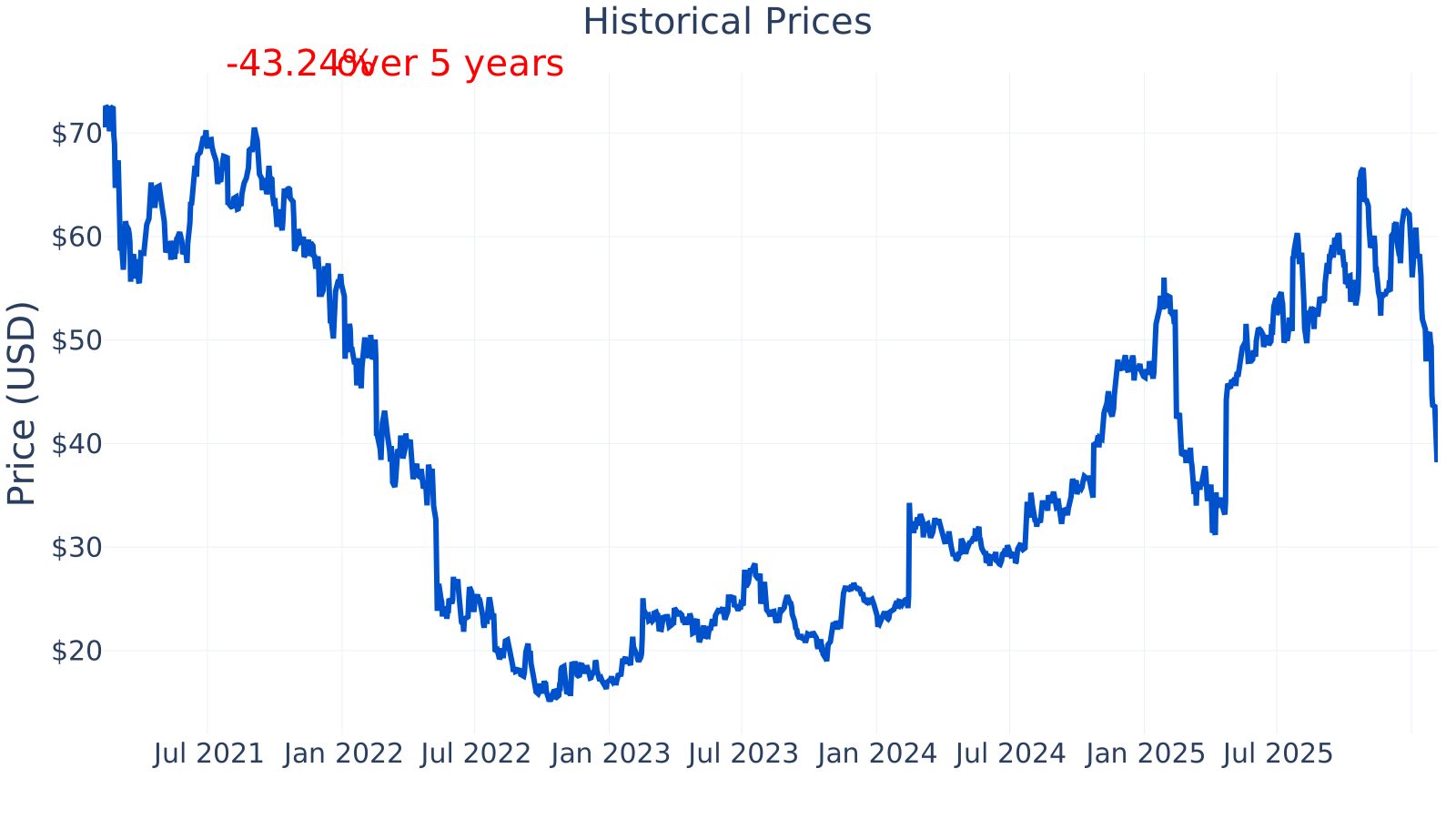
Pegasystems’ market capitalization is about $6.9B, and its beta (~1.07) indicates price moves that have been roughly similar to the broader market in many periods. The company’s profit margin (~16.1%) is higher than the listed industry median (~6.0%), and its year-over-year revenue growth (~17.3%) is slightly above the industry median (~15.8%). Leverage appears comparatively modest with debt-to-equity (~12.9%) versus an industry median near 25.2%. Free cash flow over the trailing twelve months is about $439M, and the reported P/E (~26.1) sits close to the industry median (~27.8).
Growth (Medium)
Pegasystems operates in enterprise software markets tied to digital transformation—areas where organizations continuously modernize customer service, operations, and compliance-driven processes. Demand is influenced by long-term trends such as cloud adoption, the push for faster and more consistent customer experiences, and the need to reduce manual work in complex organizations.
The company’s strategy centers on expanding recurring revenue through cloud-based offerings and deepening its footprint in large enterprises where workflows can be mission-critical and costly to replace. This type of software can become embedded in day-to-day operations, which may support renewal rates and longer customer relationships when deployments are successful.
Revenue growth has been uneven quarter-to-quarter, including some periods of negative year-over-year growth, followed by stronger rebounds. The most recent value shown is about 17.3% year-over-year, with a notably strong spike earlier in 2025 (about 44.1%), illustrating that growth can be lumpy rather than smooth.
Free cash flow improved significantly over time, rising from tens of millions in earlier periods to more than $300M in 2024 and roughly $361M in early 2025 (TTM), with the latest metric listing about $439M (TTM). For long-term business resilience, sustained free cash flow can matter because it represents cash available after operating needs and capital spending.
Risks (Medium)
Pegasystems sells to large organizations, which can create a “bigger deal, longer cycle” dynamic. Enterprise customers may take time to decide, may phase deployments, and may renegotiate contracts based on budgets and priorities. This can make near-term results sensitive to the timing of large transactions, customer renewals, and shifts between license structures and cloud subscriptions.
Competition is a meaningful factor. Pegasystems participates in markets that overlap with large software platforms and specialized workflow/automation vendors. Major competitors can include Salesforce (customer engagement and platform capabilities), ServiceNow (workflow automation), Microsoft (power platform/low-code and broader enterprise stack), and other enterprise software providers that offer process automation and customer service tooling. Relative positioning often depends on industry use cases, integration needs, total cost of ownership, and how quickly customers can deploy and achieve measurable outcomes.
The company’s potential competitive advantages include long-standing enterprise relationships, workflow depth for complex processes, and switching costs once a platform becomes embedded in critical operations. However, larger competitors may bundle similar capabilities into broader suites, which can influence procurement decisions.
Leverage has changed substantially over the period shown, with debt-to-equity once appearing very high (well above 100%) before dropping sharply to about 13% most recently, which is below the industry median (~25%). Even with lower leverage today, investors typically still watch how software companies manage obligations, contract commitments, and the stability of recurring revenue.
Profitability also shifted meaningfully. Earlier periods show negative margins, but the trend improved over time to a recent profit margin of about 16%, above the industry median shown (~6%). This improvement can reduce one common risk for software firms (persistent losses), though margins can still fluctuate with sales mix, cloud transition dynamics, and investment levels in sales and product development.
Valuation
Valuation is often discussed using multiples such as the price-to-earnings ratio (P/E), but it is most useful when considered alongside growth consistency, cash generation, and business risk. Pegasystems’ latest P/E is about 26.1, close to the listed industry median (~27.8), which suggests the market is valuing it broadly in line with peers on that measure.
Historically, the P/E ratio shown has varied significantly in periods where earnings were volatile, and more recently it has moved within a more typical range for profitable software companies. In 2024–2025 points displayed, the company’s P/E was sometimes above and sometimes below the industry median, reflecting changes in earnings and market expectations rather than a stable relationship.
From a fundamentals perspective, a valuation multiple near the industry median combined with a profit margin above the median and meaningful free cash flow may indicate that the market is balancing improved profitability against risks such as competitive pressure and uneven revenue growth.
Conclusion
Pegasystems is an enterprise software company focused on workflow automation and customer engagement, with revenue increasingly oriented toward recurring arrangements such as cloud subscriptions. Over the last several years, revenue has grown from roughly $1.21B (2021) to roughly $1.50B (2024), while profitability and free cash flow have improved materially compared with earlier loss-making periods.
The long-term picture depends on execution in a competitive enterprise software landscape and the company’s ability to sustain growth while maintaining profitability during continued product investment and the ongoing shift toward cloud delivery. With valuation metrics such as P/E currently near the industry median, the market appears to be reflecting both the company’s improved financial profile and the continuing uncertainties typical of enterprise software vendors (deal timing, competition, and customer budget cycles).
Sources:
- SEC EDGAR — Pegasystems Inc. Form 10-K (Annual Report) (various years)
- SEC EDGAR — Pegasystems Inc. Form 10-Q (Quarterly Report) (various quarters)
- Pegasystems Investor Relations — SEC Filings (company-hosted filing library)
- Wikipedia — “Pegasystems” (company background and basic facts)
This article is for informational purposes only and does not constitute financial advice. Some content is AI-generated. See Disclaimer