Stock Analysis · Payoneer Global Inc (PAYO)
Overview
Payoneer Global Inc (PAYO) is a financial technology company that helps businesses move money across borders. In simple terms, it provides a platform for companies—especially small and mid-sized businesses, online sellers, and service providers—to get paid internationally, pay suppliers and contractors, and manage multiple currencies without needing a traditional bank setup in every country.
The business is designed for “global commerce,” such as marketplaces, e-commerce merchants, and businesses that sell services internationally. Payoneer’s role is mainly to handle the complicated parts: currency conversion, local and international transfers, and compliance checks required for regulated financial activity.
In its public reporting, Payoneer commonly describes revenue in broad “transaction and usage-driven” categories rather than consumer-style subscription tiers. The main revenue drivers typically include:
- Fees tied to payment transactions (for receiving and sending funds, including cross-border transfers)
- Foreign exchange (FX) spread / conversion revenue when customers convert one currency to another
- Card and spend-related revenue connected to Payoneer-issued cards and business spending features
- Value-added services for business customers (depending on product usage and corridor)
Because revenue mix can change by period and Payoneer’s filings may present these streams using different groupings, exact percentages by source are not always consistently disclosed as a simple split in every report.
Across recent years, total revenue expanded substantially (from about $473M in 2021 to about $1.053B in 2025). Over the same span, the company moved from a loss in 2021 to positive net income in later years, although profitability has not followed a straight line (net income was lower in 2025 than in 2024).
Key Figures
| Metric | Value | Industry ⓘ |
|---|---|---|
| Date | Mar 02, 2026 | |
| Context | ||
| Sector | Technology | |
| Industry | Software - Infrastructure | |
| Market Cap ⓘ | $1.56B | |
| Beta ⓘ | 1.04 | |
| Fundamental | ||
| P/E Ratio ⓘ | 24.00 | 24.58 |
| Profit Margin ⓘ | 6.95% | 6.79% |
| Revenue Growth ⓘ | 47.00% | 16.35% |
| Debt to Equity ⓘ | 7.25% | 26.59% |
| PEG ⓘ | N/A | |
| Free Cash Flow ⓘ | $206.62M | |
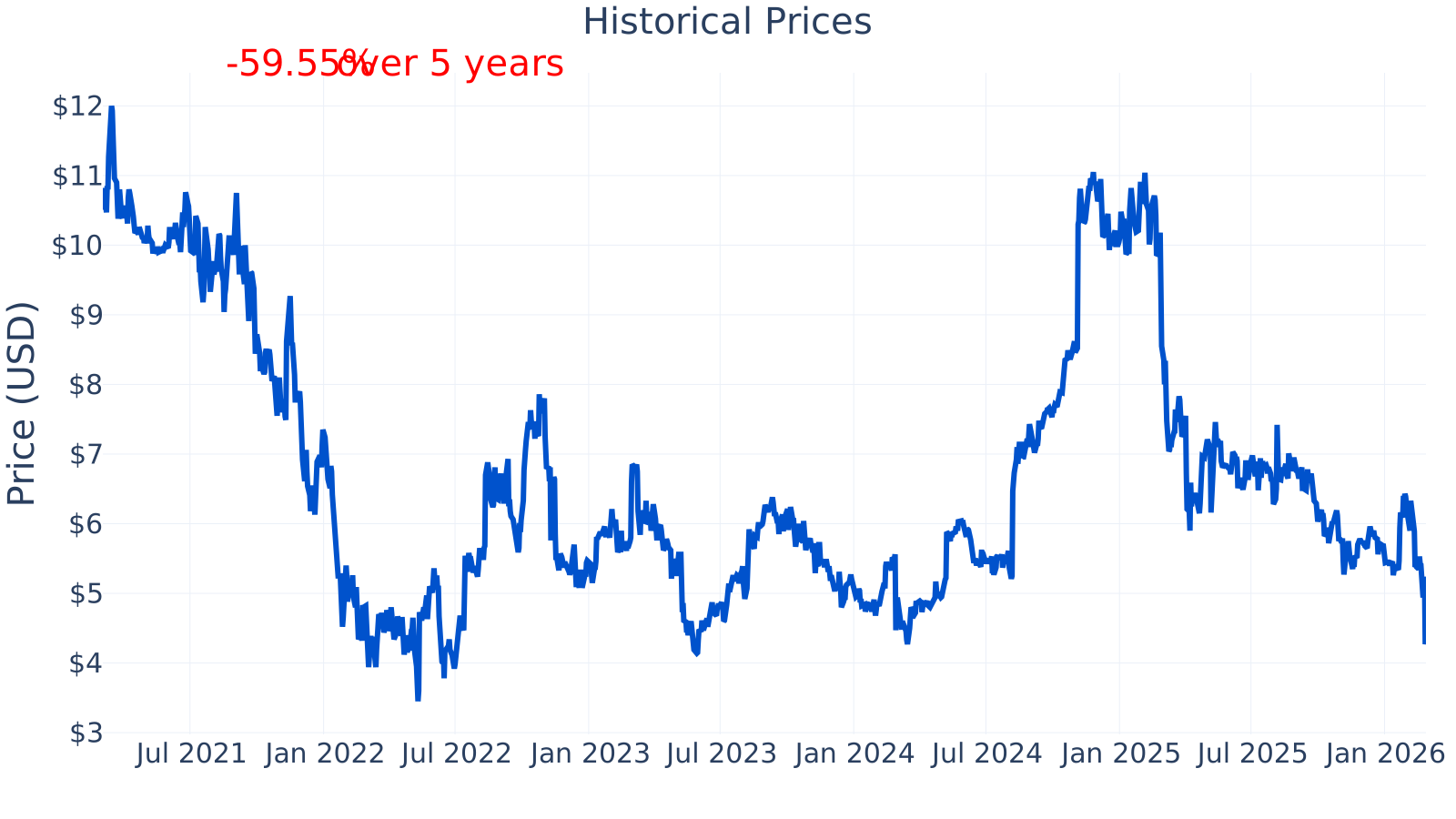
Payoneer’s market capitalization is about $1.56B, placing it in the smaller-cap range. The stock’s beta of ~1.04 suggests price movements that have been roughly similar to the broader market historically. The latest P/E ratio is ~24.0, close to the industry median (~24.6). Profit margin is about 7.0%, slightly above the industry median (~6.8%). Recent year-over-year revenue growth shows 47% versus an industry median of about 16%, while debt-to-equity is ~7% versus an industry median near 27%, indicating relatively modest leverage compared with many peers. Trailing twelve-month free cash flow is about $206.6M.
Growth (Medium)
Payoneer operates in the broader trend of cross-border digital payments and tools for global business-to-business commerce. The underlying demand driver is straightforward: more small and mid-sized businesses are selling internationally through online channels and need ways to receive payments, pay partners, and handle currency conversion efficiently.
Strategically, Payoneer’s approach aims to benefit from this trend by positioning itself as an “operating layer” for global business payments—supporting multiple currencies, local receiving accounts, and payout capabilities. In theory, as customers increase international sales volume, usage-based payment and FX revenues can scale alongside that activity.
The chart shows revenue growth decelerating from very high levels earlier (often above 30%–40% year-over-year in 2021–2023) to lower—but still positive—levels more recently (single digits by 2025). This pattern can be consistent with a business maturing from an earlier rapid-growth phase into a more normalized growth rate, though it also means future results may rely more on execution, product expansion, and competitive positioning than on pure market tailwinds.
Free cash flow improved meaningfully over time, moving from negative in 2021 (about -$30M) to positive levels in subsequent years, reaching roughly $141M by 2024 and about $126M by 2025 (TTM shown). Sustained positive cash generation can provide flexibility for investments in product development, compliance infrastructure, and potential acquisitions, but the year-to-year changes also show it is not perfectly steady.
Risks (High)
A key risk for Payoneer is that payments is a highly competitive space with many capable players. Pricing pressure can emerge over time because many payment services can look similar to customers, especially for basic payment acceptance and payout functions. Payoneer’s ability to keep differentiating—through global coverage, reliability, compliance capability, and integration into customer workflows—matters for maintaining margins.
Another major risk is regulatory and compliance complexity. Handling cross-border money movement requires strong controls (for example, anti-money-laundering and sanctions compliance). Regulatory expectations can tighten, and operating across many countries can increase complexity and cost. Compliance issues can also create reputational risk, which is particularly important for a payments brand.
Payoneer also faces customer and partner concentration risk in certain channels (for example, reliance on large marketplaces or specific partner ecosystems), a topic commonly discussed in payments company filings. Changes in marketplace policies, integration terms, or partner economics could affect volumes and revenue.
Leverage appears relatively low in recent periods. The most recent debt-to-equity value is around 7%, below the industry median (about 27%). Lower leverage can reduce financial strain during downturns, although it does not remove operational and competitive risks.
Profitability improved markedly from losses in 2021–2022 to positive margins later. The most recent profit margin is about 7%, close to the industry median. The chart also shows that margins peaked higher in parts of 2024–2025 (low double digits) before easing back, highlighting that profitability can fluctuate based on volume mix, pricing, costs, and investment pace.
On competitive positioning, Payoneer is not generally described as the single dominant global leader in payments; instead, it competes in specific cross-border business segments. Main competitors depend on the use case (merchant acquiring, payouts, remittances, or business accounts). Well-known competitors and adjacent alternatives include PayPal (and its merchant ecosystem), Wise (cross-border transfers), Block (Square ecosystem), Adyen and Stripe (payment processing), and traditional banks for business international payments. Compared with the largest platforms, Payoneer is smaller, which can be a disadvantage in brand reach and scale—but it may also allow specialization in cross-border SMB and marketplace-linked workflows.
Valuation
At a latest P/E of about 24, Payoneer trades near the industry median shown (about 24.6). Historically, the P/E ratio shown has varied significantly, including periods where it was much higher (often influenced by lower earnings levels) and more recent periods where it moved closer to typical software/infrastructure peer ranges.
Whether the current valuation level is “high” or “low” cannot be concluded from P/E alone, but some context is visible in the fundamentals presented above: revenue growth has slowed to single digits most recently (after much faster growth earlier), profit margin is positive but not exceptionally high, free cash flow is positive, and leverage appears modest. A market-level valuation near the peer median often implies expectations that are not dramatically different from the average company in the same broad peer set, though the key question becomes whether Payoneer’s future growth and profitability trajectory ends up better or worse than those expectations.
Conclusion
Payoneer is a cross-border business payments platform positioned around global commerce needs such as international receiving, payouts, and currency conversion. Financially, the company shows a multi-year pattern of strong revenue expansion compared with earlier years, an evolution toward positive profitability, and a move to meaningful positive free cash flow. At the same time, the more recent period shows slower year-over-year revenue growth and some variability in net income and margins.
The long-term picture depends primarily on execution in a competitive and regulated market: sustaining product differentiation, keeping compliance strong, defending pricing, and expanding customer usage while managing costs. From the valuation metrics shown, the stock’s earnings multiple appears broadly in line with the industry median, suggesting that market expectations may be relatively balanced rather than extreme, with future outcomes likely driven by the company’s ability to maintain profitable growth as the business matures.
Sources:
- U.S. Securities and Exchange Commission — EDGAR database (Payoneer Global Inc filings, including Form 10-K and Form 10-Q)
- Payoneer Global Inc — Investor Relations materials and SEC filing documents (business description, risk factors, and financial statements)
- Wikipedia — “Payoneer” (basic company background)
This article is for informational purposes only and does not constitute financial advice. Some content is AI-generated. See Disclaimer