Stock Analysis · Payoneer Global Inc (PAYO)
Overview
Payoneer Global Inc (PAYO) provides payment and financial services that help businesses send, receive, and manage money internationally. The company focuses heavily on cross-border commerce, supporting small and mid-sized businesses, marketplaces, and enterprises that need to pay suppliers, contractors, and partners in other countries, and get paid by customers abroad. In practice, Payoneer acts as a bridge between local payment methods and the global banking system, offering multi-currency accounts, international transfers, checkout/payment acceptance options, and tools to manage business payments.
In its SEC filings, Payoneer describes revenue primarily in terms of how it earns fees on payment activity and related services. The main revenue drivers are generally tied to the volume of funds moving through its platform and the services attached to those flows:
- Transaction and service fees from enabling cross-border payments and money movement (for example, receiving funds, withdrawing to bank accounts, and paying third parties).
- Interest income earned on customer balances and funds held for operational purposes (the importance of this can rise or fall with interest rates and balance levels).
- Other platform-related revenues tied to value-added services offered to business customers (as described in company filings).
From an investor’s perspective, the key idea is that Payoneer’s business model is closely connected to (1) global e-commerce and services trade, and (2) how efficiently it can onboard customers, keep them active, and monetize payment volume while managing risk and compliance costs.
Across 2021–2024, total revenue increased from about $473M (2021) to about $978M (2024), while the company moved from operating losses in 2021 to positive operating income by 2022 and materially higher operating income in 2023–2024. This indicates that operating expenses grew more slowly than revenue over that period, which is often an important sign of improving scale in a payments platform.
Key Figures
| Metric | Value | Industry ⓘ |
|---|---|---|
| Date | Feb 08, 2026 | |
| Context | ||
| Sector | Technology | |
| Industry | Software - Infrastructure | |
| Market Cap ⓘ | $2.28B | |
| Beta ⓘ | 1.04 | |
| Fundamental | ||
| P/E Ratio ⓘ | 35.17 | 25.67 |
| Profit Margin ⓘ | 6.96% | 6.91% |
| Revenue Growth ⓘ | 47.00% | 15.20% |
| Debt to Equity ⓘ | 7.25% | 19.82% |
| PEG ⓘ | N/A | |
| Free Cash Flow ⓘ | $165.94M | |
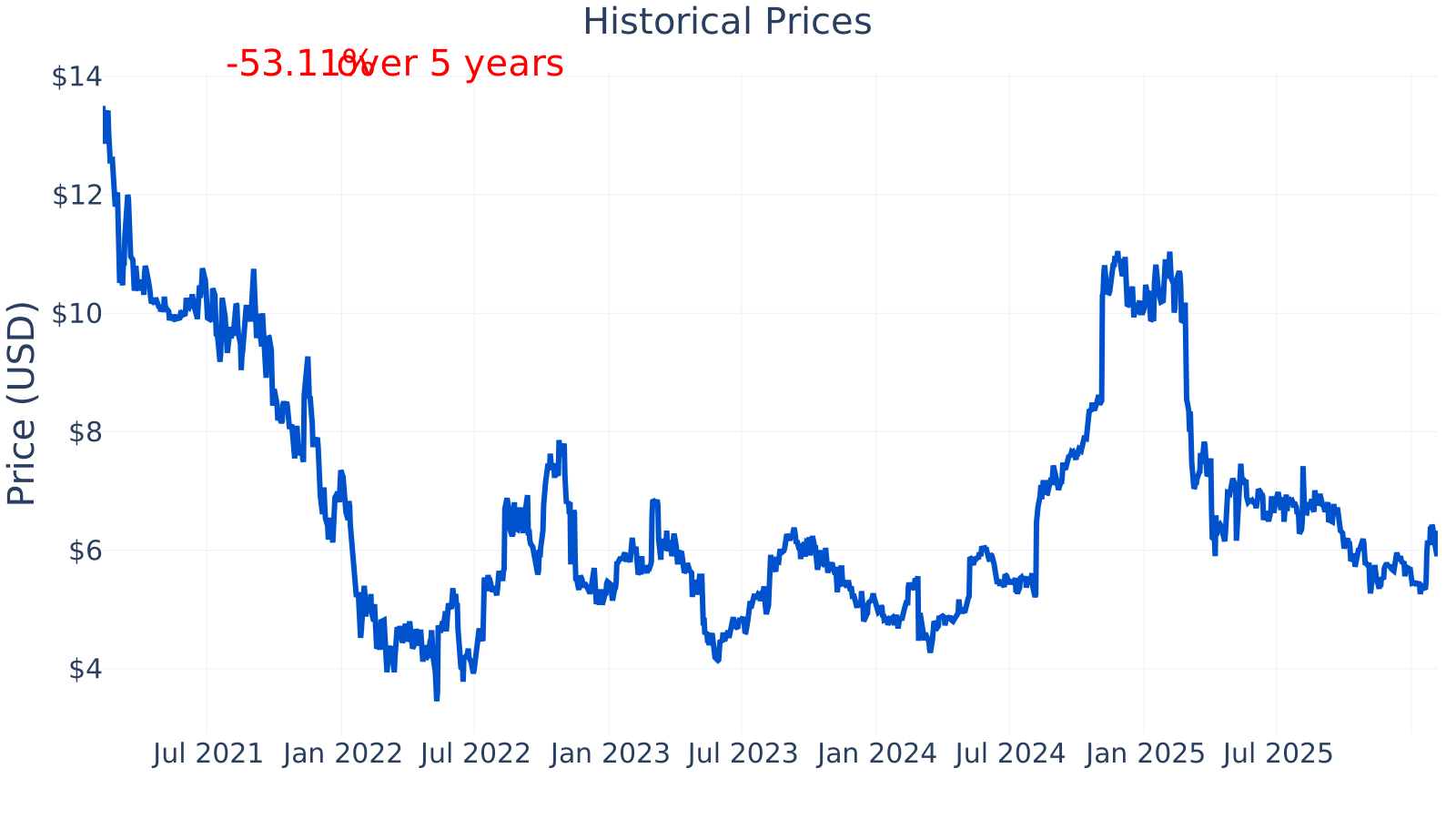
Payoneer’s market capitalization is about $2.28B, and its beta is about 1.04, which suggests price movements broadly in line with the overall market on average (though single stocks can still be volatile). The P/E ratio is about 35.2 versus an industry median near 25.7, meaning the stock is priced at a higher earnings multiple than the typical company in its listed industry group. Profit margin is about 7.0%, roughly in line with the industry median shown, while revenue growth year-over-year is about 47.0%, well above the industry median near 15.2%. Debt-to-equity is about 7.3% versus an industry median near 19.8%, indicating comparatively low balance-sheet leverage in this peer set. Trailing twelve-month free cash flow is about $166M, showing the business has recently been generating cash after operating needs and capital spending.
Growth (Medium)
Payoneer operates in a part of the financial technology ecosystem that benefits from long-term trends such as cross-border e-commerce, international outsourcing, digital services exports, and marketplace-driven trade. As more small businesses sell internationally and more work is performed across borders, the need for simple international payments, local receiving accounts, and compliant payout systems tends to increase.
Revenue growth has remained positive over the periods shown, but it has slowed from very high levels (often above 30–40% earlier in the series) toward high single digits more recently (around 8–9% in 2025 quarters shown). A deceleration like this can happen as a company becomes larger, as comparisons get tougher, or as certain revenue components (including those influenced by interest rates or specific customer segments) normalize. For long-term analysis, an important point is whether Payoneer can re-accelerate growth through new products, deeper penetration in existing customer groups, or expansion in regions and verticals, rather than relying on temporary tailwinds.
Free cash flow improved notably from negative levels in 2021 to positive and growing levels through 2024, with the most recent trailing twelve-month figure shown around $166M. Consistent cash generation can matter for a payments company because it can provide flexibility to invest in product development, compliance, and customer acquisition while maintaining financial resilience.
Potential catalysts discussed in company materials for businesses like Payoneer typically include expanding partnerships with marketplaces and platforms, increasing “share of wallet” with existing business customers (more services per customer), and continued product development in areas like receivables, payables, and multi-currency capabilities. The strength of these catalysts depends on execution and competitive positioning, which is addressed in the risk section.
Risks (High)
This article is for informational purposes only and does not constitute financial advice. Some content is AI-generated. See Disclaimer