Stock Analysis · Paylocity Holdng (PCTY)
Overview
Paylocity Holding (PCTY) is a cloud software company focused on payroll and human resources (HR) for mid-sized organizations. In simple terms, it provides an online system that helps employers pay employees, handle taxes, track time worked, manage benefits, and support other HR tasks like onboarding and performance workflows.
The business model is largely recurring: customers typically pay ongoing fees to access the platform and related services. Because payroll and HR are “must-run” functions, demand can be relatively steady—although new customer sign-ups and expansions can still be influenced by hiring conditions and the broader economy.
In its filings, Paylocity describes revenue as primarily coming from two broad categories, with recurring subscription-style fees being central to the model:
- Recurring platform and service fees (fees tied to using the software and processing payroll/HR services)
- Interest income on funds held for clients (interest earned while client payroll/tax funds are held prior to being remitted)
Over recent years, the company has shown a pattern of rising revenue and profitability in absolute dollars, with meaningful ongoing spending on product development and sales efforts.
Looking at how revenue turns into profit over time, total revenue increased substantially from fiscal 2021 to fiscal 2025 (from about $636M to about $1.595B). Over the same period, operating income also expanded (from about $58M to about $304M), suggesting the company has been scaling while still investing in areas like research and development.
Key Figures
| Metric | Value | Industry ⓘ |
|---|---|---|
| Date | Feb 08, 2026 | |
| Context | ||
| Sector | Technology | |
| Industry | Software - Application | |
| Market Cap ⓘ | $6.41B | |
| Beta ⓘ | 0.55 | |
| Fundamental | ||
| P/E Ratio ⓘ | 27.73 | 27.79 |
| Profit Margin ⓘ | 14.19% | 6.02% |
| Revenue Growth ⓘ | 28.20% | 15.80% |
| Debt to Equity ⓘ | 15.42% | 25.15% |
| PEG ⓘ | 1.23 | |
| Free Cash Flow ⓘ | $444.27M | |
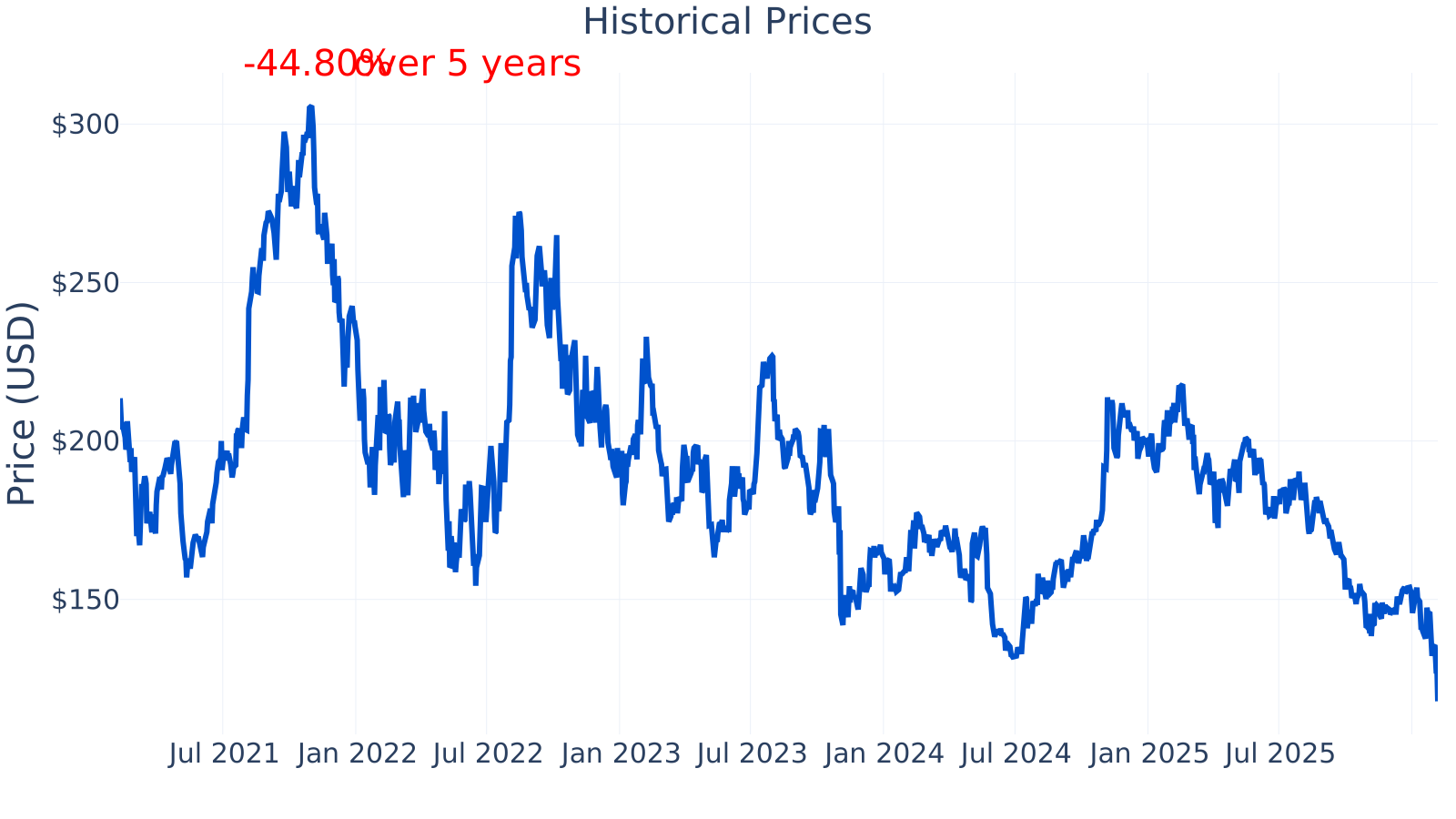
Paylocity’s market capitalization is about $6.4B, placing it in the mid-cap range. The stock’s beta (~0.55) indicates it has historically moved less than the broader market on average (though any single stock can still be volatile).
On profitability, the company’s profit margin is ~14.2%, which is notably above the industry median (~6.0%) shown here. Growth is also higher than the industry median in this snapshot: year-over-year revenue growth ~28.2% versus an industry median ~15.8%.
Balance-sheet leverage appears moderate in this view, with debt-to-equity ~15.4% compared with an industry median ~25.2%. Free cash flow over the trailing twelve months is approximately $444M, indicating the business has been generating cash after operating costs and capital spending.
Growth (medium)
Paylocity operates in the HR and payroll software market, which benefits from long-term digitization trends: employers continue to shift away from manual processes and legacy systems toward integrated cloud platforms. This trend is supported by the need for compliance, reporting, and secure handling of sensitive employee information—areas that often favor specialized software providers.
From a strategy standpoint, Paylocity positions itself as an integrated platform: payroll is often the “core” function, and additional modules (time tracking, benefits, talent/workforce tools) can be added over time. This kind of expansion within existing customers can matter for long-term growth because it can increase revenue per customer without relying only on signing up brand-new clients.
Revenue growth has been strong at points in the timeline (often above 30% earlier), but it also shows periods of slowing and even a negative quarter (around late 2024 in this series). That pattern is important: it suggests growth can be uneven, potentially reflecting customer hiring trends, implementation timing, or comparisons against stronger prior-year periods.
Free cash flow has risen over time in the periods shown (from roughly $73M in 2021 to roughly $381M by 2025 in this series). For a software company, sustained improvements in cash generation can be a meaningful signal that the model is scaling and that operating discipline is improving alongside growth.
Potential catalysts for future results typically include expanding product adoption among existing customers, continued customer wins in the mid-market, and interest-rate-related effects on interest income earned on client funds (which can help reported revenue and earnings when rates are higher, but can also reverse if rates fall).
Risks (medium)
A key business risk is competition. Payroll and HR software is a crowded category with well-known providers and a steady flow of new product features across the industry. Competitive pressure can show up as higher sales and marketing spending, pricing concessions, or slower customer additions.
Another risk is sensitivity to employment conditions. Payroll revenue is often linked to the number of employees paid and the overall activity level at customer organizations. If hiring slows or customers reduce headcount, that can affect growth rates. In addition, interest income tied to client funds can be influenced by interest rates, creating a tailwind in some environments and a headwind in others.
There are also execution and technology risks common to cloud platforms: the company must maintain high uptime, protect sensitive data, keep pace with changing tax and labor rules, and continue to update the product in ways that retain customers and attract new ones.
Debt-to-equity has generally been below the industry median for much of the period shown, though there is a noticeable spike around late 2024 before trending back down. Even with that temporary increase, the latest level shown is around 15%, which is lower than the industry median in the same snapshot, indicating comparatively modest leverage in this view.
Profit margin has been consistently positive and has generally improved over time, landing around 14% most recently in the series. The industry median shown is lower throughout, and in earlier periods it is even negative, highlighting that many peers in the broader application software group may be less profitable. That said, profitability can fluctuate with spending decisions (sales capacity, R&D investment) and competitive dynamics.
In terms of competitive positioning, Paylocity is a significant participant in the mid-market, but it is not the only scaled provider. Commonly cited competitors in company discussions and market context include ADP, Paychex, Paycom, Workday, and other HR/payroll software and service providers. Relative placement often depends on customer size focus, breadth of modules, service model, and ease of implementation; these factors can shift over time as vendors evolve their platforms.
Valuation
Valuation is often discussed using the price-to-earnings (P/E) ratio, which compares the stock price to company earnings. This is a simplified measure and should be read alongside growth and risk factors, especially for software businesses where profitability and growth can change meaningfully over time.
The latest P/E shown is about 27.7, close to the industry median (~27.8) in the same snapshot. Historically in this series, Paylocity’s P/E ratio appears to have been much higher earlier and then compressed over time, which can happen when earnings grow, the stock price falls, or both.
Interpreting whether the current valuation is “high” or “low” depends on context: the company shows higher-than-median profit margin and stronger growth than the median in the table, while also facing the usual competitive and macro sensitivities of payroll/HR software. The PEG ratio (~1.23) included in the table is one way investors sometimes relate valuation to growth; it suggests the valuation is not extreme relative to growth assumptions embedded in that metric, though it is only one lens and depends on forecast assumptions.
Conclusion
Paylocity operates a recurring, cloud-based payroll and HR platform aimed at mid-sized employers, a category supported by long-term digitization and compliance needs. The company has demonstrated sizable revenue expansion across recent fiscal years and rising cash generation, while maintaining profit margins above the broader industry median shown here.
At the same time, results can be influenced by hiring conditions, interest-rate effects on interest income, and strong competition from both specialized payroll providers and broader enterprise software platforms. The valuation snapshot presented shows a P/E ratio roughly in line with the industry median, meaning the market is not obviously pricing it far above or below peers on that single measure, despite above-median profitability in this view.
Sources:
- SEC EDGAR — Paylocity Holding, Inc. filings (Form 10-K, Form 10-Q)
- Paylocity Investor Relations — Annual Report materials and shareholder communications (company-hosted)
- Paylocity Investor Relations — Press releases (earnings releases, business updates)
This article is for informational purposes only and does not constitute financial advice. Some content is AI-generated. See Disclaimer


