Stock Analysis · Paychex Inc (PAYX)
Overview
Paychex Inc. is a provider of payroll and human resources (HR) services, primarily for small and mid-sized businesses. In simple terms, it helps employers pay workers correctly and on time, handle payroll taxes and filings, manage benefits (like health insurance), support retirement plans, and run other HR processes that companies need to stay compliant and organized.
The business model is largely recurring: many clients pay ongoing fees for payroll processing, HR support, and related software and services. Another important piece is interest income earned on funds Paychex holds temporarily while processing payroll and tax payments (“float”), which can rise or fall depending on interest rates and the volume of client funds processed.
Main revenue sources are typically grouped as follows in Paychex reporting:
- Management Solutions (payroll services, HR administration, benefits-related services, HR outsourcing/PEO, time and attendance, and related offerings)
- Retirement Solutions (recordkeeping and administrative services for retirement plans)
- Interest on funds held for clients (income tied to interest rates and the level of client funds processed)
Over the last several fiscal years, revenue and operating income have generally trended upward. Costs of delivering services grew more slowly than revenue, which supported solid gross profit dollars, while operating expenses (like sales and administrative costs) increased but did not prevent operating income from expanding overall.
Across fiscal years shown, total revenue rises from about $4.06B (FY2021) to about $5.57B (FY2025). Operating income also increases overall (about $1.46B to about $2.28B), while interest expense becomes noticeably larger in the most recent year shown, which is consistent with a higher debt load and/or higher interest rates.
Key Figures
| Metric | Value | Industry ⓘ |
|---|---|---|
| Date | Mar 30, 2026 | |
| Context | ||
| Sector | Technology | |
| Industry | Software - Application | |
| Market Cap ⓘ | $32.85B | |
| Beta ⓘ | 0.89 | |
| Fundamental | ||
| P/E Ratio ⓘ | 20.24 | 24.50 |
| Profit Margin ⓘ | 25.84% | 7.69% |
| Revenue Growth ⓘ | 19.90% | 16.65% |
| Debt to Equity ⓘ | 124.91% | 27.07% |
| PEG ⓘ | 1.76 | |
| Free Cash Flow ⓘ | $2.15B | |
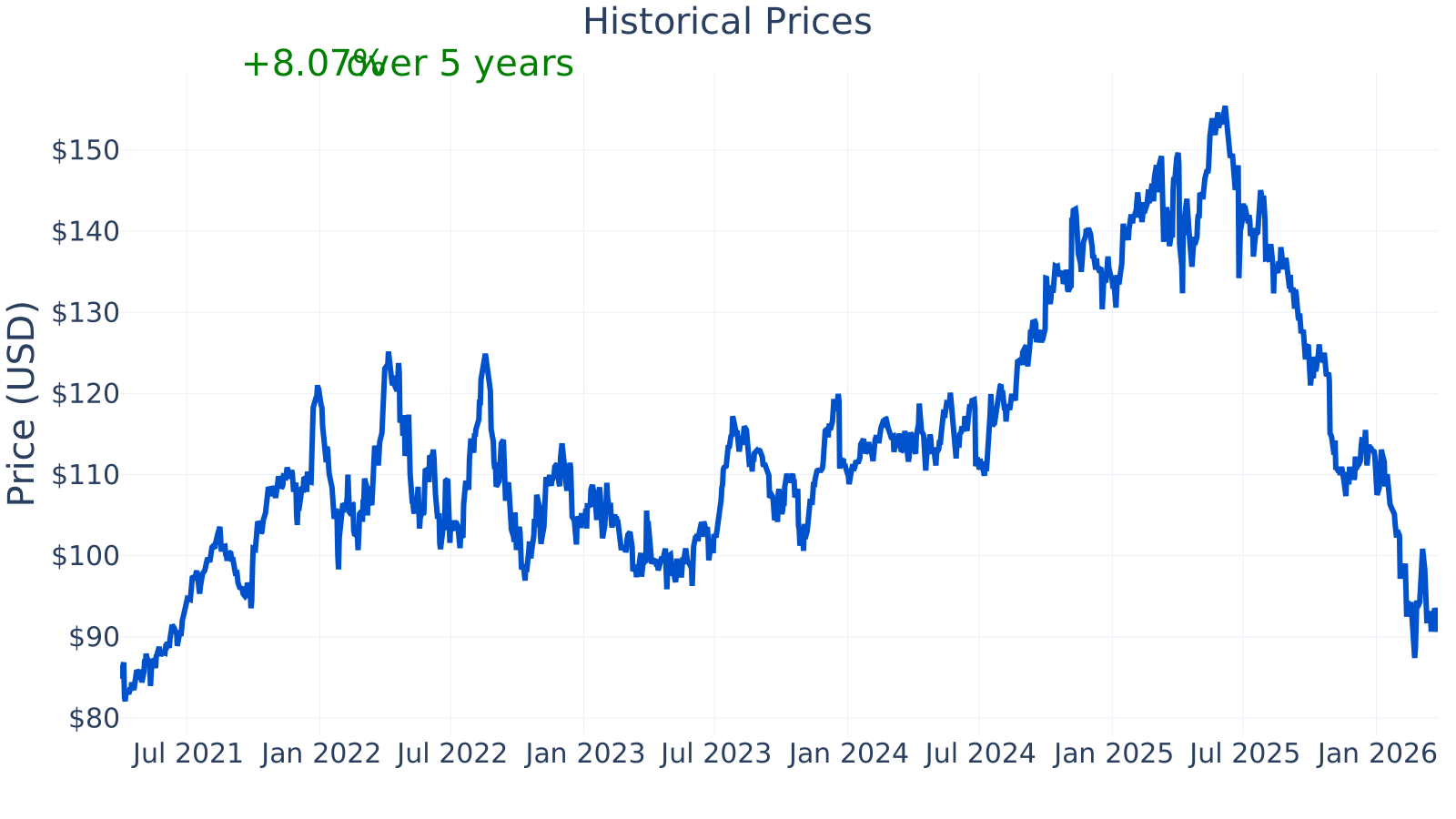
Paychex’s market capitalization is about $32.8B, and the stock has a beta of ~0.89, which indicates it has historically moved somewhat less than the broader market. On profitability, the latest net profit margin shown is about 25.84%, which is well above the industry median shown (about 7.69%). Recent year-over-year revenue growth is about 19.90%, slightly above the industry median shown (about 16.65%). Free cash flow over the trailing twelve months is about $2.15B, highlighting meaningful cash generation.
Growth (Medium)
Payroll and HR administration tend to be durable needs: employers must run payroll, handle taxes, and comply with regulations regardless of the economic cycle. Over time, the industry benefits from continued outsourcing by small and mid-sized businesses that prefer using specialized providers rather than building in-house systems. Another long-term tailwind is the increasing complexity of benefits, multi-state workforces, and compliance requirements, which can encourage adoption of more comprehensive HR solutions.
Strategically, Paychex emphasizes expanding its service mix beyond basic payroll into broader HR offerings (such as HR outsourcing/PEO and benefits administration) and retirement services. This approach can support growth by increasing revenue per client and making the service relationship “stickier” (harder to replace), because more business processes run through the same provider.
Revenue growth slowed into the mid-single digits during parts of 2023–2024 (as shown), then re-accelerated more recently, reaching roughly 19.9% in the latest period. This pattern suggests growth can vary with the economic backdrop and product mix, but also that stronger momentum is possible when conditions and pricing/volume trends are favorable.
Free cash flow has been consistently positive in the periods shown, rising from roughly $1.43B (FY2022 trailing period shown) to about $2.15B most recently, despite a dip around FY2025 in the series. For a service-and-software-oriented company, steady cash generation can be important because it helps fund operations, dividends, debt repayment, and acquisitions without relying as heavily on external financing.
Risks (Medium)
A key operational risk is sensitivity to employment levels and small-business formation: fewer employees on client payrolls, lower client retention, or slower new client additions can affect processing volumes and related service fees. In addition, part of Paychex’s earnings can be influenced by interest rates through interest earned on client funds held; falling rates can reduce that contribution, while rising rates can support it (with timing and reinvestment dynamics).
Competition is also a meaningful risk. The market includes large, well-known providers with significant resources. Major competitors commonly cited in the payroll/HR services space include Automatic Data Processing (ADP), Workday (more enterprise-focused), and a range of other HR and payroll software and services firms, including providers focused on small businesses and HR outsourcing. Paychex is generally viewed as a leading provider in the small-to-mid-market segment, where scale, distribution, compliance capabilities, and service quality can create advantages. Still, pricing pressure, product innovation from competitors, and switching incentives (such as promotions or integrated platforms) can affect growth and margins over time.
Another notable risk is balance-sheet leverage and interest costs. Debt can be manageable when cash flows are stable, but higher leverage can reduce flexibility if business conditions weaken.
The debt-to-equity ratio was relatively low and trending down from 2021 through early 2025 (roughly in the 20%–30% range), then it jumps sharply to around 125% in the latest reading. This is far above the industry median shown (about 27%–35% recently). The jump suggests a material change in capital structure (for example, increased borrowing and/or changes in equity), which makes monitoring interest expense and debt maturities more important.
Profitability is a core strength, but it can still move with pricing, wage inflation, sales and marketing intensity, and client mix.
Net profit margin remains high by industry standards, but it has eased from around 32% in 2024 to about 25.8% most recently. Even after this decline, the margin shown remains above the industry median in the same chart, indicating comparatively strong profitability, though recent compression is something to watch.
Valuation
One simple way investors often contextualize valuation is the price-to-earnings (P/E) ratio, which compares the stock price to earnings. This measure is best interpreted alongside business stability, growth rate, margins, and risk profile.
The chart shows Paychex’s P/E spending most of the time in roughly the mid-20s to low-30s since 2021, with the latest point near the mid-20s. The latest P/E in the table is about 20.24, which is below the industry median of ~24.5 shown there, and also below many of the company’s own higher readings earlier in the period. At the same time, Paychex’s high margins and recurring revenue characteristics can sometimes lead the market to assign higher multiples than more cyclical or lower-margin companies. The recent increase in leverage (and higher interest expense visible in the income flow) can be a counterweight, because higher debt can raise risk and reduce financial flexibility.
Overall, the valuation picture here is “mixed but explainable”: profitability is strong versus peers, recent revenue growth has improved, and cash generation is sizable, while the balance-sheet shift and margin compression are factors that can influence how much investors are willing to pay for each dollar of earnings.
Conclusion
Paychex is a scaled provider of payroll and HR services with a business model built around recurring client relationships. The company has shown rising revenue and operating income over multiple years, generates substantial free cash flow, and maintains profit margins that are well above the industry median shown, even after a recent step-down.
The main items that shape the long-term profile are the durability of payroll/HR demand, Paychex’s ability to deepen client relationships through broader HR and benefits offerings, and the external backdrop (employment trends and interest rates). The most notable risk signal in the figures shown is the sharp rise in debt-to-equity to about 125%, paired with higher interest expense in the latest year presented, which increases the importance of monitoring leverage and margin stability going forward.
In valuation terms, the current P/E shown is lower than the industry median and below many of the company’s own readings over the past few years, while business fundamentals reflect a combination of strong profitability and improved recent growth, offset by higher leverage and some margin pressure.
Sources:
- SEC EDGAR — Paychex Inc. Form 10-K (Annual Report)
- SEC EDGAR — Paychex Inc. Form 10-Q (Quarterly Report)
- Paychex Investor Relations — Annual Reports & SEC Filings
- Paychex Investor Relations — Press Releases (Earnings Releases)
- Wikipedia — “Paychex” (company overview and history)
This article is for informational purposes only and does not constitute financial advice. Some content is AI-generated. See Disclaimer