Stock Analysis · Patrick Industries Inc (PATK)
Overview
Patrick Industries, Inc. (PATK) is a manufacturer and distributor of building products and components used mainly in recreational vehicles (RVs), as well as in manufactured housing and various “industrial” end markets. In simple terms, it supplies many of the parts that go into an RV or similar living/transport products—such as interior and exterior components and other materials—selling largely to original equipment manufacturers (OEMs) and, to a smaller extent, aftermarket channels.
The company’s revenue is typically discussed by end market in its annual reporting. Based on that framing, its main revenue drivers are generally:
- Recreational Vehicles (RV) (historically the largest contributor)
- Manufactured Housing (MH)
- Industrial and other markets (a mix of adjacent, non-RV end uses)
Exact percentages can shift from year to year with RV production cycles and acquisitions; the company’s annual report provides the most current split by end market.
Looking at the multi-year income flow, revenue has been volatile across the cycle (notably falling after the 2022 peak), while operating income and net income declined meaningfully versus the high point in 2022. Interest expense also increased over time, which matters because it can reduce net income even when gross profit holds up.
Key Figures
| Metric | Value | Industry ⓘ |
|---|---|---|
| Date | Apr 27, 2026 | |
| Context | ||
| Sector | Consumer Cyclical | |
| Industry | Recreational Vehicles | |
| Market Cap ⓘ | $3.23B | |
| Beta ⓘ | 1.34 | |
| Fundamental | ||
| P/E Ratio ⓘ | 24.89 | 16.19 |
| Profit Margin ⓘ | 3.42% | 3.22% |
| Revenue Growth ⓘ | 9.20% | 9.10% |
| Debt to Equity ⓘ | 138.63% | 117.93% |
| PEG ⓘ | 3.46 | |
| Free Cash Flow ⓘ | $246.49M | |
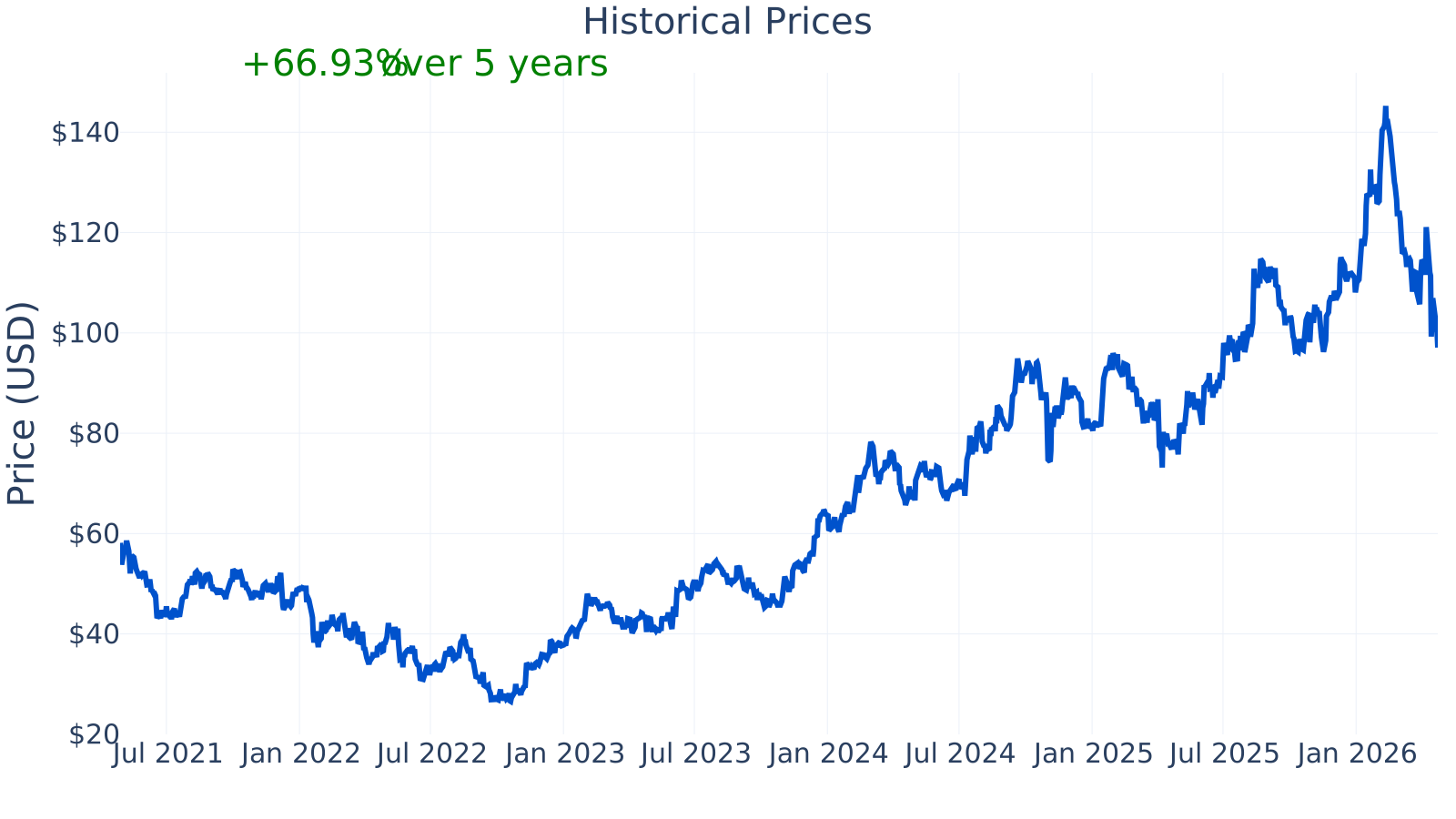
Patrick Industries’ market capitalization is about $3.23B, and its beta (~1.34) suggests the stock has tended to move more than the broader market. The company’s latest P/E ratio (~24.9) is above the industry median (~16.2). Profit margin is about 3.42%, slightly above the industry median (~3.22%). Year-over-year revenue growth is about 9.2%, roughly in line with the industry median (~9.1%). Leverage is elevated: debt-to-equity ~139% versus an industry median near 118%. Trailing twelve-month free cash flow is about $246.5M. The PEG ratio (~3.46) is one indicator that the current earnings multiple is high relative to commonly used growth expectations (PEG interpretations vary and depend heavily on the growth inputs used).
Growth (Medium)
Patrick operates in markets that are economically sensitive. RV demand, in particular, tends to be cyclical—often rising when consumer confidence is strong and financing is accessible, and falling when interest rates rise or consumers pull back on big-ticket purchases. Manufactured housing and certain industrial end markets can provide some diversification, but RV trends have historically been a major swing factor for the company’s overall results.
A key part of Patrick’s long-term strategy has been broadening its product portfolio and expanding into adjacent markets, often through acquisitions, while also growing content per unit (supplying more components per RV or unit produced). The basic logic is that a wider set of products and end markets can reduce reliance on any single category over time, even if RV remains a meaningful driver.
The year-over-year revenue trend highlights the cyclicality: very strong growth earlier in the period, then a notable contraction during the industry downturn, followed by a return to positive growth more recently (latest reading around 9%).
Free cash flow has remained positive across the period shown, peaking above $390M (TTM) and later moderating to roughly $246M. For a component supplier in cyclical end markets, sustained positive free cash flow can be important because it supports debt service, reinvestment, and flexibility through weaker demand periods.
Risks (High)
The largest risk factor is end-market cyclicality, especially RVs. Changes in interest rates, lending standards, dealer inventory levels, and consumer demand can quickly affect OEM production volumes, which can flow through to Patrick’s sales and profitability. Because RVs are discretionary purchases, downturns can be sharp.
Leverage is another key consideration. Debt-to-equity has generally trended down from very high levels earlier in the period but remains elevated (most recently about 139%), and above the industry median. Higher leverage can increase sensitivity to interest rates and reduce flexibility during weaker cycles, particularly if profitability or cash generation declines.
Profit margins have compressed from higher levels earlier in the period (mid-to-high single digits) to the low single digits more recently (around 3–4%). While the latest margin is slightly above the industry median, the overall decline suggests the business has faced a tougher pricing/cost environment and/or less favorable volume/mix than during peak demand years.
On competitive positioning, Patrick’s scale and broad product offering can be advantages: large OEM customers often value suppliers that can deliver consistently across multiple plants and provide a wide range of components. However, many of Patrick’s products can face competition from other component and material suppliers, and OEMs may dual-source to manage costs and supply-chain risk. Competitive advantage here tends to come from relationships, breadth of catalog, operational execution, and the ability to integrate acquisitions rather than from a single protected product.
Main competitors vary by product line (components and building products) and by end market, and competition can include both specialized component manufacturers and broader building-product suppliers. In practice, Patrick competes on a combination of cost, reliability, quality, service levels, and how much content it can provide per unit for large OEM customers.
Valuation
The P/E ratio has risen substantially from the very low levels seen during the weaker part of the cycle (when the stock price and/or earnings expectations were depressed) to a much higher multiple more recently. The latest P/E (about 24.9) is above the industry median (about 16.2), indicating the market is currently assigning a higher earnings multiple than peers in the same broad industry group.
Whether that higher multiple is “justified” depends on factors that can change over time: expectations for a sustained demand recovery in RVs, the company’s ability to grow in manufactured housing and industrial markets, margin resilience, and how leverage and interest expense evolve. The combination of (1) cyclicality, (2) still-elevated leverage, and (3) currently higher-than-industry earnings multiple means the valuation can be more sensitive to changes in growth and profitability expectations.
Conclusion
Patrick Industries is a components supplier with meaningful exposure to the RV market and added diversification through manufactured housing and industrial end markets. The business shows the hallmarks of a cyclical company: revenue and earnings can expand rapidly during strong demand periods and contract when OEM production slows. Recent results show a return to positive revenue growth and continued positive free cash flow, while profitability has been lower than peak-cycle levels and leverage remains relatively high.
From a long-term ownership perspective, the key facts to weigh are the company’s ability to navigate RV cycles, maintain cash generation across downturns, and execute on diversification while managing debt and interest costs. The current valuation metrics show a higher earnings multiple than the industry median, which increases the importance of sustained improvement in margins and/or growth to support that pricing over time.
Sources:
- SEC EDGAR — Patrick Industries, Inc. Form 10-K (Annual Report) (most recent filing)
- SEC EDGAR — Patrick Industries, Inc. Form 10-Q (Quarterly Reports) (most recent filings)
- Patrick Industries, Inc. — Investor Relations materials and press releases (company-hosted)
- Wikipedia — “Patrick Industries” (basic company background)
This article is for informational purposes only and does not constitute financial advice. Some content is AI-generated. See Disclaimer