Stock Analysis · Parsons Corp (PSN)
Overview
Parsons Corporation (PSN) is a services company that helps government and commercial customers plan, build, and operate complex projects. Its work is centered on national security and critical infrastructure—areas where customers often sign multi-year contracts and where technical capabilities, safety requirements, and compliance rules matter.
In simple terms, Parsons earns money by providing professional services (engineering, program management, digital solutions, and related support) tied to long-duration customer needs such as defense, intelligence, and infrastructure modernization. A large share of its activity is tied to government budgets and procurement processes, which can make the business more stable than purely discretionary consumer-driven demand, but also more dependent on contract timing and policy priorities.
Main revenue sources are generally organized around long-term contract work across government and infrastructure end-markets. Percentages by revenue stream are typically disclosed in annual filings by segment and/or customer mix; those details should be taken from the company’s latest Form 10-K for the most precise split.
From 2021 through 2024, revenue expanded materially (from about $3.66B to about $6.75B), while gross profit also rose (from about $0.85B to about $1.41B). Over the same period, operating income increased (from about $130M to about $419M), suggesting that growth was accompanied by improved operating profit in those years.
Key Figures
| Metric | Value | Industry ⓘ |
|---|---|---|
| Date | Feb 16, 2026 | |
| Context | ||
| Sector | Technology | |
| Industry | Information Technology Services | |
| Market Cap ⓘ | $6.77B | |
| Beta ⓘ | 0.67 | |
| Fundamental | ||
| P/E Ratio ⓘ | 29.21 | 19.24 |
| Profit Margin ⓘ | 3.79% | 4.91% |
| Revenue Growth ⓘ | -7.50% | 5.85% |
| Debt to Equity ⓘ | 52.13% | 58.47% |
| PEG ⓘ | N/A | |
| Free Cash Flow ⓘ | $382.83M | |
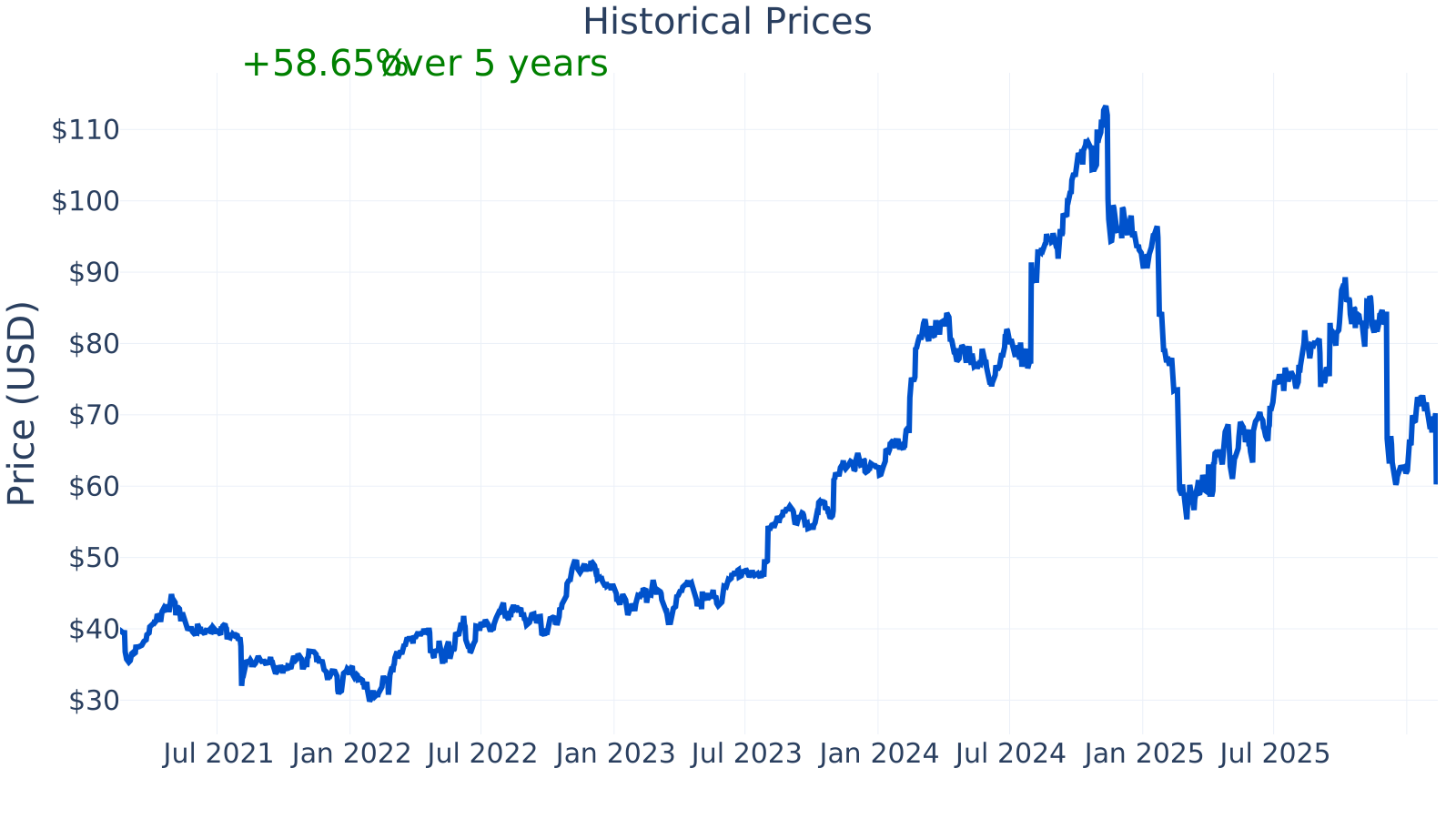
Parsons’ market capitalization is about $6.77B and the stock’s beta is about 0.67, which indicates the shares have historically moved less than the overall market. The company’s P/E ratio is ~29.2, above the industry median of ~19.2, meaning the market is pricing PSN at a higher multiple than many peers in its industry group. Profitability (net profit margin) is about 3.79%, below the industry median of ~4.91%. Recent year-over-year revenue growth is about -7.5%, versus an industry median of ~5.85%. Leverage (debt-to-equity) is about 52%, slightly below the industry median of ~58%. Trailing twelve-month free cash flow is about $382.8M.
Growth (medium)
Parsons operates in markets that are often supported by multi-year priorities: government modernization (including digital capabilities and cybersecurity) and investment in critical infrastructure. These areas tend to be less dependent on short consumer cycles and more linked to public budgets and regulated infrastructure needs. That said, growth can be uneven from year to year due to contract awards, project timing, and the pace at which work is authorized and funded.
The year-over-year revenue growth trend shows a strong period of expansion through 2022–2024, followed by a marked slowdown and then negative readings in 2025 (ending at roughly -7.5%). For long-term business assessment, this type of pattern typically raises two practical questions: whether the prior growth period included one-time step-ups (for example, large contract ramps) and whether the current softness reflects timing (delays, award cadence) versus a lasting loss of demand. Those answers are usually discussed in management’s annual report narrative and segment disclosures.
Free cash flow has been meaningful over time, with trailing twelve-month figures ranging from roughly $220M–$522M in the periods shown, and most recently around $383M. For a services-and-contracting model, cash generation is important because it can support reinvestment, acquisitions, and debt management, and it can help the company navigate years when contract timing makes reported growth look weaker.
Risks (medium)
Parsons’ results are exposed to government contracting dynamics. Budget changes, procurement delays, protests, continuing resolutions, and shifts in program priorities can affect the timing of awards and the pace of revenue recognition. Contract performance risk is also important: cost overruns, schedule issues, or compliance failures can reduce profitability, lead to disputes, or harm the company’s ability to win future work.
Debt-to-equity has generally been in a moderate range (recently about 52%) and often below the industry median in the periods shown. It did rise meaningfully around 2024 compared with earlier levels, which can matter because higher leverage can reduce flexibility if business conditions weaken or if interest costs rise.
Profit margin has been volatile over the time period shown: it was very low during parts of 2024 before improving sharply in 2025 (ending near 4.72%, close to the industry median of ~4.74%). For long-term evaluation, the key issue is whether margins can be maintained at healthier levels as the company competes for new work—government and large infrastructure contracting can be price-competitive, and execution quality often determines whether a project is meaningfully profitable.
Competition is a persistent factor. Parsons competes with other large government services and engineering firms for prime contracts and subcontracting roles. Competitive positioning typically depends on past performance ratings, security clearances, customer relationships, specialized technical skills, and the ability to staff and deliver at scale. In many federal markets, leadership tends to be contract- and program-specific rather than a single company dominating every category, so relative strength can vary by agency, mission area, and contract vehicle.
Valuation
PSN’s current P/E ratio is about 29.2, compared with an industry median of about 19.2. Historically, the company’s P/E has moved significantly over time, and by late 2025 it appeared closer to the low-to-mid 20s on the chart. A higher-than-median P/E commonly indicates the market expects stronger future earnings performance, more durable growth, improving margins, or lower perceived risk than the typical peer. If earnings growth slows or margins come under pressure, higher multiples can be harder to sustain; conversely, if growth re-accelerates and profitability holds up, the premium multiple can appear more consistent with the operating profile.
Because Parsons’ recent revenue growth turned negative while profitability metrics improved, a key valuation consideration is whether earnings and cash flow improvements are expected to persist even without top-line expansion. That relationship—growth, margins, and cash generation—tends to drive how much investors are willing to pay per dollar of earnings over time.
Conclusion
Parsons is a contract-driven services company focused on government-related missions and critical infrastructure, with multi-year demand drivers and historically meaningful free cash flow. From 2021 to 2024, the company scaled revenue substantially and increased operating income, but the more recent period shows a slowdown and negative year-over-year revenue growth.
The main long-term issues to track are (1) whether revenue returns to steady growth as contract timing normalizes, (2) whether improved profit margins can be sustained through competitive bidding and project execution, and (3) how effectively the company manages the risks of government procurement cycles and contract performance. On valuation, the current P/E is above the industry median, which implies higher expectations than the typical peer and makes future execution and earnings consistency especially important to monitor.
Sources:
- U.S. SEC EDGAR — Parsons Corporation filings (Form 10-K, Form 10-Q)
- Parsons Corporation Investor Relations — SEC filings and investor materials (company-hosted)
- Wikipedia — “Parsons Corporation” (basic company background)
This article is for informational purposes only and does not constitute financial advice. Some content is AI-generated. See Disclaimer