Stock Analysis · Papa John's International Inc (PZZA)
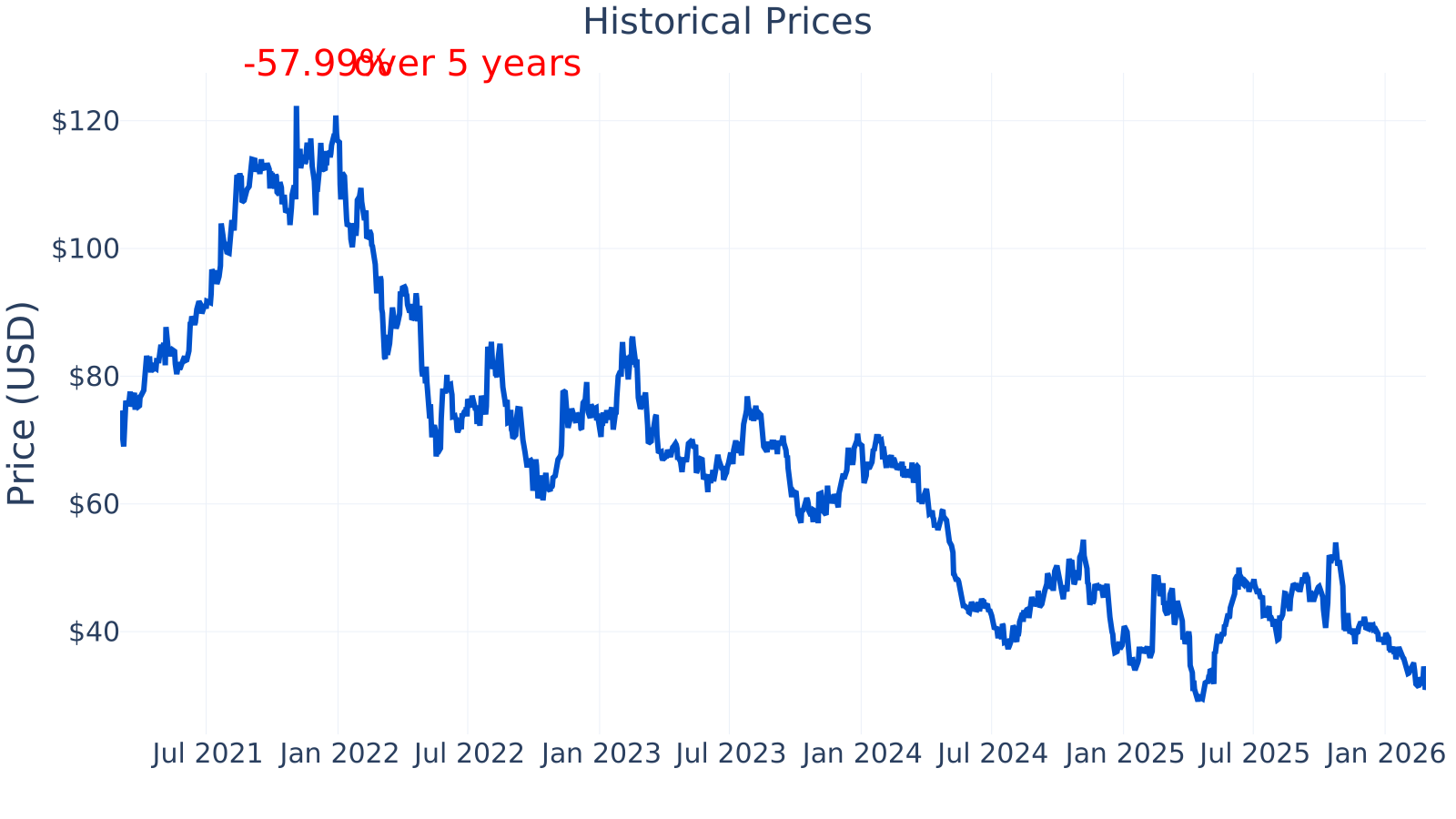
Overview
Papa John’s International, Inc. operates and franchises pizza restaurants under the Papa Johns brand. The business is built around a large franchise system (independently owned restaurants) supported by a smaller base of company-owned restaurants. In addition to selling pizzas and other menu items, the company provides brand marketing, digital ordering capabilities, and supply chain services that help franchisees run their local stores.
In practice, Papa John’s revenue is generally driven by a mix of (1) products sold through its supply chain network to restaurants, (2) royalties and fees paid by franchisees for the right to operate under the brand, and (3) sales from company-owned restaurants. The exact split and definitions can vary by reporting period, but the typical ordering from largest to smallest is:
- Supply chain / commissary sales to restaurants (often the largest component)
- Franchise royalties and fees (higher-margin revenue tied to franchise sales)
- Company-owned restaurant sales (direct restaurant revenue)
The company’s economics are influenced not only by how many pizzas are sold, but also by commodity costs (cheese, meats, grains), labor costs, restaurant traffic, delivery and carryout mix, and the pace of new restaurant openings/closures across its system.
Over the years shown, total revenue is relatively steady around the ~$2.05–$2.14B range, while profitability appears more variable. Operating income drops notably in 2025 versus 2024, alongside higher operating expenses, which helps explain why net income is lower despite similar revenue.
Key Figures
| Metric | Value | Industry ⓘ |
|---|---|---|
| Date | Mar 02, 2026 | |
| Context | ||
| Sector | Consumer Cyclical | |
| Industry | Restaurants | |
| Market Cap ⓘ | $1.03B | |
| Beta ⓘ | 1.21 | |
| Fundamental | ||
| P/E Ratio ⓘ | 27.50 | 27.73 |
| Profit Margin ⓘ | 1.49% | 7.24% |
| Revenue Growth ⓘ | -6.10% | 7.35% |
| Debt to Equity ⓘ | -52.22% | 99.20% |
| PEG ⓘ | 1.91 | |
| Free Cash Flow ⓘ | $61.30M | |
Papa John’s has a market capitalization of about $1.03B and a beta of ~1.21, which means the stock has historically moved somewhat more than the broader market. The current P/E ratio is ~27.5, close to the restaurant industry median (~27.7) in the provided peer set.
Two operating signals stand out versus the industry median: profit margin is ~1.49% (industry median ~7.24%), and year-over-year revenue growth is ~-6.1% (industry median ~7.35%). Free cash flow over the trailing twelve months is about $61.3M. The reported debt-to-equity is negative, which commonly occurs when accounting equity is negative (often linked to leveraged capital structures and share repurchases), making simple debt-to-equity comparisons less intuitive than they are for companies with positive equity.
Growth (Medium)
Pizza is a mature category within restaurants, but it benefits from long-running consumer habits and a strong off-premise mix (delivery and carryout), where digital ordering and loyalty programs can influence frequency and customer retention. That said, mature categories usually depend more on execution (store operations, marketing, value positioning, and unit growth) than on rapid industry expansion.
For Papa John’s, long-term growth typically depends on a few measurable levers: expanding the number of restaurants (especially internationally), improving same-store sales trends, strengthening franchisee economics (so franchise partners are willing and able to open more locations), and keeping the brand relevant in a highly promotional market.
The year-over-year revenue pattern is uneven. It shows strong growth in 2021, then a slowdown and periods of contraction, including a recent reading of roughly -6.1%. This type of path often indicates a tougher operating backdrop (competition, value promotions, and/or demand normalization) rather than a consistent expansion phase.
Free cash flow remains positive in each period shown but fluctuates meaningfully—from about $179M (2021) down to the $46–$93M range in later years, with roughly $54M shown in 2025 (March) and about $61M on the latest trailing basis. For long-term business flexibility, stable and growing free cash flow is usually preferable, so variability is something to monitor alongside underlying restaurant sales trends.
Potential catalysts in this type of business are usually operational rather than “one-time”: better value/marketing, product innovation, delivery partnerships, improved speed and consistency in stores, and steadier franchise development. These factors can lift sales and, importantly, improve margins if cost pressures ease.
Risks (High)
The restaurant industry is competitive and sensitive to consumer spending, promotions, and cost inflation. Pizza brands also face direct price comparison because customers can easily switch between competitors based on deals, convenience, and perceived quality. When the sector becomes heavily promotional, it can pressure margins even if sales volumes hold up.
Profitability has been relatively low versus the industry median for an extended period in the series shown. The latest profit margin is about 3.15% (and the latest-metrics snapshot shows ~1.49%), while the industry median sits closer to ~6.9%–8.1% across much of the timeline. Lower margins leave less room for error if commodity, wage, or advertising costs rise, and they can limit how much the company can invest without affecting earnings.
The debt-to-equity ratio is negative for most of the period shown, ending around -52% on the latest point. Negative debt-to-equity often reflects negative shareholders’ equity rather than “no debt,” and it can happen after years of leverage and share repurchases. This does not automatically imply distress, but it does make the balance sheet more sensitive to earnings downturns, interest rates, and refinancing conditions than it would be with a large positive equity base.
Competition is another key risk. Papa John’s competes with other large global pizza chains (such as Domino’s and Pizza Hut) as well as thousands of regional pizza operators and local independent restaurants. In many markets, the largest players benefit from scale in advertising, technology, and supply chain purchasing. Papa John’s is a major brand, but it is not the clear category leader by store count or sales in many geographies, which can make share gains harder and promotions more intense.
Despite these challenges, the company does have recognizable brand equity and a franchised model that can scale with less capital than a fully company-owned restaurant chain. The main question is whether that brand strength translates into consistently competitive franchisee economics and stable margins over time.
Valuation
On a price-to-earnings basis, Papa John’s currently trades at around 27.5x, which is very close to the industry median (~27.7x) in the peer set provided. Historically in the period shown, the company’s P/E has varied widely (often in the teens to 30s+), sometimes above and sometimes below the industry median. The latest point shown (late 2025) indicates a higher P/E than some earlier points in 2024–2025, which can happen when either the stock price rises, earnings fall, or both.
Because the P/E ratio is closely tied to earnings, it can be less informative when margins are under pressure or when profitability is volatile. In that context, readers often pair P/E with operating signals like revenue direction, margin trends, and cash generation. Here, the valuation multiple looks broadly in line with the peer median, while recent revenue growth is negative and margins are below the median—an important combination to track in future filings.
Conclusion
Papa John’s is a globally known pizza chain built on a franchise-heavy model supported by supply chain operations. The business appears to produce positive free cash flow, but recent years show uneven revenue growth and profitability that is meaningfully below the median level seen in the broader restaurant peer set provided. The stock’s valuation (by P/E) is roughly in line with the industry median, suggesting the market multiple is not an outlier versus peers, even as operating performance indicators look challenged.
From a long-term, fundamentals-focused perspective, the key items that typically determine outcomes for a company like this are: whether same-store sales stabilize and improve, whether margins recover toward more typical industry levels, and whether the franchise system can expand profitably without relying on heavy discounting. Future SEC filings are the primary place to verify progress on these points, including segment results, franchisee health indicators, and balance sheet disclosures.
Sources:
- U.S. SEC EDGAR — Papa John’s International, Inc. filings (Form 10-K, Form 10-Q)
- Papa John’s International, Inc. — Investor Relations materials (annual report content and press releases, where available)
- Wikipedia — “Papa John’s” (basic company background)
This article is for informational purposes only and does not constitute financial advice. Some content is AI-generated. See Disclaimer


