Stock Analysis · Palo Alto Networks Inc (PANW)
Overview
Palo Alto Networks, Inc. (PANW) is a cybersecurity company. In simple terms, it helps organizations protect their computer networks, cloud services, and employees’ devices from cyberattacks. Its products are used by enterprises, governments, and other large organizations that need to prevent threats, detect suspicious activity, and respond quickly when something goes wrong.
The company’s offering is commonly described as a “platform” approach: instead of using many separate security tools from different vendors, customers can consolidate more of their security needs with Palo Alto Networks across three main areas—network security, cloud security, and security operations (tools that help monitor and respond to threats).
Palo Alto Networks reports revenue mainly through two broad categories in its financial filings:
- Subscriptions and support (typically the largest share): recurring revenue tied to security software, cloud-delivered services, and ongoing support.
- Product: primarily hardware and related components (such as network security appliances), plus associated licenses depending on how a deal is structured.
Over time, the business mix has generally shifted toward more recurring subscriptions and support, which can make revenue more predictable compared to one-time product sales.
From FY2021 to FY2025, total revenue increased from about $4.26B to about $9.22B. Over the same period, the company moved from operating losses (FY2021–FY2022) to operating profits (FY2023–FY2025). Research and development spending also rose (about $1.14B in FY2021 to about $1.98B in FY2025), reflecting continued investment in product development.
Key Figures
| Metric | Value | Industry ⓘ |
|---|---|---|
| Date | Feb 07, 2026 | |
| Context | ||
| Sector | Technology | |
| Industry | Software - Infrastructure | |
| Market Cap ⓘ | $108.97B | |
| Beta ⓘ | 0.75 | |
| Fundamental | ||
| P/E Ratio ⓘ | 100.84 | 25.66 |
| Profit Margin ⓘ | 11.69% | 6.68% |
| Revenue Growth ⓘ | 15.70% | 15.20% |
| Debt to Equity ⓘ | 3.99% | 19.82% |
| PEG ⓘ | 1.36 | |
| Free Cash Flow ⓘ | $3.94B | |
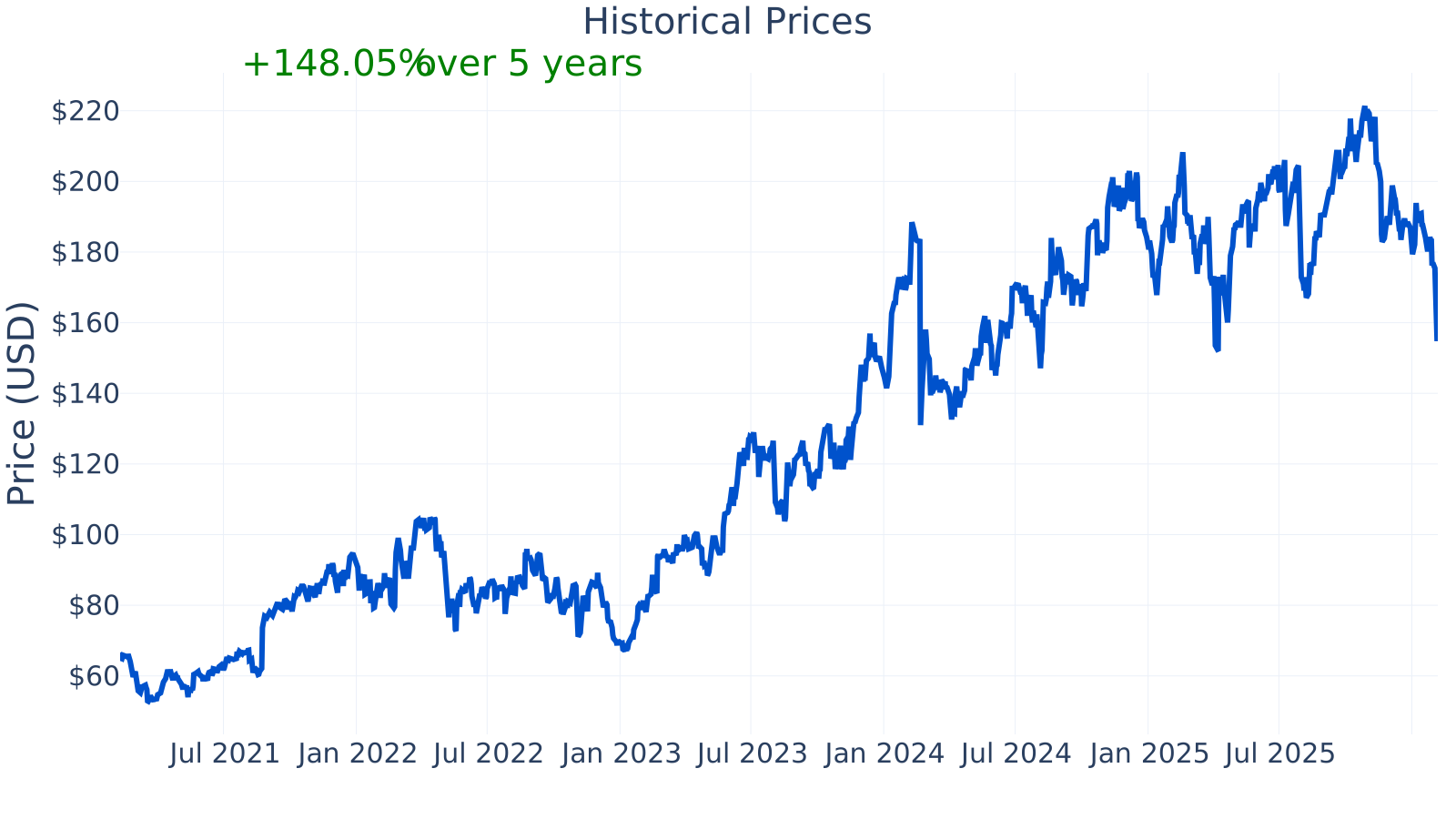
Palo Alto Networks’ market capitalization is about $109B, placing it among the larger publicly traded cybersecurity-focused companies. The stock’s beta of ~0.75 indicates that, historically, its price has tended to move less than the broader market on average (though individual periods can differ significantly).
Profitability and growth appear above the industry median in this peer set: profit margin ~11.7% versus an industry median of ~6.7%, and year-over-year revenue growth ~15.7% versus a median of ~15.2%. Leverage is comparatively low based on debt-to-equity ~4.0% versus an industry median of ~19.8%. The company also generated about $3.94B in trailing twelve-month free cash flow, which is a key indicator of cash generation after operating costs and capital spending.
Growth (Medium)
Cybersecurity is broadly viewed as a long-duration growth area because digital systems keep expanding: more cloud computing, more remote and hybrid work, and more software-connected devices. As organizations digitize more of their operations, the number of potential attack points grows, and security spending often remains a priority due to regulatory requirements, reputational risk, and the high cost of breaches.
Palo Alto Networks’ strategy focuses on consolidation and platform adoption—encouraging customers to use a more integrated set of tools across network, cloud, and security operations. This can support growth if customers reduce the number of vendors they use and standardize on a smaller set of platforms.
Revenue growth has moderated from very high levels earlier in the period (above 20% year-over-year in several quarters) to the mid-teens more recently (around 15–16%). That pattern is common as a company gets larger, but it also means future returns may depend more on execution, mix shift toward higher-value subscriptions, and sustained customer expansion.
Free cash flow increased from about $1.51B (FY2022 trailing period shown) to about $2.69B (FY2023), and more recently sits around $2.92–$2.93B (FY2024–FY2025 points shown), with the latest trailing twelve-month value at about $3.94B in the key figures table. In practical terms, this suggests the business has been generating substantial cash while continuing to invest in development and go-to-market activities.
Risks (Medium)
The cybersecurity market is highly competitive and changes quickly. A core risk is that new threat types, new technologies, or shifts in customer preferences could reduce demand for parts of the company’s product set unless it continues to innovate. Another important risk is customer procurement behavior: large customers may optimize budgets, reduce vendor counts, or negotiate pricing more aggressively, which can affect billings growth and renewal dynamics.
The company also faces execution risk related to integrating acquisitions, managing a broad portfolio, and maintaining a consistent user experience across products. Cybersecurity vendors additionally carry reputational risk: if a major vulnerability or outage occurs in their own products or services, it can impact trust, retention, and future sales.
Leverage appears low on a debt-to-equity basis in the latest period at about 4%, below the industry median of roughly 20%. The longer history shows a sharp decline over time from very high levels to today’s low level, indicating a substantially less leveraged balance-sheet profile than earlier years.
Profit margin improved markedly over the period shown, moving from negative margins in FY2021–FY2022 to positive margins, and reaching levels above the industry median. The most recent profit margin is about 11.7% versus an industry median near 6.9%. The chart also shows a spike to much higher margins around FY2024, followed by a normalization toward the mid-teens; shifts like this can be influenced by one-time items (including tax-related effects) and other non-recurring factors, so long-term profitability is often better assessed across multiple periods.
Competitive positioning is typically discussed in terms of breadth (network, cloud, and security operations), customer scale, and the ability to consolidate tools into fewer platforms. Major competitors span large platform vendors and specialists, including companies such as:
- CrowdStrike (endpoint protection and threat detection)
- Fortinet (network security and secure networking)
- Zscaler (cloud-based secure access / zero trust)
- Check Point Software (network security)
- Cisco and Microsoft (broad enterprise security portfolios alongside larger ecosystems)
Palo Alto Networks is generally positioned as a large, scaled vendor with a broad platform. The key competitive question for the long term is whether it continues to win platform expansions inside existing customers while also attracting new customers in a crowded market.
Valuation
One commonly used valuation measure is the price-to-earnings (P/E) ratio, which compares the stock price to earnings. For Palo Alto Networks, the latest P/E ratio is about 100.8, versus an industry median around 25.7. A higher P/E can reflect expectations of stronger future growth, improving profitability, or a business mix viewed as higher quality (such as recurring revenue). It can also signal that the market price already assumes a lot of good outcomes.
The historical P/E trend shown is volatile, with periods where the P/E was much lower (around the 40–60 range during parts of 2024) and more recently above 100. Compared with the industry median (generally around the high-20s to ~40 in the period shown), Palo Alto Networks has often traded at a premium when earnings-based valuation is meaningful. The PEG ratio (about 1.36) adds context by relating valuation to growth, but it depends heavily on growth assumptions and how earnings are measured for a company whose profitability has been evolving.
In plain terms: the valuation appears to embed expectations for continued solid growth and sustained profitability improvements. If growth slows meaningfully or margins compress, valuation multiples can change quickly; conversely, if the company sustains strong cash generation and expands profitability, a higher multiple can persist.
Conclusion
Palo Alto Networks is a large cybersecurity company focused on protecting networks, cloud environments, and security operations, with a business model that leans increasingly toward recurring subscriptions and support. Over the last several years, revenue roughly doubled (about $4.26B to $9.22B), profitability improved from losses to profits, and free cash flow reached multi-billion-dollar levels, indicating strong cash generation.
The industry backdrop benefits from ongoing digitization and persistent cyber threats, while the company’s platform strategy aims to capture more share within customers by consolidating tools. At the same time, the competitive environment is intense, technology shifts are constant, and customer spending patterns can change. On valuation, the current earnings multiple is substantially above the industry median, implying that market expectations for future performance are relatively demanding.
Sources:
- SEC EDGAR — Palo Alto Networks, Inc. Form 10-K (Annual Report)
- SEC EDGAR — Palo Alto Networks, Inc. Form 10-Q (Quarterly Reports)
- Palo Alto Networks Investor Relations — Annual Reports and Shareholder Materials
- Palo Alto Networks Investor Relations — Earnings Call Transcripts (company-hosted/public)
- Wikipedia — “Palo Alto Networks” (company background)
This article is for informational purposes only and does not constitute financial advice. Some content is AI-generated. See Disclaimer