Stock Analysis · Palantir Technologies Inc (PLTR)
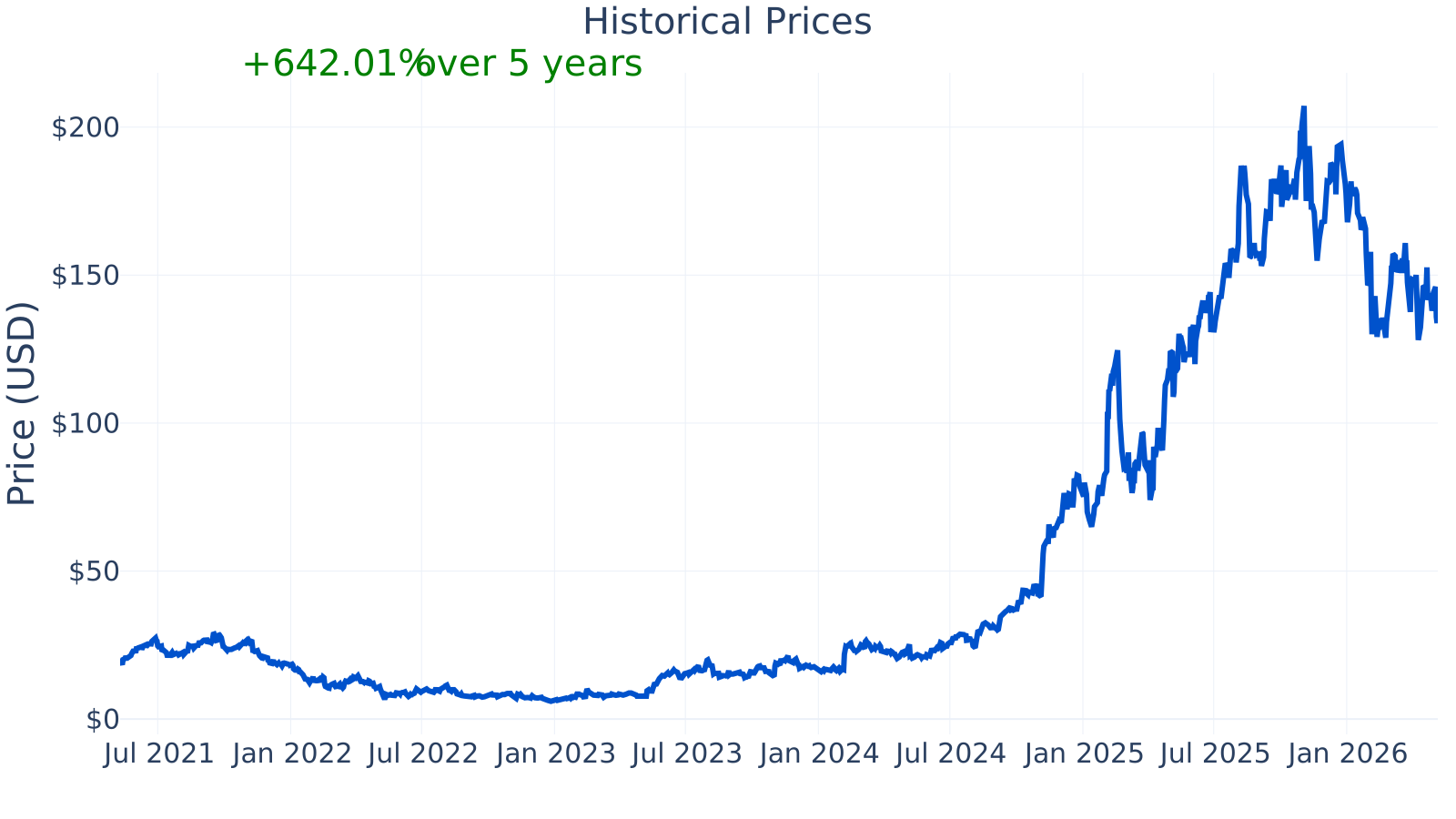
Overview
Palantir Technologies Inc builds software platforms designed to help organizations bring together data from many sources, manage it securely, and turn it into decisions and actions. In practice, the company’s products are used for tasks like operational planning, monitoring complex systems, detecting patterns (including fraud or security threats), and supporting decision-making in environments where data is large, messy, and sensitive.
Palantir generally serves two broad customer groups: government organizations (including defense and intelligence-related work) and commercial companies. It has positioned itself around “operational” data work—connecting data, applying rules and models, and enabling teams to run workflows—rather than being only a database or only an analytics dashboard.
In its SEC filings, Palantir typically discusses revenue by customer type (government vs. commercial) and by geography. Exact percentages can change over time and are best taken from the most recent annual report (Form 10-K) and quarterly report (Form 10-Q). At a high level, its main sources of revenue are:
- Commercial customers (enterprises across industries, generally sold via subscriptions and multi-year agreements)
- Government customers (public-sector contracts, including national security and civilian agencies)
Like many software companies, Palantir’s cost structure includes ongoing engineering investment (research and development) and significant go-to-market and support expenses. Over time, operating leverage (growing revenue faster than costs) is a key driver of profitability.
From 2021 to 2025, the company’s revenue increased substantially (about $1.54B to about $4.48B), while net income moved from a loss to a positive result (about -$520M to about +$1.63B). Over the same period, gross profit grew strongly, and operating income turned positive, indicating improving scale and cost efficiency.
Key Figures
| Metric | Value | Industry ⓘ |
|---|---|---|
| Date | May 08, 2026 | |
| Context | ||
| Sector | Technology | |
| Industry | Software - Infrastructure | |
| Market Cap ⓘ | $328.55B | |
| Beta ⓘ | 1.52 | |
| Fundamental | ||
| P/E Ratio ⓘ | 153.99 | 29.58 |
| Profit Margin ⓘ | 43.67% | 6.71% |
| Revenue Growth ⓘ | 84.70% | 18.30% |
| Debt to Equity ⓘ | 2.51% | 24.92% |
| PEG ⓘ | 2.90 | |
| Free Cash Flow ⓘ | $2.69B | |
Palantir’s market capitalization is shown at roughly $329B, and its beta of ~1.52 indicates the stock has tended to move more than the overall market (higher volatility). The table also shows a P/E ratio near 154 versus an industry median near 30, alongside a profit margin around 43.7% (industry median around 6.7%) and year-over-year revenue growth around 84.7% (industry median around 18.3%). Debt is relatively low, with debt-to-equity around 2.5% compared with an industry median around 24.9%. Free cash flow over the trailing twelve months is shown at about $2.69B.
Growth (High)
Palantir operates in the broader software and data/AI ecosystem, where organizations continue to modernize how they manage information, automate decisions, and deploy AI-assisted workflows. This is widely considered a long-duration trend because data volumes keep rising, security requirements are tightening, and companies are under pressure to improve efficiency and resilience.
Strategically, Palantir’s approach centers on being a “system layer” that connects data, permissions, and operational processes. If customers embed the software deeply into how they run critical workflows, switching can become difficult, which can support renewal rates and expansions over time. Another potential tailwind is increased interest in deploying AI in regulated or high-stakes settings (for example, where auditability, access controls, and governance matter), which aligns with Palantir’s product positioning described in its filings.
The year-over-year revenue growth trend shows a clear acceleration over the period displayed, rising from the mid-teens/20% range (during parts of 2022–2023) to higher levels later, reaching about 84.7% most recently. Sustaining that pace is typically harder as a company becomes larger, but the direction of the trend indicates momentum in the latest period.
Free cash flow has also expanded markedly over time, from roughly $225M (TTM in early 2022) to about $2.69B most recently. For long-term business durability, consistently positive and growing free cash flow can matter because it provides flexibility to reinvest in product development, pursue partnerships, or withstand downturns without relying heavily on new debt or equity financing.
Risks (High)
Palantir faces several notable risks that are common for companies selling mission-critical software, plus a few that are specific to its customer base and public profile. A key business risk is customer concentration and contract dynamics in government work: public-sector purchasing can be cyclical, subject to budget changes, competitive bidding, and program timing. Commercial growth can be sensitive to enterprise IT spending cycles, procurement scrutiny, and the time it takes to convert pilots into large deployments.
Competition is also a meaningful risk. The company operates in areas that overlap with large cloud providers and established enterprise software vendors. Depending on the use case, alternatives can include building in-house systems or adopting other platforms for data integration, analytics, and AI deployment. Competitive pressure can show up as pricing constraints, slower expansion within accounts, or higher sales costs.
Palantir’s competitive advantages, as described in its filings, are typically framed around deep experience in sensitive environments, security and access controls, and the ability to deploy across complex organizations. Whether it is “the leader” depends on the exact category: the market is not a single, neatly defined segment, and many customers use a mix of tools. The most direct competition often comes from a combination of:
- Hyperscale cloud providers offering integrated data and AI stacks
- Large enterprise software companies with data/analytics platforms
- Specialized vendors for data integration, governance, or analytics
- Internal engineering teams building custom solutions
The debt-to-equity ratio trends downward across the period shown, ending at roughly 2.5%, well below the industry median shown (around 18%–33% across many of the points). Lower leverage can reduce financial risk, though it does not remove operational and valuation risk.
Profitability improved significantly over time. The profit margin was negative earlier in the period displayed, then moved into positive territory and rose to about 43.7% most recently, compared with an industry median near 7.0%. Because margins can be influenced by one-time items and accounting effects (especially for companies transitioning from losses to profits), long-term readers often track whether operating income and free cash flow remain strong over multiple periods.
Valuation
Valuation is one of the most sensitive parts of the PLTR discussion because the stock’s pricing has often implied high expectations for future growth. A common yardstick is the price-to-earnings ratio (P/E). Palantir’s latest P/E in the table is about 154, compared with an industry median around 30. This gap indicates the market is valuing Palantir at a substantially higher multiple than many peers in the same broad industry classification, which typically requires continued strong growth and sustained profitability to justify over time.
The historical P/E values shown on the chart (where meaningful values are available) have been far above the industry median across the displayed dates, including readings above 200 in several periods. This pattern suggests that valuation has remained elevated rather than “mean reverting” to the industry norm. That does not determine outcomes by itself, but it does mean the stock price can be more sensitive to changes in growth rates, margins, or guidance.
Another lens is the relationship between valuation and growth expectations. The table shows a PEG ratio near 2.9, which is one way to relate P/E to growth; higher PEG figures often imply that a lot of growth is already reflected in the price. In other words, even with strong recent operating improvements (including rising margins and free cash flow), the current valuation metrics indicate that the market is already assuming significant future progress.
Conclusion
Palantir is a software company focused on integrating data and enabling operational decision-making across government and commercial customers. The business shows strong recent momentum in growth and profitability: revenue has accelerated in the most recent period shown, free cash flow has expanded sharply, margins have improved substantially, and balance-sheet leverage appears low compared with the industry median.
At the same time, the company operates in highly competitive markets that overlap with major platform vendors and specialized providers, and it has exposure to the timing and budgeting realities of government contracting. The valuation metrics shown (including a P/E far above the industry median) indicate that the stock price embeds high expectations, which can increase sensitivity to execution risk and changes in growth trajectories.
Sources:
- U.S. Securities and Exchange Commission (SEC) EDGAR — Palantir Technologies Inc filings (Form 10-K, Form 10-Q, Form 8-K)
- Palantir Technologies Inc Investor Relations — Shareholder letters, quarterly results materials, and press releases
- Wikipedia — “Palantir Technologies” (basic company background)
This article is for informational purposes only and does not constitute financial advice. Some content is AI-generated. See Disclaimer


