Stock Analysis · Palantir Technologies Inc (PLTR)
Overview
Palantir Technologies Inc is a software company focused on helping organizations integrate, manage, and analyze large amounts of data so they can make better decisions. In simple terms, its platforms are designed to bring data from many places together (often messy and inconsistent), organize it, and make it usable for tasks like operations planning, risk monitoring, fraud detection, supply chain optimization, and mission-critical decision support.
Palantir has historically been strongly associated with government and defense work, but it has also expanded its commercial business, selling to companies across industries. Its software is typically used in high-stakes environments where reliability, access controls, and traceability (knowing how a conclusion was reached) matter.
From company reporting, revenue is primarily discussed in two major buckets:
- Government revenue (contracts with government agencies, including defense and intelligence-related work)
- Commercial revenue (contracts with businesses and non-government organizations)
In addition, the company often discusses performance by geography (for example, U.S. vs. international), but the core business model is selling software platforms and related services to deploy and expand usage.
Over the years shown, the company’s total revenue increased materially, while operating results improved from operating losses (2021–2022) to operating profit (2023–2025). Research and development and selling/general/administrative expenses remained significant, but they grew more slowly than revenue in the later years, which helped profitability.
Key Figures
| Metric | Value | Industry ⓘ |
|---|---|---|
| Date | Feb 06, 2026 | |
| Context | ||
| Sector | Technology | |
| Industry | Software - Infrastructure | |
| Market Cap ⓘ | $309.87B | |
| Beta ⓘ | 1.69 | |
| Fundamental | ||
| P/E Ratio ⓘ | 209.69 | 25.91 |
| Profit Margin ⓘ | 36.31% | 6.86% |
| Revenue Growth ⓘ | 70.00% | 14.65% |
| Debt to Equity ⓘ | 3.10% | 22.23% |
| PEG ⓘ | 3.62 | |
| Free Cash Flow ⓘ | $2.10B | |
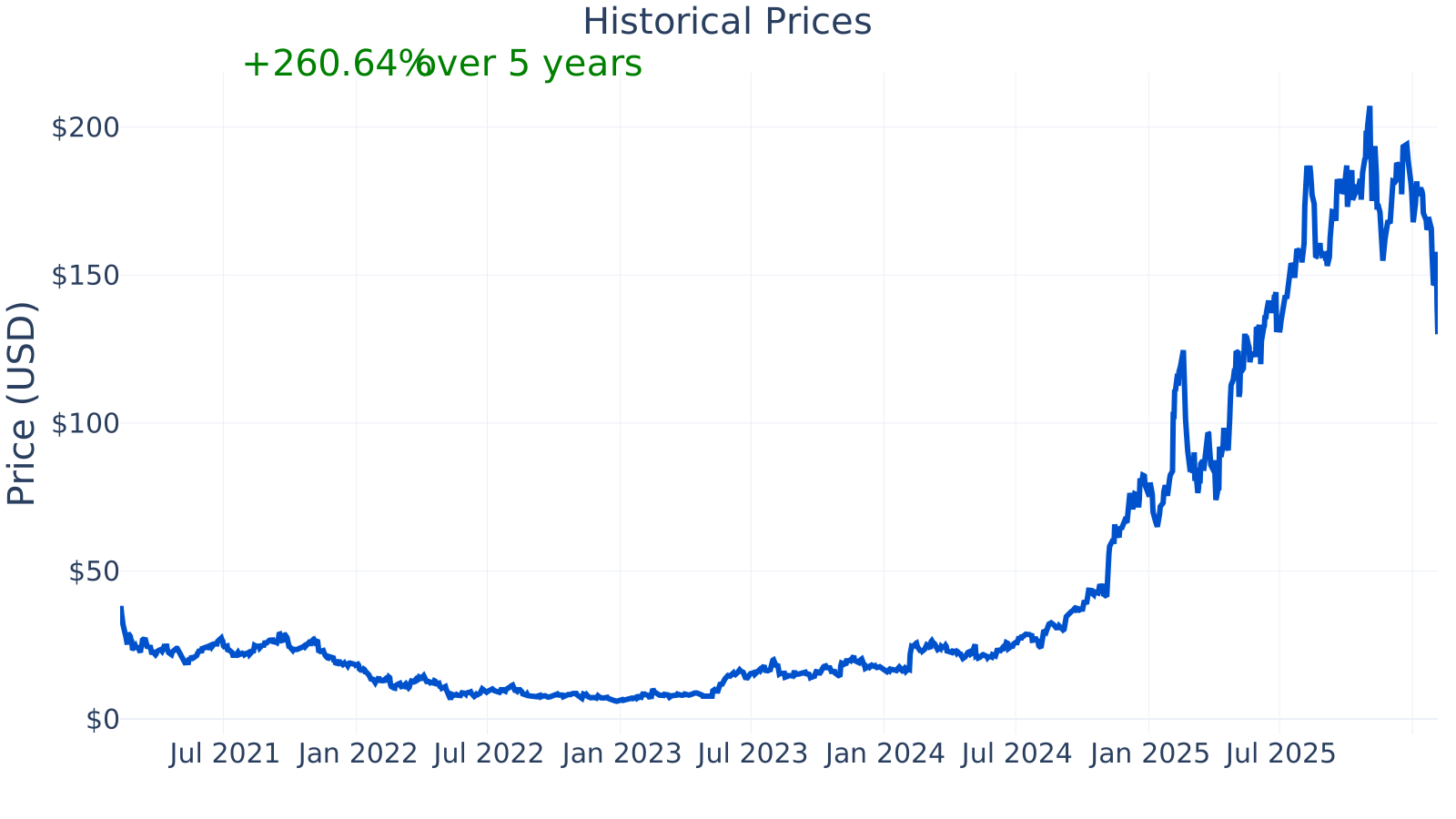
Palantir’s market capitalization is about $309.9B, and the stock shows higher-than-market volatility with a beta of 1.687. The company’s P/E ratio is ~209.7, which is far above the industry median ~25.9, indicating that the market price embeds high expectations for future earnings growth. Profitability metrics are currently strong versus the industry median, with a profit margin of ~36.3% compared with an industry median of ~6.9%. Recent year-over-year revenue growth is ~70.0% versus an industry median of ~14.7%. Balance-sheet leverage appears low, with debt-to-equity ~3.1% compared with an industry median ~22.2%. Trailing twelve-month free cash flow is about $2.10B, and the PEG ratio of ~3.62 suggests the valuation remains high even after factoring in growth expectations.
Growth (High)
Palantir operates in the enterprise software market, where organizations spend to modernize data infrastructure, improve decision-making, and deploy AI-enabled workflows. This is generally a growing area because more business activity is becoming digital, more processes are being measured, and more decisions are being automated or assisted by software. Government demand can also be supported by long-term priorities such as defense modernization, intelligence analysis, cybersecurity, and operational readiness.
The company’s strategy centers on selling a platform approach—software that can be adopted for one use case and then expanded across departments and projects over time. If platform adoption deepens within existing customers and new customer acquisition continues, that combination can support durable growth.
The chart shows revenue growth accelerating significantly over time, reaching about 70% year-over-year in the most recent period shown. That is well above typical growth rates seen across many mature software vendors, and it suggests a period of strong demand or expanding deployments.
Free cash flow has also increased sharply, rising from roughly $97.5M (2021) to about $1.32B (2025) on a trailing twelve-month basis for the points shown. For long-term business quality, rising free cash flow can matter because it indicates the business is generating cash after operating needs and investment spending, which can provide flexibility to reinvest, strengthen the balance sheet, or fund other corporate priorities.
Risks (High)
This article is for informational purposes only and does not constitute financial advice. Some content is AI-generated. See Disclaimer