Stock Analysis · PVH Corp (PVH)
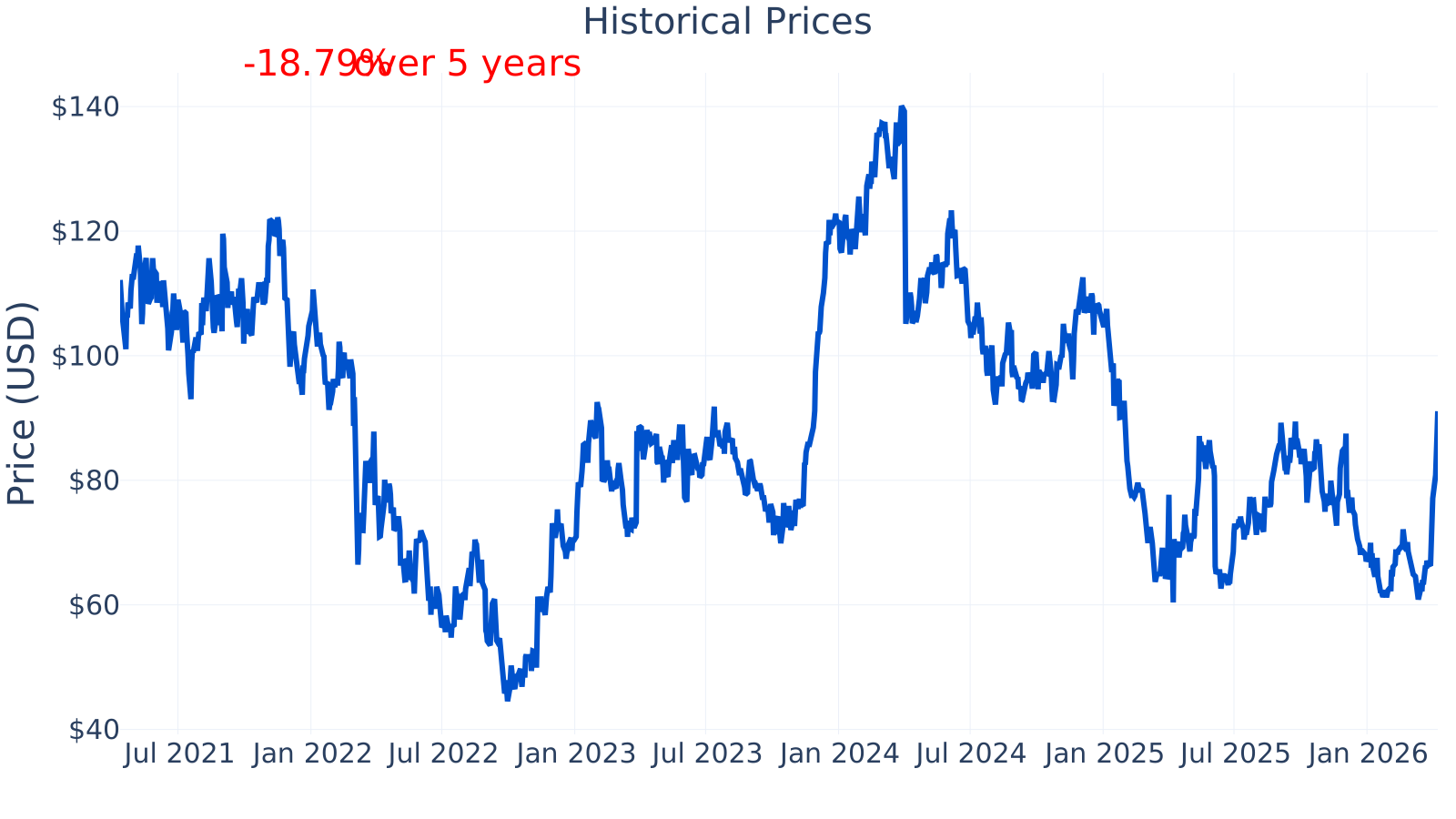
Overview
PVH Corp is a global apparel company best known for owning and operating major lifestyle brands, including Calvin Klein and TOMMY HILFIGER. The business designs, sources, markets, and sells clothing and related products through a mix of channels such as wholesale (selling to department stores and other retailers), company-owned retail stores, and digital commerce.
In its filings, PVH describes its operations primarily through its two brand segments (Calvin Klein and Tommy Hilfiger) and a smaller “Heritage Brands” group. Revenue is generally generated from a combination of:
- Wholesale (selling to third-party retailers)
- Direct-to-consumer (company-operated stores and e-commerce)
- Licensing / other brand-related income (where applicable)
Brand and geographic mix can shift over time depending on demand, promotions, and inventory levels, so the relative contribution of each stream may vary by year.
Over the last several fiscal years shown, total revenue has been broadly in the same range (roughly high-$8B to low-$9B), while profitability has moved much more than sales. In particular, selling, general, and administrative costs rose meaningfully in the most recent year shown, which helps explain why net income fell sharply despite revenue remaining close to prior levels.
Key Figures
| Metric | Value | Industry ⓘ |
|---|---|---|
| Date | Apr 10, 2026 | |
| Context | ||
| Sector | Consumer Cyclical | |
| Industry | Apparel Manufacturing | |
| Market Cap ⓘ | $4.38B | |
| Beta ⓘ | 1.61 | |
| Fundamental | ||
| P/E Ratio ⓘ | 175.17 | 23.69 |
| Profit Margin ⓘ | 0.28% | 5.33% |
| Revenue Growth ⓘ | 5.60% | 3.55% |
| Debt to Equity ⓘ | 89.70% | 117.22% |
| PEG ⓘ | 0.40 | |
| Free Cash Flow ⓘ | $538.40M | |
PVH’s market capitalization is about $4.38B. The stock’s beta of ~1.61 suggests it has tended to move more than the overall market (higher volatility). The table also shows a very high P/E ratio (~175) alongside a very low profit margin (~0.28%); this combination often happens when earnings are temporarily depressed, because the “E” in P/E becomes small. Revenue growth is shown at about 5.6% year-over-year, and trailing twelve-month free cash flow is about $538M. Debt-to-equity is about 89.7%, which is below the industry median shown (~117%).
Growth (medium)
PVH operates in the global apparel market, which is mature and highly competitive. Long-term growth typically comes from brand strength, international expansion, growing direct-to-consumer sales (especially e-commerce), and disciplined product and inventory management rather than from rapid expansion of the overall industry.
A key part of PVH’s growth logic is that Calvin Klein and Tommy Hilfiger are globally recognized brands that can be extended across product categories and geographies. In general, companies in this space aim to improve growth and resilience by balancing wholesale relationships with direct-to-consumer channels, where they can control brand presentation and capture more of the retail margin (though operating costs can be higher).
Revenue growth has been uneven across the periods shown: very strong growth in 2021 (coming off a weaker prior period), followed by softer or negative comparisons in parts of 2022–2024, and then a return to positive growth most recently (about 5.6% year-over-year). This pattern is consistent with a consumer-facing company exposed to demand swings, promotional intensity, and inventory cycles.
Free cash flow has also been volatile, including a negative period (around -$251M in 2023) followed by a recovery to solidly positive levels (about $538M most recently). For long-term business progress, sustained positive cash generation is important because it supports reinvestment in the brands, balance sheet flexibility, and shareholder return programs (when used).
Risks (high)
PVH’s results are exposed to consumer spending and confidence. Apparel demand can weaken quickly in economic slowdowns, and the sector often experiences heavy discounting when inventory builds up. The company is also exposed to execution risks such as forecasting demand, managing inventory levels, and protecting brand positioning while still driving volume.
Competition is intense across both premium and mass-market apparel, including large global brand owners and fast-fashion players. PVH’s competitive advantage is primarily its brand equity (Calvin Klein and Tommy Hilfiger), global distribution, and long-standing wholesale relationships. However, it is not the overall “leader” of the entire apparel market; it competes with a wide set of companies depending on category and price point. Commonly cited peer groups in apparel include other global brand owners (for example, companies behind multiple fashion and lifestyle labels) as well as athletic and fast-fashion brands competing for consumer attention and shelf space.
Debt-to-equity is shown at about 89.7% most recently. That is below the industry median displayed (about 119%), but it is still meaningful leverage, which can increase sensitivity to downturns if profitability weakens. The longer-term line shows leverage moving down earlier in the period and then rising again more recently.
Profitability is the most notable risk signal in the recent data. PVH’s profit margin fell to about 0.28% most recently, well below the industry median shown (about 5.32%). Earlier periods in the chart show PVH reaching mid-to-high single-digit margins, which highlights how quickly earnings can change in apparel due to pricing, promotions, product costs, and operating expense levels.
Valuation
Apparel companies are often valued with an emphasis on normalized (through-the-cycle) earnings and cash flow, because short-term profitability can swing sharply with promotions and inventory management. When current earnings are unusually low, headline valuation measures can look distorted.
The current P/E ratio shown in the table (~175) is far above the industry median displayed (~23.7), but the historical chart indicates PVH’s P/E has more often been in a much lower range (often in the single digits to teens across much of 2022–2026 on the timeline shown). The large jump in the latest snapshot is consistent with the sharp decline in recent net income and profit margin; with lower earnings, the P/E mechanically rises even if the stock price has not increased.
Because of this sensitivity, interpreting whether the stock price is “expensive” or “cheap” depends heavily on whether profitability is viewed as temporarily pressured (with a potential return toward prior margin levels) or structurally lower (for example, due to higher ongoing costs or more persistent discounting). Cash flow trends and management’s discussion in filings about drivers of margins, inventory, and demand are typically central to that assessment.
Conclusion
PVH is a branded apparel company built around two globally recognized labels, with revenue that has been relatively stable in the high-$8B to low-$9B range in the years shown. The main swing factor in the recent fundamentals is profitability: net income and profit margin dropped sharply most recently even though sales did not collapse, suggesting cost, pricing, or mix pressures.
From a long-term perspective, the key facts to weigh are the durability of Calvin Klein and Tommy Hilfiger demand, PVH’s ability to manage inventory and promotions through cycles, and whether margins and earnings can stabilize closer to historical levels. Risks remain elevated due to the cyclicality of apparel, intense competition, and the recent margin compression, while balance sheet leverage appears meaningful but not unusually high versus the industry median shown.
Sources:
- U.S. SEC EDGAR — PVH Corp filings (Form 10-K, Form 10-Q)
- PVH Corp Investor Relations — Annual Report materials and SEC filing archive
- Wikipedia — “PVH (company)” (basic company background and brand overview)
This article is for informational purposes only and does not constitute financial advice. Some content is AI-generated. See Disclaimer


