Stock Analysis · PDF Solutions Inc (PDFS)
Overview
PDF Solutions Inc (PDFS) is a technology company focused on improving how advanced computer chips (semiconductors) are designed and manufactured. Its products and services are used by chipmakers and companies in the semiconductor supply chain to monitor production, analyze data from manufacturing steps, and identify issues that can reduce quality or yield (the percentage of usable chips produced). In simple terms, the company helps customers “see” what is happening in complex chip production lines and make better decisions to reduce defects and improve efficiency.
From the company’s filings, PDF Solutions describes its offerings as software, analytics, and related services that support semiconductor manufacturing and product lifecycle management, including data-driven approaches to improve process control and ramp new chip designs to volume production more smoothly. Revenue can include recurring elements (software and subscriptions/maintenance) and service-based work (implementation, consulting, and support), with customer demand influenced by semiconductor capital spending and new technology transitions.
Main revenue sources (typical categories described in company filings; exact percentages can vary by period and should be checked in the most recent annual report):
- Software and analytics offerings (often the larger, more scalable portion when adoption expands)
- Services and support (implementation, professional services, and customer support tied to deployments)
- Other related items (as disclosed in filings, if applicable)
Over recent years, total revenue increased meaningfully (from about $111.1M in 2021 to about $219.0M in 2025). Gross profit also expanded over the same period, but operating expenses (notably research and development and selling/general/administrative costs) remained substantial, which helps explain why net income has been inconsistent year to year.
Key Figures
| Metric | Value | Industry ⓘ |
|---|---|---|
| Date | Feb 16, 2026 | |
| Context | ||
| Sector | Technology | |
| Industry | Software - Application | |
| Market Cap ⓘ | $1.33B | |
| Beta ⓘ | 1.56 | |
| Fundamental | ||
| P/E Ratio ⓘ | N/A | 27.48 |
| Profit Margin ⓘ | -0.29% | 7.66% |
| Revenue Growth ⓘ | 24.60% | 15.80% |
| Debt to Equity ⓘ | 28.28% | 24.71% |
| PEG ⓘ | 2.37 | |
| Free Cash Flow ⓘ | -$20.50M | |
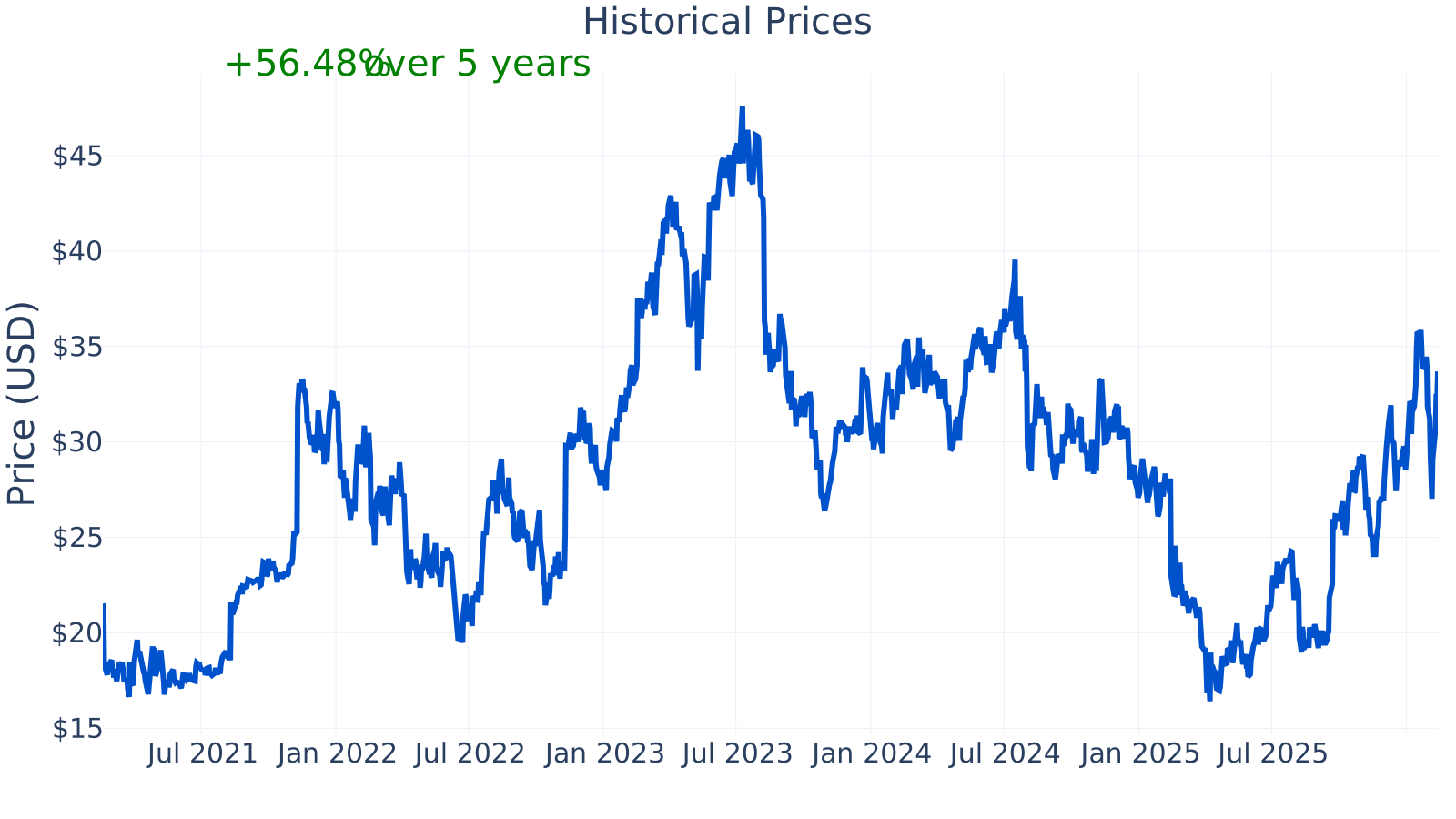
At the latest point shown, PDF Solutions has a market capitalization of about $1.33B and a beta of ~1.56, which is commonly interpreted as meaning the stock has tended to move more than the overall market. Recent fundamentals show a mixed picture: revenue growth year over year of ~24.6% (above the industry median of ~15.8%) alongside a slightly negative net profit margin of about -0.29% (below the industry median of ~7.66%). The company’s debt-to-equity is ~28.3%, somewhat above the industry median of ~24.7%. Free cash flow over the trailing twelve months is shown as -$20.5M, indicating cash outflow after operating needs and capital spending during that period.
Growth (medium)
PDF Solutions operates in and around the semiconductor ecosystem, which is shaped by long-term demand for more computing power and more chips in areas like data centers, networking, automotive electronics, and industrial systems. While the industry can be cyclical, the underlying trend toward more advanced manufacturing steps and tighter quality requirements tends to increase the value of analytics, process control, and software that can improve yield and shorten ramp times.
A key point for long-term growth is whether PDF Solutions can deepen its role in customers’ manufacturing flows and expand adoption across more production lines, more fabs, or more stages of the product lifecycle. In many software-and-analytics business models, growth can improve as deployments scale and recurring revenue becomes a larger share of the mix, although the pace depends on customer rollouts and industry conditions.
The year-over-year revenue growth shown has been strong at times (often above 20% and reaching much higher in earlier periods), dipped close to flat in parts of 2023–2024, and then re-accelerated into the mid-20% range by late 2025. That pattern is consistent with a business exposed to customer deployment timing and broader semiconductor cycles.
Free cash flow has also been uneven: it was positive in multiple periods (including a higher point around 2023) and later turned negative by 2025. For a company aiming to compound over long horizons, sustained positive free cash flow often becomes more important over time because it can fund product development and growth without relying as much on external financing.
Risks (high)
One of the central risks is profitability consistency. Even with revenue growth, the company has shown periods of thin or negative profitability, reflecting meaningful ongoing spending on research and development and operating costs. If revenue growth slows or expenses rise faster than revenue, earnings can deteriorate quickly.
The profit margin trend shows a long improvement from large losses earlier in the timeline toward near break-even and modestly positive quarters, but it returns to around break-even/slightly negative by late 2025 (about -0.29%) while the industry median is notably higher. This suggests the company’s operating model may still be sensitive to spending levels, mix, and timing of revenue recognition.
Another important risk is industry cyclicality and customer concentration dynamics (as commonly discussed in semiconductor-facing company filings). Semiconductor customers can delay software rollouts, reduce services work, or pause spending when the cycle weakens, which can create volatility in quarterly results.
Balance-sheet and financing risk appears more moderate than many highly leveraged companies, but leverage changed meaningfully in 2025, which is worth monitoring.
Debt-to-equity stayed very low for multiple years (around 2%–4% through 2024 in the periods shown), then stepped up sharply to around 28%–29% in 2025, landing near 28.3% at the latest point. Even though this level is not extreme, the change in direction can matter because higher leverage can reduce flexibility during down cycles.
Competition is also a meaningful risk. PDF Solutions sells into a market where customers can rely on internal engineering teams and a broad set of software, inspection, test, and data/analytics vendors across the semiconductor equipment and software landscape. In general terms, the competitive set can include:
- Large electronic design automation (EDA) and semiconductor software providers with broad platforms
- Semiconductor manufacturing equipment and metrology/inspection vendors that bundle software and analytics with tools
- In-house solutions built by major chipmakers and foundries
PDF Solutions’ competitive positioning, as typically described in filings, is tied to specialized domain expertise in semiconductor yield improvement and manufacturing analytics. Whether that translates into durable advantages depends on continued innovation, integration depth with customers, and the ability to demonstrate measurable manufacturing benefits.
Valuation
Valuation for PDF Solutions can be harder to interpret using a single metric because profitability has been close to break-even at times, which can cause the P/E ratio to swing dramatically. When net income is very small, even modest price moves (or small earnings changes) can make P/E look very high or not meaningful.
In the periods where P/E is shown, the company’s P/E reached very elevated levels (for example, well above 100 and at times above 400), while the industry median in the same display is far lower (often around the 40–60 range in those dates). This gap can occur when earnings are small relative to the company’s market value. In that context, readers often place more emphasis on whether revenue growth remains durable and whether margins and free cash flow can improve over time, because those factors largely determine whether valuation becomes easier to support with earnings.
With a market cap around $1.33B and mixed profitability/negative trailing free cash flow as shown, the key valuation question becomes how reliably the company can translate revenue growth into sustained earnings and cash generation across an industry cycle. Without that consistency, standard earnings-based comparisons to the broader application software group can be less informative.
Conclusion
PDF Solutions is positioned in a specialized part of the semiconductor ecosystem, offering software and analytics intended to improve manufacturing outcomes as chip complexity increases. The company has demonstrated meaningful revenue expansion over the last several years and re-accelerated year-over-year growth into the mid-20% range by late 2025.
At the same time, the financial profile shown is not yet consistently profitable, profit margins have recently hovered around break-even while the broader industry median is higher, and free cash flow turned negative in the most recent trailing period displayed. Leverage also increased notably in 2025 compared with prior years, which adds another item to track.
For long-term evaluation, the central items to monitor are whether revenue growth remains resilient through semiconductor cycles, whether operating costs scale more slowly than revenue over time (supporting stronger margins), and whether free cash flow returns to sustained positive levels.
Sources:
- SEC EDGAR — PDF Solutions Inc filings (Form 10-K, Form 10-Q, Form 8-K)
- PDF Solutions Inc — Investor Relations materials and press releases (company-hosted)
- Wikipedia — “PDF Solutions” (basic company background)
This article is for informational purposes only and does not constitute financial advice. Some content is AI-generated. See Disclaimer


