Stock Analysis · PC Connection Inc (CNXN)
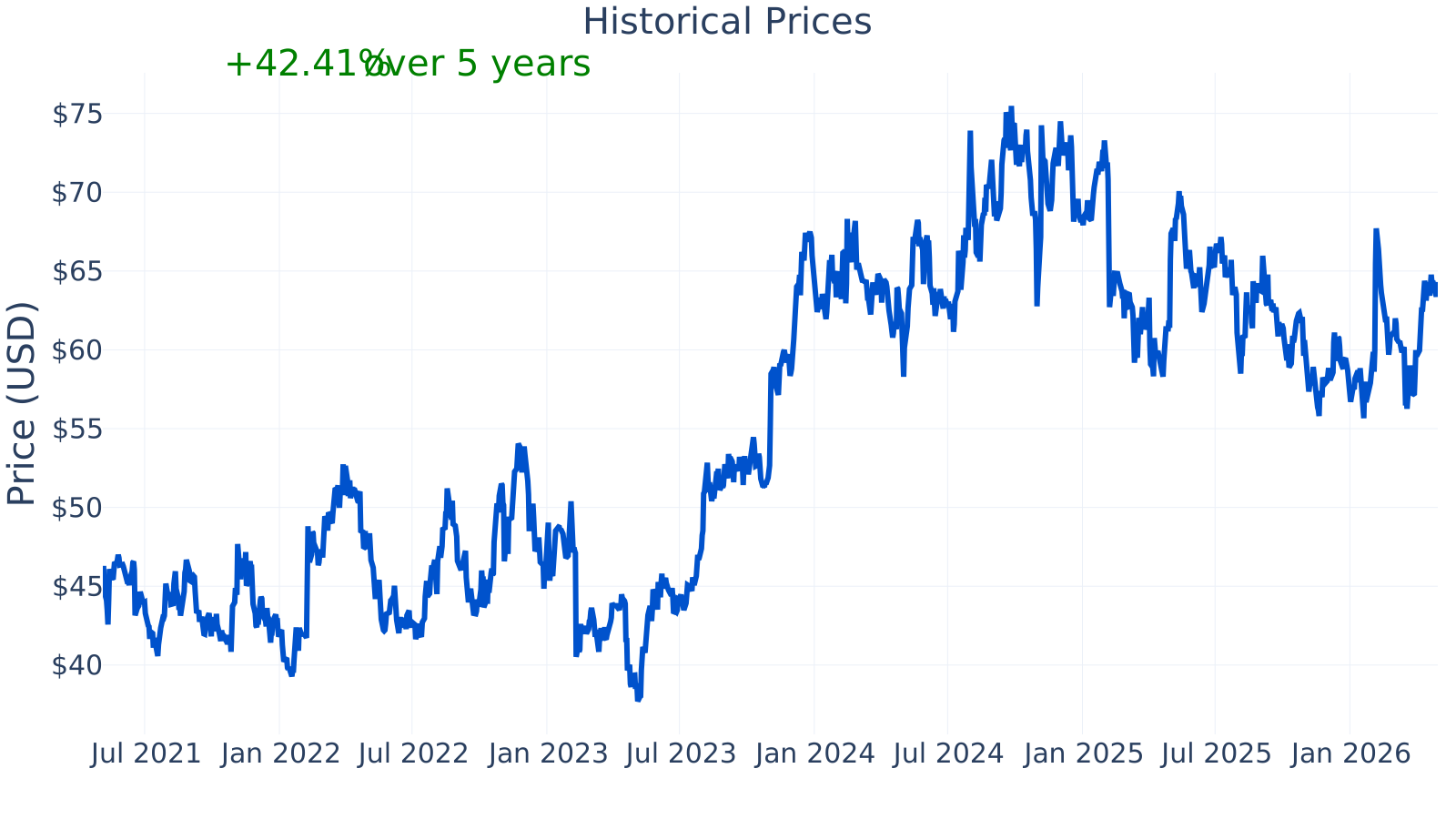
Overview
PC Connection, Inc. (CNXN) is a U.S.-based company that sells information technology (IT) products and services. In simple terms, it acts as a large reseller and solutions provider: it helps organizations and consumers select, buy, and deploy items like computers, networking gear, software, and related services. The company operates through business units that focus on different customer groups, including enterprise and mid-sized organizations, public sector customers (such as government and education), and small business/consumer channels.
Because it operates in IT distribution and solutions, a large portion of revenue typically comes from selling hardware and software produced by other manufacturers, with additional revenue from configuration, services, and support. This business model usually produces high revenue dollars but relatively thin profit margins compared with software-only companies, because much of each sale is the pass-through cost of the product itself.
Main sources of revenue (high-level, described by what the company sells; segment mix and exact percentages depend on the period and are detailed in filings):
- IT hardware (e.g., desktops/laptops, servers, peripherals)
- Software and cloud-related offerings (licenses and subscriptions sold through the company)
- Networking and communications equipment
- Services (configuration, integration, support, and related professional services)
The income flow over recent years shows a relatively stable scale: total revenue was about $2.80–$3.12 billion from 2021 to 2025, while net income stayed in a narrower band (roughly in the $70–$90 million range). This pattern is consistent with an IT reseller model where profitability depends heavily on execution, mix of higher-value services, and managing operating costs.
Across 2021–2025, revenue remained in the same general range (about $2.8–$3.1 billion). Over the same span, net income stayed comparatively steady (roughly $70–$90 million), suggesting that profitability has been more stable than revenue growth, with results influenced by product mix and operating expense discipline.
Key Figures
| Metric | Value | Industry ⓘ |
|---|---|---|
| Date | May 04, 2026 | |
| Context | ||
| Sector | Technology | |
| Industry | Electronics & Computer Distribution | |
| Market Cap ⓘ | $1.62B | |
| Beta ⓘ | 0.86 | |
| Fundamental | ||
| P/E Ratio ⓘ | 18.69 | 18.85 |
| Profit Margin ⓘ | 3.02% | 1.88% |
| Revenue Growth ⓘ | 3.00% | 18.95% |
| Debt to Equity ⓘ | 0.70% | 29.85% |
| PEG ⓘ | 1.70 | |
| Free Cash Flow ⓘ | $124.43M | |
PC Connection’s market capitalization is about $1.62 billion and its beta is 0.864, which indicates the stock has historically moved somewhat less than the broader market. The latest P/E ratio is about 18.7, close to the industry median (~18.9). Profit margin is about 3.02%, which is higher than the industry median (~1.88%) for the peer group shown, while year-over-year revenue growth is about 3.0%, well below the industry median (~18.95%). Debt-to-equity is extremely low at about 0.70% versus an industry median near 29.85%, pointing to limited balance-sheet leverage. Free cash flow over the trailing twelve months is about $124.4 million, and the PEG ratio shown is about 1.70 (a metric often used to relate valuation to growth expectations).
Growth (Medium)
PC Connection participates in the broad IT spending market—an area supported long-term by ongoing needs such as device refresh cycles, cybersecurity, networking upgrades, cloud adoption, and modernization of workplace technology. However, IT distribution and resale is a competitive, often price-sensitive field. Growth tends to be influenced by corporate and public-sector IT budgets, product cycles (PC refreshes, server upgrades), and the company’s ability to attach higher-value services to product sales.
Recent revenue growth has been uneven. After strong year-over-year growth during parts of 2021 and 2022, growth turned negative through much of 2023 and early 2024, then improved again more recently. The latest reading is around +3% year over year, which indicates modest expansion rather than a high-growth profile.
Cash generation has also fluctuated meaningfully over the last several years. Trailing twelve-month free cash flow moved from a low level in 2022 to a much higher level by 2024, dropped in 2025, and then rebounded to about $124 million most recently. For a reseller model with comparatively thin margins, sustained free cash flow is an important indicator because it can support reinvestment, resilience during downcycles, and shareholder returns (subject to company decisions and conditions described in filings).
Potential catalysts tend to be more operational and cyclical than “breakthrough” in nature: a stronger enterprise/public-sector spending cycle, successful expansion of higher-margin services, improved mix toward solutions and software-related offerings, and disciplined working-capital management (inventory and receivables) can all materially affect results.
Risks (Medium)
The company’s biggest risks are typical for IT resellers and solution providers. Demand can be cyclical: customers may delay hardware refreshes or reduce project spending during uncertain economic periods. Competition is intense, and many products sold are similar across distributors, which can pressure pricing and gross margin. Results can also be affected by supplier relationships and availability (for example, changes in vendor programs, allocation, or terms), and by execution risk in growing services where staffing and delivery quality matter.
PC Connection’s balance sheet leverage appears conservative.
Debt-to-equity is extremely low (about 0.70% most recently) and has generally remained far below the peer median over time in the chart. Low leverage can reduce financial strain during downturns, but it does not eliminate operating risks such as demand swings, margin compression, or working-capital volatility.
Profitability is also a key watch item in this industry because margins are typically thin.
The company’s net profit margin has been around the ~3% range recently and has generally compared favorably to the peer median in the chart. Even so, a small change in pricing, vendor incentives, freight costs, or operating expenses can meaningfully affect net income because the baseline margin level is not high.
In terms of competitive positioning, PC Connection competes with large IT distributors and resellers as well as solutions providers. Notable competitors in the broader space include large distributors (such as TD SYNNEX and Ingram Micro) and large solution providers/resellers (such as CDW and Insight Enterprises). Relative to the largest players, PC Connection is smaller, which can be a disadvantage in purchasing scale, but it may compete through customer focus, service quality, specialized offerings, and execution in particular customer segments (enterprise, SMB, and public sector), as described in company filings.
Valuation
The P/E ratio has generally been in the mid-teens to around 20 over the period shown, and the latest P/E is about 18.7, close to the industry median on the table. That places valuation near the peer midpoint by this single measure. Interpreting that valuation depends heavily on expectations for future growth and stability: the company’s recent revenue growth is modest (around +3% year over year), while profit margin is relatively higher than the peer median and leverage is very low.
For a business with cyclical revenue patterns and thin margins, a key part of “context” is whether the company can sustain profitability and free cash flow through different IT spending environments. The recent rebound in trailing free cash flow and the low debt load support financial flexibility, while the below-median recent revenue growth suggests the market may be treating it more like a steady operator than a fast grower.
Conclusion
PC Connection is an IT products and solutions reseller operating in a large, established market. The business profile tends to be characterized by large revenue volume, competitive pricing dynamics, and profitability that depends on execution, services attachment, and cost control rather than rapid structural expansion.
The facts highlighted above show a company with very low leverage, profit margins that have compared well versus the peer median shown, and free cash flow that has been positive but variable. At the same time, recent revenue growth has been modest relative to the peer median on the table, reflecting the cyclical and competitive nature of IT resale. Valuation, as indicated by the P/E ratio, appears broadly in line with the peer median, meaning the market is not pricing it as an extreme outlier based on earnings.
Sources:
- SEC EDGAR — PC Connection, Inc. — Form 10-K (Annual Report)
- SEC EDGAR — PC Connection, Inc. — Form 10-Q (Quarterly Report)
- PC Connection, Inc. Investor Relations — SEC Filings
- Wikipedia — “PC Connection”
This article is for informational purposes only and does not constitute financial advice. Some content is AI-generated. See Disclaimer


