Stock Analysis · Ouster Inc (OUST)
Overview
Ouster Inc. designs and sells lidar sensors—devices that use laser light to measure distance and build a 3D view of the surroundings. In simple terms, lidar helps machines “see” their environment. Ouster’s products are used in areas such as industrial automation (for example, robots and smart facilities), automotive and trucking (advanced driver assistance and autonomy-related work), and smart infrastructure (traffic management and safety applications). The company also offers related software and solutions that help customers interpret and use lidar data in real-world systems.
Revenue mainly comes from selling lidar units and, to a smaller extent, software and services tied to those deployments. Public filings often describe the business in these broad categories rather than a simple consumer-style menu of products.
Main revenue streams (high-level):
- Lidar sensors / hardware sales (primary driver)
- Software and services (typically smaller, tied to deployments and support)
In many hardware-focused technology companies, the mix between hardware and software can matter over time because software can be more recurring. Ouster’s filings can be used to track whether software/services become a larger share as deployments scale.
Across the years shown, revenue rises materially (from about $33.6M in 2021 to about $169.4M in 2025), while operating costs remain heavy. Research and development and sales/administration are large line items, which is common for a company still working toward consistent profitability. Gross profit improves notably by 2024–2025 (gross profit about $40.5M in 2024 and $83.4M in 2025), indicating better unit economics and/or pricing and mix, but the company still reports net losses in each year shown.
Key Figures
| Metric | Value | Industry ⓘ |
|---|---|---|
| Date | Mar 23, 2026 | |
| Context | ||
| Sector | Technology | |
| Industry | Electronic Components | |
| Market Cap ⓘ | $1.26B | |
| Beta ⓘ | 3.05 | |
| Fundamental | ||
| P/E Ratio ⓘ | N/A | 39.69 |
| Profit Margin ⓘ | -35.65% | 6.11% |
| Revenue Growth ⓘ | 106.60% | 17.40% |
| Debt to Equity ⓘ | 6.53% | 41.32% |
| PEG ⓘ | N/A | |
| Free Cash Flow ⓘ | -$64.85M | |
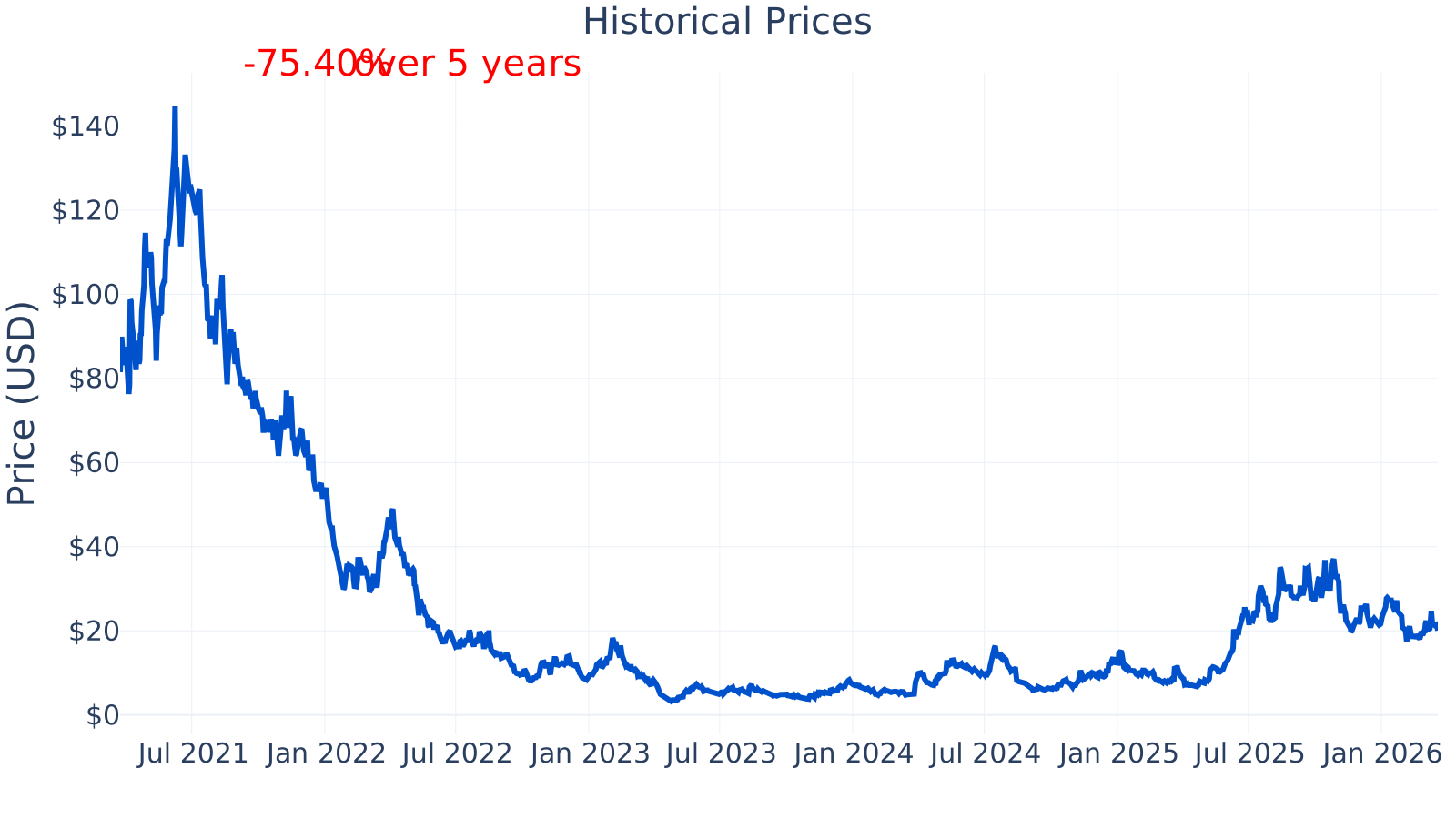
At the latest point provided, Ouster’s market capitalization is about $1.26B. The stock’s beta (~3.05) suggests it has historically moved much more than the overall market, which is a useful context point for long-term holders who may experience large ups and downs. The company’s profit margin is negative (~-35.6%) versus an industry median around +6.1%, highlighting that profitability remains a key gap versus many peers. On the other hand, year-over-year revenue growth (~106.6%) is far above the industry median (~17.4%), and debt-to-equity (~6.5%) is below the industry median (~41.3%), indicating comparatively modest leverage. Free cash flow over the trailing twelve months is negative (~-$64.8M), meaning the business is still consuming cash overall.
Growth (High)
Lidar is commonly positioned as an enabling technology for automation: machines and systems that need to detect objects and navigate safely often benefit from precise 3D sensing. That places Ouster in an industry that can expand as more robots, automated vehicles, and sensor-rich infrastructure are deployed. However, the pace of adoption can be uneven, depending on budgets, product qualification cycles, and how quickly customers move from pilot projects to broader rollouts.
Ouster’s strategy—continuing to invest in product development while expanding commercial deployments—matches a “scale-up” phase: win more design slots, grow shipments, and improve margins as volumes rise and manufacturing becomes more efficient. For long-term business progress, two operational signposts tend to matter most: (1) sustained revenue growth and (2) a clear path toward better profitability and cash generation.
The year-over-year growth line is volatile but often very high, with the most recent point shown at roughly 106.6%. That indicates strong expansion off a smaller base, but it can also reflect the reality that large orders or timing shifts can swing quarterly comparisons.
Free cash flow remains negative across the timeline shown, but the magnitude improves from roughly -$147.9M (2023) to about -$35.8M (2025) at the latest point displayed. If that trend continues, it can reduce the company’s need for external funding over time. A common catalyst for companies at this stage is reaching a combination of higher gross profit and controlled operating expenses such that cash burn narrows meaningfully or turns positive.
Risks (Very High)
The main risk is straightforward: the company is still unprofitable. Even with improving gross profit in the later years shown, operating expenses remain large, and net income is negative. If revenue growth slows or margins compress, the timeline to profitability can extend, and funding needs can increase.
Another key risk is customer concentration and long sales cycles. Lidar deployments in industrial, automotive, and infrastructure can involve extended testing and qualification. Decisions may be delayed by customer budgets, engineering timelines, or broader economic conditions, which can make results lumpy.
There is also competitive and technological risk. Lidar is a crowded field that includes well-capitalized competitors and, in some cases, customers exploring in-house solutions. Competitive pressure can show up as pricing pressure, higher R&D requirements, or slower-than-expected adoption of a particular approach.
Debt-to-equity trends lower in the most recent periods shown, ending around 6.5%, well below the industry median shown (about 41.3%). Lower leverage can provide flexibility, but it does not remove the core challenge of funding operations while free cash flow is negative.
Profit margin improves dramatically over time (moving from very deep losses earlier to about -35.6% most recently), but it remains below zero and below the industry median (about +6.1%). This reinforces that the company’s progress has been more visible in growth and gross profit than in bottom-line profitability.
On competitive advantages, Ouster’s positioning centers on its lidar product portfolio and its ability to deliver sensors and supporting software suited to real deployments. Whether that becomes a durable advantage depends on execution: product performance, manufacturing quality, cost, and the ability to win and retain large customers at scale. In many hardware categories, sustained leadership is usually demonstrated by a combination of consistent volume growth, improving margins, and repeatable customer wins rather than a single “winner-takes-all” moment.
Main competitor types to expect in this space include:
- Other lidar manufacturers focused on automotive, industrial, or mapping markets
- Large industrial technology firms that bundle sensing into broader automation platforms
- Alternative sensing approaches (cameras, radar, and sensor fusion systems) that can reduce the need for lidar in some use cases
Valuation
A price-to-earnings (P/E) ratio is often less informative for companies with negative earnings. In the periods shown, Ouster’s P/E is not displayed (effectively not meaningful), while the industry median P/E shown rises over time and sits around 39.7 in the latest table. For companies still reporting losses, valuation discussions often rely more on business trajectory indicators—such as revenue growth, gross margin development, operating expense discipline, and cash burn—rather than earnings-based multiples.
With a market capitalization around $1.26B and still-negative profit margin and free cash flow, the market’s view of value is likely influenced by expectations of continued growth and further margin improvement. If growth remains high and losses continue to narrow, valuation can be easier to justify than if growth slows before profitability improves. Conversely, if commercialization takes longer than expected, the valuation can become harder to support because funding needs and dilution risk may rise.
Conclusion
Ouster operates in lidar sensing, an area tied to long-term trends in automation and machine perception. The financial profile shown is a mix of very strong revenue growth and meaningful ongoing losses, with signs of improvement in gross profit and profit margin over time. Leverage appears relatively modest versus the industry median, while free cash flow remains negative but has improved materially from prior years.
From a long-term, fundamentals-based lens, the key items to monitor are whether revenue growth can remain durable as the base gets larger, whether margins continue to improve, and whether cash burn keeps shrinking. The largest uncertainties remain competitive intensity, adoption timing across end markets, and the company’s ability to translate growth into sustained profitability.
Sources:
- U.S. SEC EDGAR — Ouster Inc. filings (Form 10-K, Form 10-Q, Form 8-K)
- Ouster Inc. Investor Relations — Press releases and shareholder materials
- Wikipedia — “Ouster” (basic company background)
This article is for informational purposes only and does not constitute financial advice. Some content is AI-generated. See Disclaimer


