Stock Analysis · Ouster Inc (OUST)
Overview
Ouster, Inc. designs and sells lidar sensors—devices that use laser light to measure distances and create a precise 3D view of the surrounding environment. In simple terms, lidar helps machines “see” the world in detail, which can be useful for automation and safety. Ouster’s products are used across several end markets, including industrial automation, smart infrastructure (for example, traffic and road monitoring), robotics, and some automotive-related applications.
The company’s revenue primarily comes from selling lidar sensors and related software/services that help customers integrate, manage, and interpret the data from those sensors. In its filings, Ouster reports revenue as a single line item rather than breaking it out into detailed categories with consistent percentages by end market in the summary financial statements, so a reliable largest-to-smallest percentage split is typically not available from the standard financial tables alone.
At a high level, revenue is generally tied to:
- Lidar sensor sales (hardware) — the core product shipped to customers.
- Software and related offerings — tools and services that support deployment and usage (often smaller than hardware for many hardware-first companies, though exact percentages depend on the period and are not always disclosed as a fixed mix).
From 2021 to 2024, total revenue increased materially (from about $33.6M to about $111.1M). Over the same period, operating expenses remained large relative to gross profit, which helps explain why net income stayed negative despite revenue growth.
Key Figures
| Metric | Value | Industry ⓘ |
|---|---|---|
| Date | Feb 08, 2026 | |
| Context | ||
| Sector | Technology | |
| Industry | Electronic Components | |
| Market Cap ⓘ | $1.17B | |
| Beta ⓘ | 2.90 | |
| Fundamental | ||
| P/E Ratio ⓘ | N/A | 41.23 |
| Profit Margin ⓘ | -64.17% | 6.11% |
| Revenue Growth ⓘ | 40.80% | 13.80% |
| Debt to Equity ⓘ | 6.43% | 39.00% |
| PEG ⓘ | N/A | |
| Free Cash Flow ⓘ | -$31.68M | |
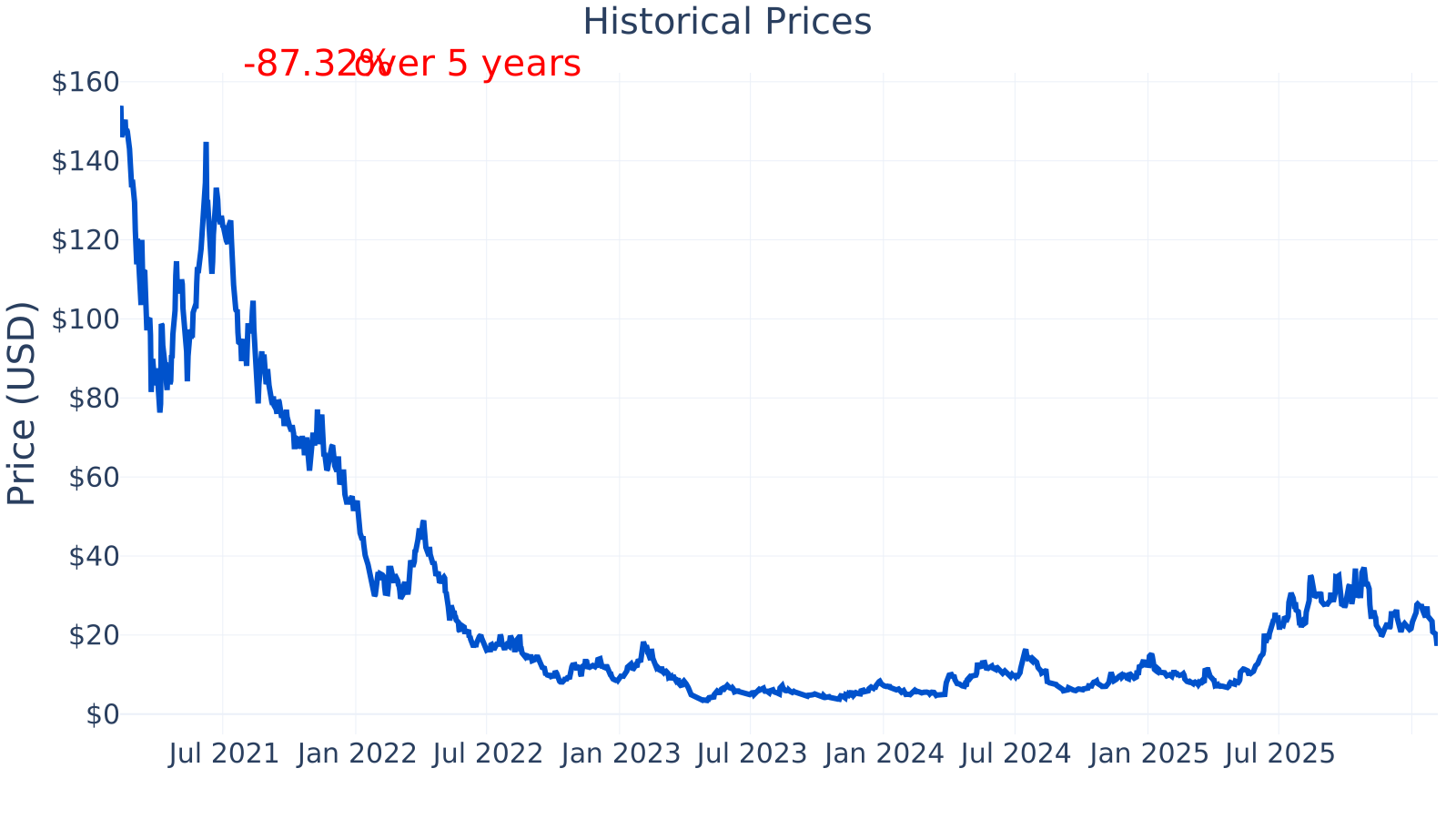
Ouster’s market capitalization is about $1.17B, placing it in the smaller-company range where share prices can be more volatile. That volatility shows up in the beta of ~2.9, which indicates the stock has historically moved much more than the broader market.
Profitability remains a central issue: the profit margin is about -64%, versus an industry median near +6%. On the growth side, year-over-year revenue growth is about 41%, notably higher than the industry median near 14%. The balance sheet, however, looks less leveraged than many peers: debt-to-equity is ~6% versus an industry median around 39%. Free cash flow over the trailing twelve months is still negative at roughly -$31.7M, meaning the business used more cash than it generated from operations and investment over that period.
Growth (Medium)
Lidar is closely tied to long-term trends in automation and sensing: more robots in warehouses and factories, more machine-assisted safety systems, and more data-driven infrastructure. These trends can support demand for sensors that operate reliably in different lighting and weather conditions and deliver accurate distance measurement.
Ouster’s strategy centers on scaling shipments, improving unit economics (for example, manufacturing efficiency and product cost), and expanding use cases beyond any single market. In practice, the company’s growth outlook depends on converting customer projects into repeatable, higher-volume deployments—especially in industrial and infrastructure settings where purchasing cycles can still be lengthy.
The recent pattern shows strong growth compared with the industry median, although quarterly growth rates have fluctuated over time. That variation is common for smaller hardware companies where a limited number of large orders can influence year-over-year comparisons.
Free cash flow has remained negative, but the magnitude of cash outflow has improved compared with earlier periods (for example, less negative in 2025 vs. 2023). A key long-term catalyst to watch is whether revenue scale and gross profit expansion can consistently outpace operating costs, pushing cash flow toward breakeven.
Risks (High)
This article is for informational purposes only and does not constitute financial advice. Some content is AI-generated. See Disclaimer


