Stock Analysis · OneStream Inc (OS)
Overview
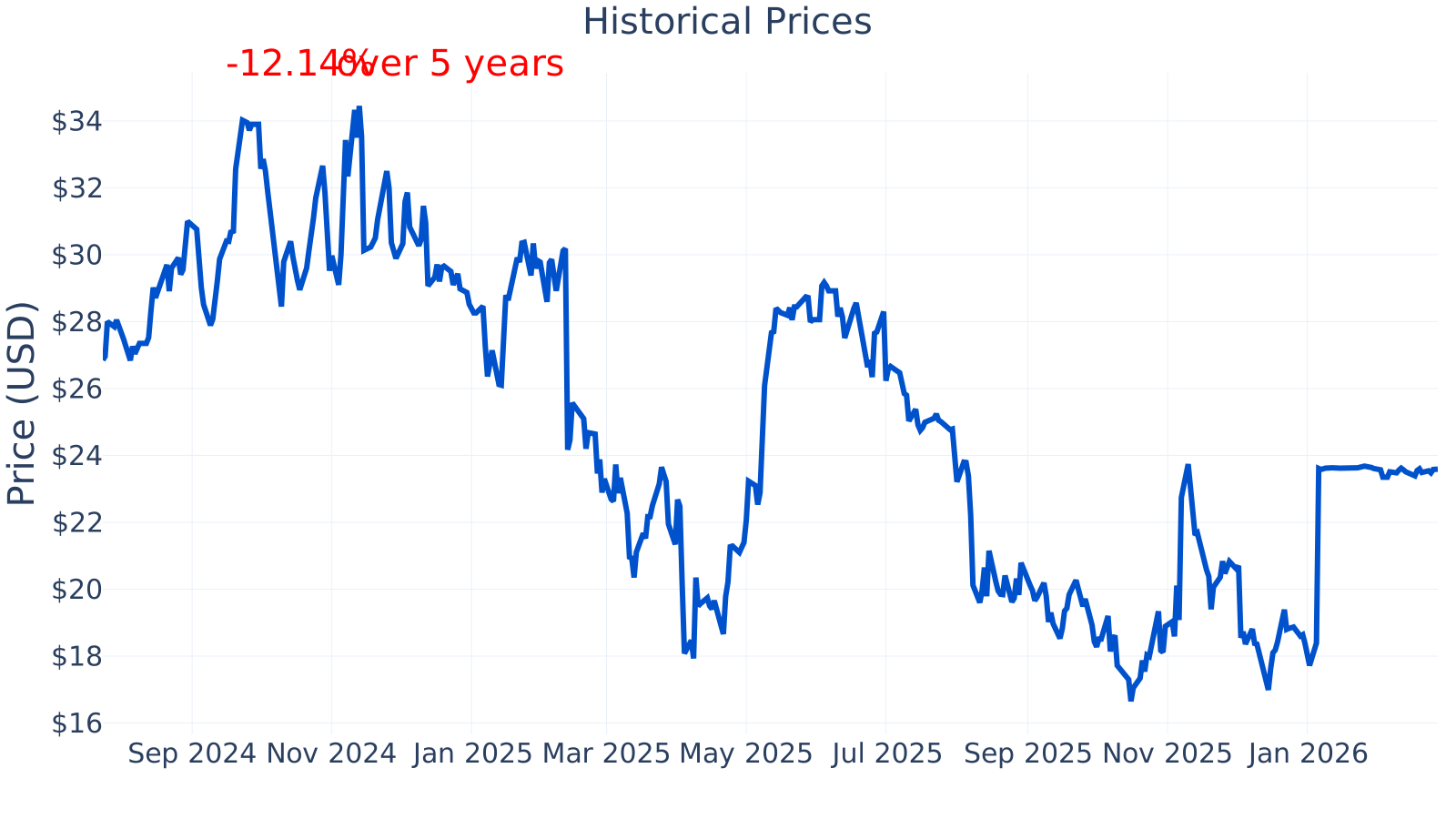
OneStream Inc. (OS) develops software used by finance teams to run core planning and reporting processes in one place. Its platform is designed to help organizations consolidate financial results, plan budgets and forecasts, manage reporting, and support other “office of the CFO” workflows. In practice, the company sells software and related services that aim to replace spreadsheets and fragmented finance tools with a single system.
In its filings, OneStream describes revenue that is primarily driven by software access (typically under subscription-style arrangements) and supplemented by services such as implementation and customer support. In simple terms, the software portion is generally the largest and tends to be more recurring over time, while services are often tied to deployments and ongoing help.
Main revenue sources (from largest to smallest; exact percentages depend on the period and the company’s reporting categories):
- Subscription/software revenue (access to the platform and related cloud or term-based arrangements)
- Services revenue (implementation, training, and support-type services)
At a high level, the company has grown revenue meaningfully over recent years, but it has also reported net losses, reflecting continued investment in operating expenses such as research and development and sales and marketing.
From 2022 to 2025, revenue increased (about $279M to about $602M), and gross profit increased as well (about $187M to about $413M). Net income, however, remained negative across these years, which suggests that operating costs (including research and development and selling/general/administrative expenses) have been large relative to gross profit as the company scales.
Key Figures
| Metric | Value | Industry ⓘ |
|---|---|---|
| Date | Mar 02, 2026 | |
| Context | ||
| Sector | Technology | |
| Industry | Software - Infrastructure | |
| Market Cap ⓘ | $5.79B | |
| Beta ⓘ | N/A | |
| Fundamental | ||
| P/E Ratio ⓘ | N/A | 24.58 |
| Profit Margin ⓘ | -8.36% | 6.79% |
| Revenue Growth ⓘ | 23.60% | 16.35% |
| Debt to Equity ⓘ | 2.93% | 26.59% |
| PEG ⓘ | N/A | |
| Free Cash Flow ⓘ | $95.63M | |
As shown in the latest metrics, the company’s market capitalization is about $5.8B. Revenue growth year over year is about 23.6%, which is higher than the stated industry median of 16.4%. Profit margin is about -8.4% versus an industry median near 6.8%, indicating the company is still not reporting profits on a net basis. Debt-to-equity is about 2.9%, which is notably below the industry median (about 26.6%), suggesting relatively modest balance-sheet leverage. Trailing twelve-month free cash flow is about $95.6M.
Growth (Medium)
OneStream operates in enterprise software for financial planning, consolidation, and reporting—areas that are typically supported by long-term demand because organizations need ongoing budgeting/forecasting, regulatory reporting, and performance management. Modernization trends (moving away from spreadsheets and disconnected legacy tools, and adopting cloud-based enterprise systems) can support continued adoption for vendors in this category.
The company’s strategy, as described in its public filings, centers on expanding usage within existing customers and adding new customers who want a single platform for multiple finance processes. A practical growth driver in this business model is “land and expand”: an initial deployment can be followed by additional modules, more users, or broader rollout across business units and geographies.
The year-over-year revenue growth shown (roughly in the 19%–26% range across the periods displayed) indicates the business has been expanding at a relatively strong pace. Sustaining this type of growth typically depends on maintaining competitive product capabilities, effective enterprise sales execution, and customer retention.
Free cash flow is shown as positive and rising across the periods displayed (from about $58.5M to about $69.5M in the charted points, with the latest table showing $95.6M on a trailing basis). For long-term business durability, positive free cash flow can be meaningful because it indicates the company may be able to fund operations and growth initiatives without relying solely on external financing, even while reported net income remains negative.
Risks (High)
A central risk is that the company has reported net losses in recent years, and profitability can remain pressured if operating expenses (such as product development and enterprise sales costs) grow as fast as—or faster than—gross profit. Enterprise software can be a scale business, but reaching consistent profitability can take time and may not follow a straight line.
The profit margin trend shown remains negative, but it improves significantly from roughly -45% in earlier periods displayed to about -8% more recently. Even with improvement, the company is still below the industry median margin (shown as positive). This gap matters because it highlights ongoing execution risk: the company needs to keep growing while controlling costs to close the profitability difference versus more mature peers.
Competition is another key risk. The market for finance planning, consolidation, and performance management software includes large enterprise vendors and specialized providers. In broad terms, competitors can include major enterprise software suites and well-known finance/planning platforms. Competing against larger vendors can involve pricing pressure, longer sales cycles, and higher customer expectations for integrated, end-to-end capabilities.
OneStream’s competitive positioning, as described in its filings, is tied to providing a unified platform for multiple CFO workflows (rather than separate tools for each job), plus ongoing product investment. Whether that translates into durable competitive advantages depends on factors like product differentiation, switching costs (how hard it is for customers to migrate away), customer satisfaction and retention, and the pace of innovation relative to peers.
Financial risk from leverage appears relatively limited in the periods shown: debt-to-equity declines from about 6.0% to about 2.9%, and it remains below the industry median throughout. While low leverage can reduce balance-sheet stress, it does not remove the operational risks tied to profitability, customer retention, and competitive dynamics.
Valuation
Traditional valuation ratios such as price-to-earnings (P/E) can be less informative when a company reports net losses, because earnings may be negative or volatile. In those cases, investors often focus more on revenue growth, gross margin structure, free cash flow generation, and the path toward sustainable profitability.
The P/E chart does not display meaningful company values across the periods shown (shown as 0), while the industry median P/E remains around the high-20s to low-30s range. This pattern is consistent with a company that is not yet producing positive earnings on a trailing basis, making direct P/E comparison to profitable peers less useful. In this context, whether the stock price is “expensive” or “cheap” is typically framed by how credible and timely the profitability path is, alongside the durability of growth and cash generation.
Conclusion
OneStream is a finance-focused enterprise software company with solid recent revenue growth and positive free cash flow in the periods shown. At the same time, it has reported net losses and profit margins that remain below the broader industry median, which raises execution risk around cost control and the pace at which profitability can improve.
From a long-term, fundamentals-oriented perspective, the key facts to track over time are whether revenue growth remains resilient, whether margins continue to improve toward positive territory, and whether free cash flow stays consistently positive while the company competes in a crowded market with both large suite vendors and specialized platforms.
Sources:
- SEC EDGAR — OneStream Inc. registration and periodic filings (e.g., Form S-1, Form 10-K, Form 10-Q)
- OneStream Inc. Investor Relations — Company filings and shareholder materials posted by the company
- Wikipedia — “OneStream” (basic company background and history)
This article is for informational purposes only and does not constitute financial advice. Some content is AI-generated. See Disclaimer