Stock Analysis · ON Semiconductor Corporation (ON)
Overview
ON Semiconductor Corporation (often called onsemi) designs and sells semiconductor components that help control and convert electrical power and process signals. In simple terms, its chips help systems run efficiently and reliably in products such as electric vehicles (EVs), charging and power infrastructure, factory automation equipment, and many other electronics.
The company presents its business around three main product groups:
- Power Solutions Group (PSG): parts that manage, convert, and protect power (important for EV powertrains, chargers, data center power, and industrial power systems).
- Analog and Mixed-Signal Group (AMG): chips that condition, measure, and manage real-world signals (used broadly across automotive and industrial electronics).
- Intelligent Sensing Group (ISG): image sensors and related products that “see” or detect (used for automotive sensing and some industrial applications).
For revenue mix by end market, onsemi typically highlights automotive and industrial as the largest areas, with additional exposure to other markets (such as computing/consumer depending on the period). Exact percentages can vary by quarter and are detailed in company filings.
Across recent years, revenue rose from about $6.74B (2021) to $8.33B (2022), then softened to about $7.08B (2024) and $6.00B (2025). Profitability also moved materially: net income was about $1.01B (2021), $1.90B (2022), $2.18B (2023), then declined to about $1.57B (2024) and $0.12B (2025). This pattern is consistent with a cyclical semiconductor environment where demand and pricing can change faster than fixed operating costs.
Key Figures
| Metric | Value | Industry ⓘ |
|---|---|---|
| Date | May 08, 2026 | |
| Context | ||
| Sector | Technology | |
| Industry | Semiconductors | |
| Market Cap ⓘ | $39.43B | |
| Beta ⓘ | 1.94 | |
| Fundamental | ||
| P/E Ratio ⓘ | 73.98 | 53.51 |
| Profit Margin ⓘ | 9.46% | 8.08% |
| Revenue Growth ⓘ | 4.70% | 19.70% |
| Debt to Equity ⓘ | 41.18% | 20.71% |
| PEG ⓘ | 0.35 | |
| Free Cash Flow ⓘ | $1.45B | |
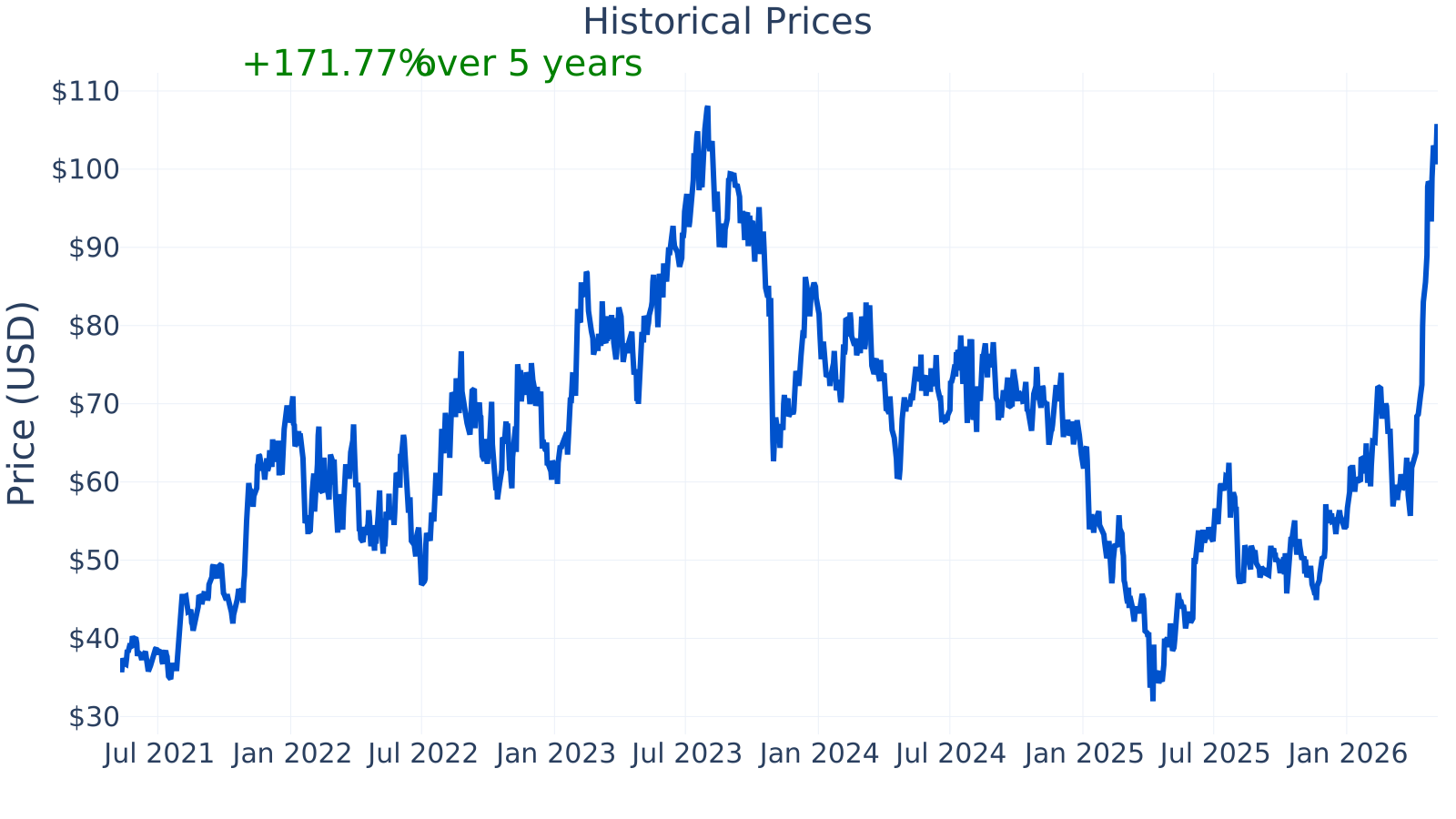
At the latest point shown, onsemi’s market capitalization is about $39.4B. The stock’s beta (~1.94) suggests it has historically moved more than the broader market (higher volatility). The trailing P/E ratio (~74.0) is above the industry median (~53.5), while the latest profit margin (~9.46%) is slightly above the industry median (~8.08%). Year-over-year revenue growth is about 4.7%, below the industry median (~19.7%). Debt-to-equity is about 41%, higher than the industry median (~21%). Trailing twelve-month free cash flow is about $1.45B.
Growth (Medium)
onsemi operates in semiconductors, an industry with long-term growth drivers but meaningful short-term cycles. The long-term tailwinds are tied to “electrification” and efficiency: EVs and charging infrastructure require far more power-management semiconductor content than traditional vehicles; factories and grids are also being upgraded for automation and energy efficiency. These themes tend to support rising semiconductor content per vehicle or machine over time, even if unit volumes fluctuate.
A key part of onsemi’s strategy has been emphasizing automotive and industrial applications where reliability requirements are high, product lifecycles can be longer, and qualification barriers can be meaningful. The company also focuses on power technologies (including silicon carbide, a material often used in high-voltage power electronics) that are particularly relevant for EV traction inverters, fast charging, and high-efficiency power conversion.
The year-over-year revenue growth trend shown is clearly cyclical: it was strongly positive in 2021–2022, then turned negative through much of 2023–2025, and returns to modestly positive (~4.7%) in the latest point shown. For long-term context, this pattern is common in semiconductors, where multi-quarter inventory and demand corrections can follow periods of rapid expansion.
Free cash flow (cash left after operating needs and capital spending) is an important indicator of financial flexibility. The chart shows onsemi generating substantial free cash flow over time, with a dip around 2024 (~$0.82B) and a recovery afterward to about $1.45B most recently. This suggests the business has continued to convert a meaningful portion of operations into cash even as the cycle weakened.
Risks (High)
The biggest risk is semiconductor cyclicality. Demand can swing due to changes in customer inventories, broader economic conditions, and shifts in end markets like automotive production. When demand slows, pricing and factory utilization can weaken, and profit can decline quickly (which is visible in the recent drop in annual net income).
Another major risk is customer and end-market concentration. If a large automotive or industrial customer reduces orders, changes designs, or dual-sources to competitors, results can be affected. In addition, automotive programs involve long qualification cycles; once designed in, business can be sticky, but losing a socket can matter for years.
Technology execution also matters. Power semiconductors and automotive-grade components have demanding performance and reliability requirements. If a company misses cost targets, yield targets, or delivery commitments, customers may shift volumes.
The debt-to-equity ratio has improved significantly versus 2021 (moving from roughly 82% down to about 41%), but it remains higher than the industry median (about 15%–21% across the periods shown). That does not automatically indicate financial stress, but it can reduce flexibility during downturns compared with peers that operate with lower leverage.
Profit margin expanded strongly into 2022–2024 (peaking around the mid-20% range in the series shown), then compressed sharply during 2025 before recovering to about 9.46% most recently—roughly in line with the industry median. This volatility highlights how quickly profitability can change with product mix, pricing, and utilization.
Competitive positioning is another risk area. onsemi competes with large, well-funded semiconductor companies across power and automotive/industrial markets. Key competitors often include Infineon Technologies, STMicroelectronics, Texas Instruments, NXP Semiconductors, Analog Devices, and others depending on the product category. onsemi’s potential advantages are its focus on power and sensing for automotive/industrial needs, established customer relationships, and the difficulty of qualifying parts for automotive safety and reliability requirements. However, it is not the only scaled player pursuing these same growth areas, and competition can pressure pricing and market share.
Valuation
The P/E ratio shown varies widely over time, with a sharp increase in the most recent point on the chart. A rising P/E can happen when the stock price rises, when earnings fall, or both. Given that recent profitability has been volatile (with a notable net income decline in 2025), part of the elevated P/E can reflect a period where earnings are lower than prior peaks.
Compared with the industry median, onsemi’s latest P/E (~74) is higher than the median (~53.5). In general terms, a higher P/E implies the market is assigning a higher price relative to current earnings, which can be consistent with expectations of an earnings recovery, stronger long-term growth, or a view that recent earnings are temporarily depressed. At the same time, higher valuation multiples can leave less room for disappointment if growth is slower than expected or if the industry remains weak longer than anticipated.
Conclusion
onsemi is a semiconductor company centered on power, analog/mixed-signal, and sensing products, with a strategic emphasis on automotive and industrial markets. These end markets are supported by long-term themes such as electrification, energy efficiency, and automation, which can increase semiconductor content per vehicle or machine over time.
At the same time, the company’s recent history shows the industry’s cyclical nature: revenue growth turned negative for an extended period and profitability compressed sharply before partially recovering. Financially, onsemi has continued to generate meaningful free cash flow, while leverage has come down from earlier levels but remains above the industry median in the data shown. Valuation indicators (notably the P/E ratio) appear elevated versus the industry median, which often coincides with periods where earnings are depressed or expectations for future improvement are high.
Sources:
- SEC EDGAR — ON Semiconductor Corporation — Form 10-K (Annual Report)
- SEC EDGAR — ON Semiconductor Corporation — Form 10-Q (Quarterly Report)
- onsemi Investor Relations — Annual Report / SEC Filings section
- onsemi Investor Relations — Earnings call materials and prepared remarks (company-hosted, public)
- Wikipedia — “ON Semiconductor” (company overview and basic history)
This article is for informational purposes only and does not constitute financial advice. Some content is AI-generated. See Disclaimer


