Stock Analysis · Omnicom Group Inc (OMC)
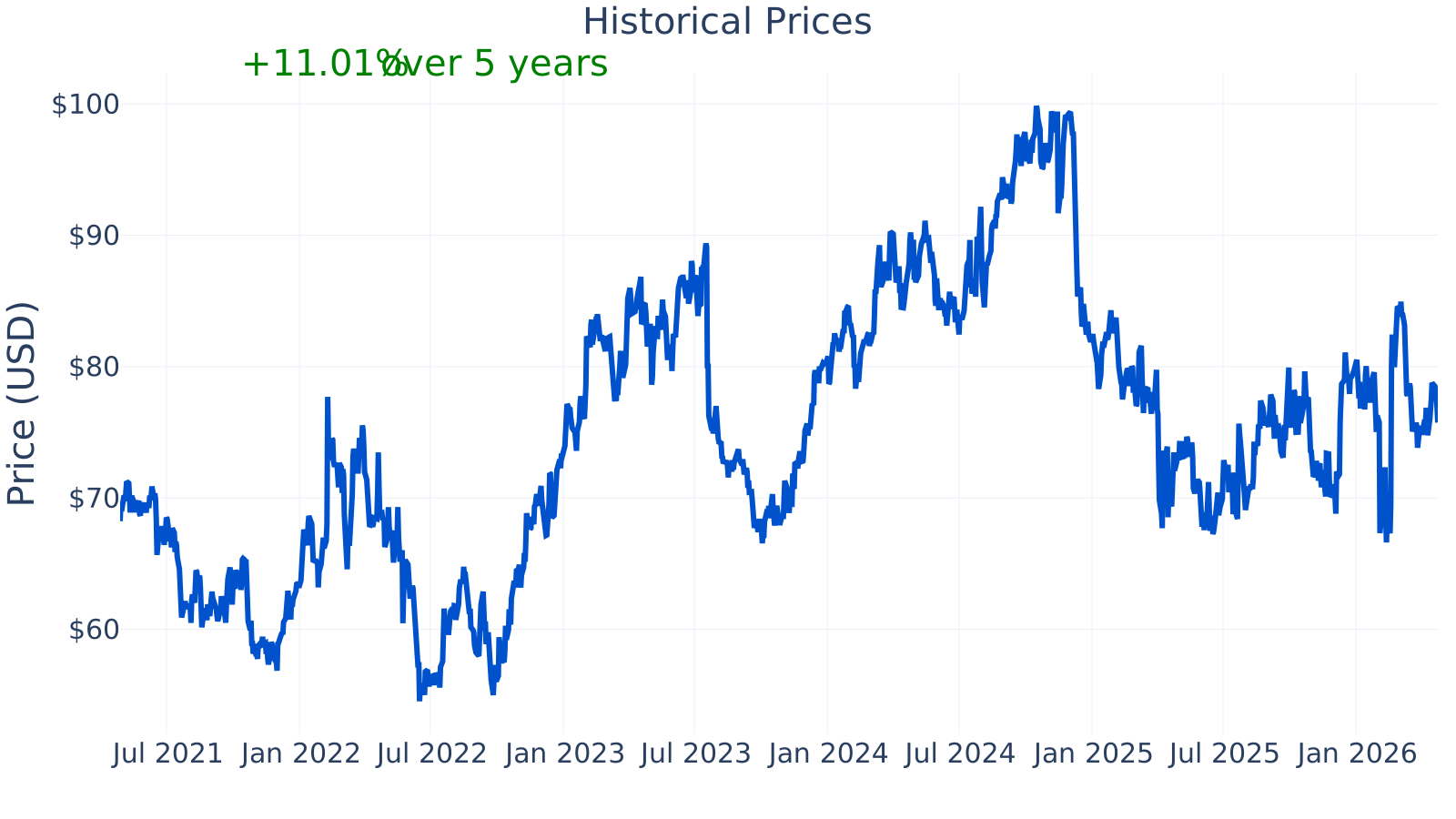
Overview
Omnicom Group Inc (OMC) is a global marketing and communications company. In simple terms, it helps organizations promote their brands and products through advertising, public relations, customer relationship management, and other marketing-related services. Omnicom operates through a large portfolio of agencies and service brands, and it generally earns fees for professional services delivered to clients (for example, strategy, creative work, media planning, and marketing execution).
Based on how Omnicom describes its operations in its SEC filings, its revenue typically comes from a mix of marketing services categories such as advertising, media-related services, precision/CRM and digital, public relations, and branding/retail-related services. The exact split can change year to year and may be presented in different ways depending on the report.
High-level revenue drivers often include:
- Advertising and creative services (campaign development and brand communications)
- Media planning and buying (helping clients choose channels and place ads)
- CRM, data-driven and digital marketing services (customer acquisition/retention programs, performance marketing)
- Public relations (reputation and communications support)
- Other marketing services (including branding and specialized offerings)
From a “where the money goes” perspective, Omnicom’s business model also tends to have a large pass-through cost component (costs paid to third parties to deliver client work), while the company’s profitability depends heavily on managing personnel costs and overhead efficiently.
Across 2021–2024, total revenue rose from about $14.3B to about $15.7B, with operating income also increasing (about $2.20B to $2.38B). The 2025 view shows a very different pattern: revenue increased to about $17.3B, but operating income dropped sharply and net income turned slightly negative. In practice, this kind of divergence usually signals large one-time or unusual items affecting expenses and/or profitability, which is something readers often verify directly in the company’s annual report details.
Key Figures
| Metric | Value | Industry ⓘ |
|---|---|---|
| Date | Apr 27, 2026 | |
| Context | ||
| Sector | Communication Services | |
| Industry | Advertising Agencies | |
| Market Cap ⓘ | $23.50B | |
| Beta ⓘ | 0.75 | |
| Fundamental | ||
| P/E Ratio ⓘ | 12.28 | 25.13 |
| Profit Margin ⓘ | -0.32% | 3.26% |
| Revenue Growth ⓘ | 27.90% | 5.90% |
| Debt to Equity ⓘ | 106.10% | 30.22% |
| PEG ⓘ | 15.97 | |
| Free Cash Flow ⓘ | $2.79B | |
Omnicom’s market capitalization is about $23.5B, and the stock’s beta of 0.75 suggests it has historically moved less than the overall market on average. The latest P/E ratio shown is about 12.3, below the industry median shown (about 25.1), which can indicate a lower valuation or different expectations for growth and risk. Revenue growth (year over year) is shown at about 27.9%, above the industry median shown (about 5.9%), while debt-to-equity is about 106%, above the industry median shown (about 30%). The profit margin is shown near -0.3%, which is notably different from prior periods where margins appear positive in the longer history below; this points to a period where profitability was pressured or distorted by special items.
Growth (Medium)
The advertising and marketing services industry is closely tied to overall economic activity and corporate marketing budgets. Over the long run, brand-building and customer acquisition remain important across most industries, but spending can be cyclical: during weaker economic periods, some clients reduce or delay marketing campaigns. On the other hand, ongoing shifts toward digital channels, data-driven targeting, and measurable performance marketing can support demand for sophisticated, integrated marketing services—areas where large agency groups try to compete by combining creative capabilities with media, data, and technology execution.
A common long-term strategy for companies like Omnicom is to deepen relationships with large clients by offering more integrated services (creative + media + data/CRM + PR) and to expand capabilities in higher-growth marketing areas. A potential catalyst for results—when executed well—tends to be stronger demand for integrated, measurable marketing programs and continued reallocation of budgets toward digital channels. That said, whether this translates into durable growth depends on client retention, pricing discipline, and cost management.
The year-over-year revenue growth line shows that growth was modest through much of 2022 and 2023, improved through 2024, and then shows a sharp increase to about 27.9% in the latest period shown. A jump of that size can reflect a real acceleration in activity, acquisitions, currency effects, or changes in comparability; the company’s 10-K/10-Q typically explains the main reasons behind any unusually large shift.
Free cash flow (trailing twelve months) is shown at about $2.79B in the latest figure listed, compared with about $1.19B (2022-03-31), $0.87B (2023-03-31), $1.25B (2024-03-31), and $1.42B (2025-03-31). For a services business, sustained free cash flow matters because it can support reinvestment, dividends, debt reduction, and share repurchases (depending on management’s capital allocation choices described in filings).
Risks (Medium-High)
The biggest business risk for an advertising and marketing services group is that client spending can be cyclical and sometimes quickly adjusted. Client concentration can also matter: losing a large account or facing pricing pressure in competitive contract renewals can affect results. Another structural risk is industry change—clients may bring some work in-house, shift spending to different platforms, or rely more on technology-driven tools. Execution risk is also relevant: these businesses depend heavily on talent retention, reputation, and consistent delivery quality across many teams and geographies.
Financial risk is often tied to leverage and the stability of operating profits. Higher debt can increase sensitivity to interest rates and refinancing conditions, and it can reduce flexibility during downturns. Omnicom’s relative position versus peers also depends on whether it can maintain margins while continuing to invest in data, analytics, and modern marketing capabilities.
The debt-to-equity trend shows Omnicom’s leverage coming down materially from very high levels earlier in the period (around 190%–230% in 2021–2022) to about 106% in the latest point shown. Even after that improvement, it remains higher than the industry median shown (roughly 24%–65% over much of the period, with about 24% at the latest point). In simple terms, this indicates Omnicom has used more debt relative to shareholder equity than many peers in the comparison set.
Competitive advantages in this industry typically come from scale (ability to serve global clients), breadth of services, long client relationships, and strong creative and media capabilities. Omnicom is one of the large global agency groups, which can be an advantage in winning multinational accounts. However, the industry is competitive, and leadership is not absolute—large accounts can move between networks.
Major competitors commonly include other global advertising holding companies such as WPP, Publicis Groupe, Interpublic Group, and Dentsu, alongside consulting firms and fast-growing digital-focused service providers. Compared to these peers, Omnicom is generally viewed as a scaled, diversified incumbent; the main question tends to be how well it sustains growth and profitability as client demands shift toward data-driven and technology-enabled marketing.
Historically in the period shown, Omnicom’s profit margin appears to have been mostly in the 8%–10% range for many quarters, often above the industry median displayed. The latest point shown is about -0.3%, which is a sharp departure from the earlier pattern and below the industry median shown (about 6.8%). A sudden move like this often reflects unusual charges, accounting impacts, or other non-recurring items; readers typically rely on the annual report notes and management discussion to understand what drove the change and whether it is expected to persist.
Valuation
Valuation for an established marketing services firm is often discussed using earnings-based multiples (like the P/E ratio), while also checking whether earnings are stable and cash flows are consistently positive. Omnicom’s latest P/E ratio shown is about 12.3, which is below the industry median shown at about 25.1. A lower P/E can occur when the market expects slower growth, sees higher risk (for example, leverage or cyclicality), or when recent earnings are viewed as less sustainable.
Over the historical period shown, Omnicom’s P/E ratio generally sits in a range around the high single digits to mid-teens, while the industry median displayed is often higher and sometimes extremely high (which can happen when some companies in the peer set have very low earnings, making the ratio less informative). In this context, interpreting valuation benefits from pairing the P/E view with what is happening to margins and leverage: if profitability is temporarily depressed (as the latest margin suggests), earnings-based multiples can become harder to compare across time, and cash flow can provide an additional reality check.
Conclusion
Omnicom is a large, diversified marketing and communications services group operating in a competitive and economically sensitive industry. The company’s scale and breadth can support long-running client relationships, while industry trends toward digital and data-driven marketing create opportunities for agencies that can execute integrated campaigns effectively.
The main points that stand out from the recent financial picture are: (1) revenue growth shows a notable recent spike, (2) free cash flow appears meaningful in absolute dollars, (3) leverage has improved but remains higher than the industry median shown, and (4) the latest profit margin reading is unusually weak versus prior quarters, which suggests the need to understand what drove the change and whether it is temporary.
From a valuation perspective, the P/E ratio shown is below the industry median shown, but interpreting that gap depends heavily on the durability of earnings and normalization of margins. In practice, long-term analysis often comes down to whether Omnicom can sustain client demand, protect margins through cycles, and maintain financial flexibility while investing in modern marketing capabilities.
Sources:
- SEC EDGAR — Omnicom Group Inc filings (Form 10-K, Form 10-Q)
- Omnicom Group Inc Investor Relations — SEC filings / annual report materials
- Wikipedia — “Omnicom Group” (basic company background)
This article is for informational purposes only and does not constitute financial advice. Some content is AI-generated. See Disclaimer


