Stock Analysis · Olaplex Holdings Inc (OLPX)
Overview
Olaplex Holdings Inc is a hair care company best known for products designed to repair and protect hair. Its brand started with a bond-building technology originally popularized in professional salons and later expanded into take-home products. The company sells through a mix of professional channels (salons and stylists), specialty retail, and direct-to-consumer online, with distribution that includes the U.S. and international markets.
In its filings, Olaplex describes its business around a “single brand” strategy (Olaplex) supported by product innovation, marketing, and distribution expansion. This approach can work well when a brand has strong recognition, but it also means results depend heavily on maintaining the brand’s relevance and pricing power over time.
Main sources of revenue are typically described by sales channel (and in some periods by geography). In recent years, the company has emphasized three core channels:
- Specialty retail (selling through large beauty-focused retailers)
- Professional (sales linked to salons, stylists, and professional distributors)
- Direct-to-consumer (company e-commerce and other direct selling)
From an overall profitability lens, Olaplex has historically generated high gross profit relative to revenue (meaning product costs were a smaller share of sales), but operating expenses have become much heavier in recent years, which has pressured net results.
Over 2021–2025, revenue peaked in 2022 ($704.3M) and then declined to about $423.0M in 2025. At the same time, selling, general, and administrative spending rose sharply by 2025 ($243.1M), while operating income compressed to $16.3M and net income turned slightly negative (-$9.3M). This combination suggests the company has been spending substantially more to support the brand and distribution than it did during its earlier high-growth period.
Key Figures
| Metric | Value | Industry ⓘ |
|---|---|---|
| Date | Mar 16, 2026 | |
| Context | ||
| Sector | Consumer Cyclical | |
| Industry | Specialty Retail | |
| Market Cap ⓘ | $803.28M | |
| Beta ⓘ | 2.24 | |
| Fundamental | ||
| P/E Ratio ⓘ | N/A | 20.21 |
| Profit Margin ⓘ | -2.19% | 4.93% |
| Revenue Growth ⓘ | 4.30% | 4.60% |
| Debt to Equity ⓘ | 40.06% | 103.28% |
| PEG ⓘ | N/A | |
| Free Cash Flow ⓘ | $56.85M | |
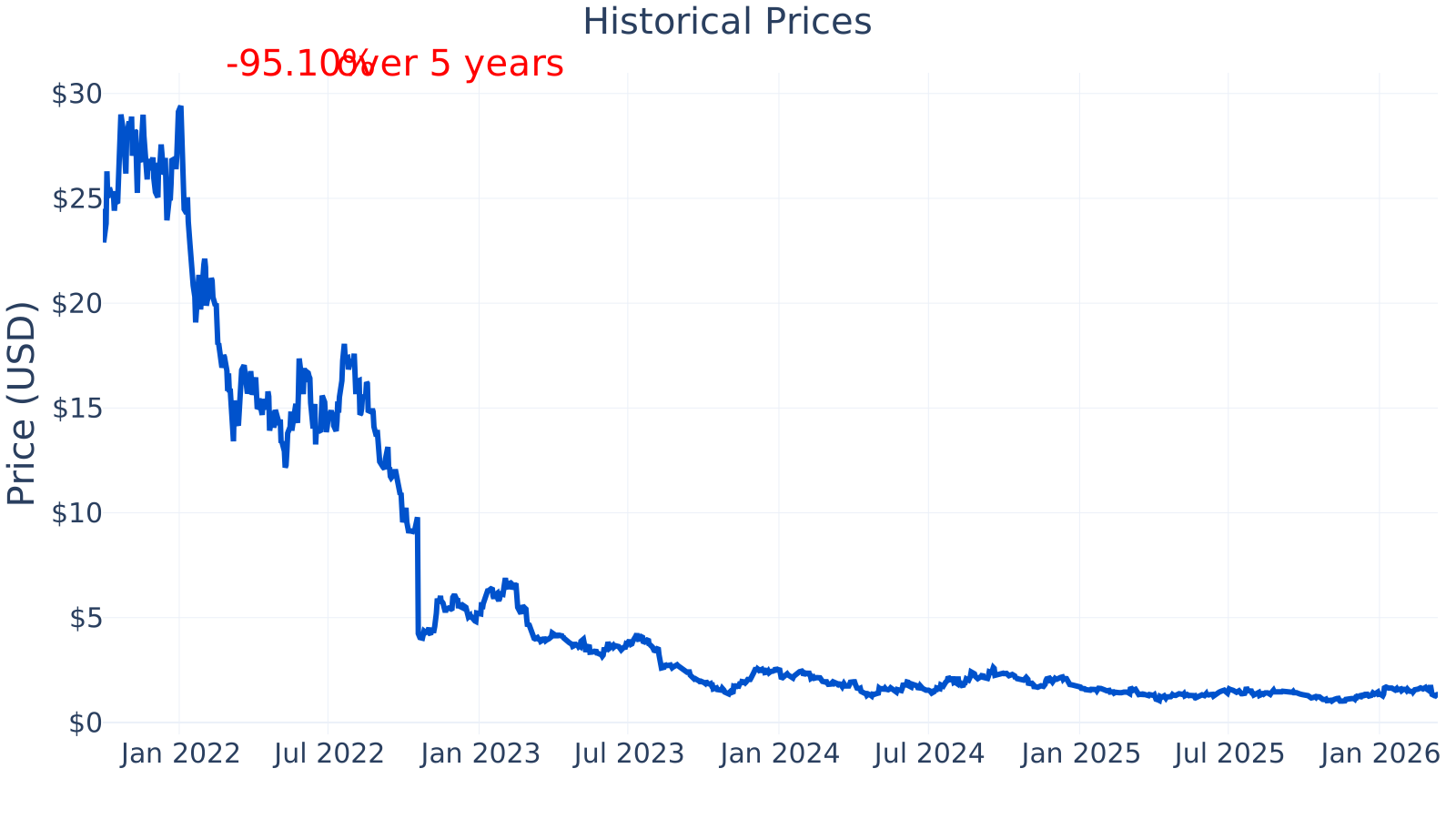
Olaplex’s market capitalization is about $803M, placing it in a smaller-cap range where share prices can be more volatile. That volatility is also reflected in a beta of 2.24, which indicates the stock has historically moved more than the broader market. The company’s most recent profit margin is -2.19% versus an industry median near 4.93%, showing profitability has been weaker than many peers recently. Year-over-year revenue growth is 4.3%, roughly in line with the industry median (~4.6%). Leverage looks lower than typical for the peer set, with debt-to-equity around 40% versus an industry median near 103%. Trailing twelve-month free cash flow is about $56.8M.
Growth (Medium)
Olaplex operates in the broader beauty and personal care market, where demand is generally supported by recurring purchase behavior and ongoing product cycles (new formulations, routines, and trends). However, within hair care, growth can be uneven because consumers can switch brands quickly, and retailers and salons adjust shelf space and recommendations based on what is trending and what sells through.
Strategically, Olaplex’s path to growth depends on keeping its brand “top of mind,” expanding internationally and across channels, and launching products that sustain repeat purchases beyond a few hero items. This can be a credible long-term strategy, but it usually requires consistent marketing effectiveness, product performance, and retailer support.
Revenue growth has been volatile. After very high growth in 2021 and early 2022, growth turned negative through much of 2023 and 2024, then returned to modestly positive by late 2025 (about 4.3% year over year at the end of 2025). This pattern is consistent with a business that moved from rapid expansion into a correction period, and then attempted to stabilize.
Free cash flow (cash left after operating needs and investments) has declined from earlier peaks (around $228.6M in 2023) to about $91.6M by early 2025, and the latest trailing figure is about $56.8M. For long-term business resilience, the key question is whether the company can stabilize demand while keeping spending (especially operating costs) aligned with its revenue base.
Risks (High)
The most important business risk is brand and demand durability. Hair care is competitive, trend-driven, and highly dependent on consumer perception, reviews, social media momentum, and stylist recommendations. If the brand loses relevance or if competing products are perceived as similar, pricing and volumes can come under pressure.
Another key risk is profitability pressure from operating costs. Even with healthy gross profit historically, a company can struggle to produce consistent earnings if selling and administrative expenses rise faster than sales. That dynamic is particularly important for a single-brand company, where the same brand must support the whole organization.
Profitability has deteriorated substantially over time. Profit margin was very high in 2021–2022 (often above 30%), then steadily fell and turned slightly negative by 2025 (about -2.19%), while the industry median remained positive (around the mid-single digits). This suggests the company’s recent cost structure and/or pricing and volume levels have not supported prior profit levels.
On balance-sheet risk, leverage appears lower than many peers recently. Debt-to-equity declined from very elevated levels in 2021 (over 100%) to about 40% by late 2025, below the industry median (roughly 100%). Lower leverage can reduce financial stress, but it does not eliminate operating risk if profitability remains weak.
Competitive positioning is another meaningful risk area. Olaplex participates in categories with many well-funded competitors, including large global beauty groups and other prestige hair care brands. In practice, competition can show up through promotional intensity, retailer negotiations, higher marketing spend, and faster product imitation. Olaplex’s competitive advantage has historically been tied to brand recognition and its proprietary technology positioning, but durability depends on continued product differentiation, consumer trust, and channel support.
Valuation
Price-to-earnings (P/E) is typically used to compare a stock price to earnings, but it becomes less informative when earnings are very low or negative. The latest P/E shown is 0.0, which is consistent with earnings that are not meaningful for a standard P/E comparison, especially given the company’s recently negative profit margin.
Historically, the chart shows that Olaplex’s P/E was much higher than the industry median in 2021–early 2022 (reflecting the market pricing in rapid growth), then moved closer to the industry range at times, and later becomes unavailable/unstable as profitability weakened. In this situation, valuation discussions often shift toward whether margins can recover and whether free cash flow can stabilize, since those fundamentals tend to drive longer-term outcomes more directly than a near-term P/E.
Conclusion
Olaplex is a recognizable hair care brand that expanded quickly and then went through a period of demand normalization and profitability compression. Recent results show modest revenue growth returning by late 2025, but profitability has weakened substantially compared with earlier years and compared with the industry median, while operating expenses have risen meaningfully.
For a long-term, fundamentals-focused view, the central issues are whether the company can rebuild sustainable profitability (not just stabilize revenue) and whether brand strength and product innovation can support durable demand across professional, retail, and direct channels. Balance-sheet leverage appears lower than many peers, and the company is still generating positive free cash flow, but the recent margin trend highlights elevated execution risk.
Sources:
- U.S. SEC EDGAR — Olaplex Holdings, Inc. Form 10-K (Annual Report)
- U.S. SEC EDGAR — Olaplex Holdings, Inc. Form 10-Q (Quarterly Report)
- Olaplex Holdings, Inc. Investor Relations — SEC Filings and shareholder materials
- Wikipedia — “Olaplex” (basic company background)
This article is for informational purposes only and does not constitute financial advice. Some content is AI-generated. See Disclaimer


