Stock Analysis · Okta Inc (OKTA)
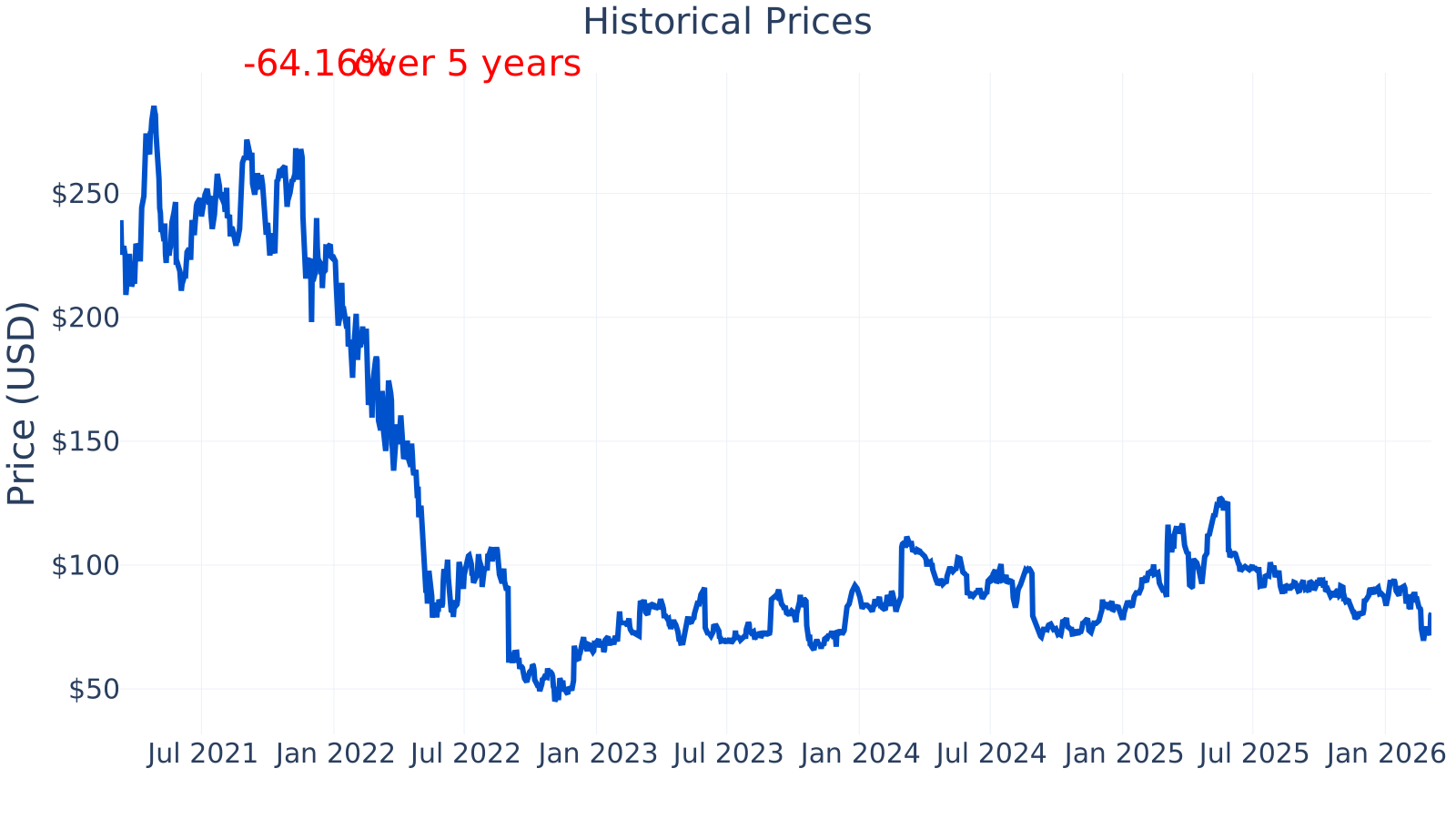
Overview
Okta Inc. is a software company focused on identity and access management. In simple terms, it helps organizations make sure the right people (employees, contractors, partners, and customers) can securely sign in to the right applications and data. Okta’s products are typically used by IT and security teams to manage login, permissions, and security policies across many cloud services and internal systems.
Okta generally earns money through subscription-based software that customers pay for over time (often annually). In its SEC filings, Okta typically describes revenue mainly by subscription revenue versus professional services and other revenue (such as implementation support). Exact percentages can change by period, and the most precise split is shown in the company’s latest Form 10-K / 10-Q.
In broad terms, the main revenue streams are:
- Subscriptions (largest): recurring fees for identity products delivered as cloud services.
- Professional services and other (smaller): setup, support, and related services.
Operationally, Okta’s model is designed around recurring relationships: customers integrate identity into many apps and workflows, and that integration can become more valuable as organizations add more applications, users, and security requirements.
Looking at the recent multi-year profitability bridge, total revenue has been rising (about $1.3B in FY2022 to about $2.9B in FY2026), while operating results moved from large losses to positive operating income. That pattern is consistent with a software company scaling fixed costs over a larger revenue base, though ongoing expenses (notably research and development and sales-related costs) remain significant.
Key Figures
| Metric | Value | Industry ⓘ |
|---|---|---|
| Date | Mar 09, 2026 | |
| Context | ||
| Sector | Technology | |
| Industry | Software - Infrastructure | |
| Market Cap ⓘ | $14.31B | |
| Beta ⓘ | 0.84 | |
| Fundamental | ||
| P/E Ratio ⓘ | 73.38 | 27.58 |
| Profit Margin ⓘ | 8.05% | 6.83% |
| Revenue Growth ⓘ | 11.60% | 16.30% |
| Debt to Equity ⓘ | 6.03% | 24.92% |
| PEG ⓘ | 0.87 | |
| Free Cash Flow ⓘ | $900.00M | |
Okta’s market capitalization is about $14.3B. The stock’s beta of 0.84 suggests it has historically moved somewhat less than the overall market on average, though individual periods can still be volatile.
Profitability has improved to a net profit margin of about 8.05%, slightly above the industry median of about 6.83%. Revenue growth year-over-year is about 11.6%, below the industry median of about 16.3%, indicating slower growth relative to many peers in the same broad industry grouping.
Balance-sheet leverage appears relatively low: debt-to-equity is about 6% versus an industry median around 25%. Free cash flow over the trailing twelve months is about $900M, which is notable because cash generation can matter for long-term flexibility (reinvestment, acquisitions, or balance-sheet strength).
Growth (Medium)
Okta operates in the identity/security segment of enterprise software—an area supported by long-term trends such as cloud adoption, remote and hybrid work, and increasing cybersecurity requirements. As organizations use more apps (SaaS and internal), identity becomes a central control point for secure access, compliance, and reducing account takeover risk. This context generally supports continued demand for identity solutions.
Strategically, Okta’s growth approach centers on expanding within existing customers (more applications, more users, more products) while continuing to acquire new customers. Identity can be “sticky” because it is integrated into daily workflows: once deployed broadly, switching can be disruptive. That said, long-term growth is not only about demand—it also depends on execution, product competitiveness, and maintaining trust in security.
Revenue growth has clearly decelerated from very high rates earlier in the period (above 60% year-over-year in FY2022) to the low-teens more recently (around 11–13% in FY2025–FY2026). Slowing growth is not unusual as a company becomes larger, but it can change how the market values the business, especially compared with faster-growing software peers.
Free cash flow shows a strong improvement over time (from under $100M in FY2022 to about $900M in FY2026). For long-term business durability, this shift can be meaningful because it indicates the company is generating substantially more cash after operating costs and necessary investments.
Risks (High)
Okta’s biggest risk category is security and reputation. Because the company is in the business of controlling access, any security incident, misconfiguration issue, or trust-impacting event can lead to customer hesitation, longer sales cycles, or increased scrutiny. In identity, “trust” is part of the product.
Another key risk is competition and platform consolidation. Many large software vendors bundle identity-related features into broader suites (cloud platforms, device management, enterprise productivity, or security stacks). This can pressure pricing, reduce Okta’s differentiation, or make deals harder to win when customers prefer fewer vendors.
A third risk is growth normalization. With revenue growth now in the low teens, performance expectations can be more sensitive to execution details such as renewals, customer expansion, and product adoption. Slower growth can also limit how much operating leverage (margin expansion) is possible if the company needs to keep investing heavily to compete.
On leverage, the trend has improved substantially over time: debt-to-equity declined from elevated levels earlier in the period to about 6% most recently, below the industry median (about 19% at the same time point). Lower leverage can reduce financial risk, though it does not remove operational and competitive risks.
Profitability has also shifted materially. Net margin moved from deeply negative levels earlier in the timeline to positive more recently, reaching about 8.05% (slightly above the industry median of about 6–7%). A key question for long-term outcomes is whether Okta can sustain and expand profitability while still investing enough to remain a top-tier identity provider.
In terms of competitive position, Okta is one of the most recognized independent identity vendors in enterprise software. Its competitive advantages often discussed in company materials include broad integrations across many third-party apps and a focus on identity as a primary function. However, it competes with large, well-resourced companies and other identity-focused providers, and leadership can vary by customer segment and use case.
Valuation
At the latest point shown in the key metrics, Okta’s P/E ratio is about 73.4, compared with an industry median around 27.6. A higher P/E commonly implies the market is pricing in either higher future earnings growth, improving profitability, lower perceived risk, or a combination of these. It can also reflect that current earnings are still relatively small compared with revenue and cash flow, which can mechanically lift the P/E even if the underlying business is improving.
The historical P/E series only appears in the most recent part of the timeline, which is consistent with a company that previously had losses (making P/E not meaningful) and more recently moved into positive earnings. In this context, valuation interpretation often depends on whether earnings and cash flow continue to scale, and whether revenue growth stabilizes or re-accelerates through product expansion and customer adoption.
Conclusion
Okta is a focused identity and access management company with a business model built largely on recurring subscriptions. The company shows a clear multi-year transition toward stronger financial quality: revenue has grown substantially over the period, free cash flow has expanded markedly, leverage appears low, and net profitability has turned positive.
At the same time, the fact pattern includes meaningful uncertainties: revenue growth has slowed into the low-teens, competition is intense (including large platform vendors), and identity providers face high trust and security expectations. Valuation metrics also indicate the stock is priced at a higher earnings multiple than the industry median, which places more weight on continued execution and ongoing improvement in earnings power.
Sources:
- SEC EDGAR — Okta, Inc. filings (Form 10-K, Form 10-Q, Form 8-K)
- Okta Investor Relations — SEC filings and shareholder materials (company-hosted)
- Wikipedia — “Okta” (basic company background)
This article is for informational purposes only and does not constitute financial advice. Some content is AI-generated. See Disclaimer


