Stock Analysis · NVIDIA Corporation (NVDA)
Overview
NVIDIA Corporation designs computing chips and related software that help computers process complex tasks faster. The company is best known for graphics processing units (GPUs), which started in gaming but have expanded into data centers where companies run artificial intelligence (AI), cloud computing, and other large-scale workloads. NVIDIA also develops networking products used inside data centers, plus software platforms that help customers build and run AI applications.
In its financial reporting, NVIDIA groups revenue mainly by market platform. Based on the most recent annual reporting (FY2026), the business is heavily weighted toward data centers, with smaller segments in gaming and specialized markets.
Main revenue sources (largest to smallest, FY2026):
- Data Center (largest share; includes AI and accelerated computing chips, systems, and networking)
- Gaming (GeForce GPUs and related products)
- Professional Visualization (workstation graphics and enterprise visualization software)
- Automotive (in-vehicle computing platforms and software)
- OEM & Other (includes some lower-volume and legacy items)
NVIDIA’s cost structure also highlights that it is a “fabless” semiconductor company: it designs chips but relies on manufacturing partners to produce them. A large portion of operating spending is research and development, reflecting the need to keep improving hardware and software.
Over the last several fiscal years, revenue and operating income expanded sharply, while research and development spending also increased in absolute dollars. The overall picture is rapid scaling: operating expenses grew, but much more slowly than revenue, which helped profitability rise significantly.
Key Figures
| Metric | Value | Industry ⓘ |
|---|---|---|
| Date | Mar 02, 2026 | |
| Context | ||
| Sector | Technology | |
| Industry | Semiconductors | |
| Market Cap ⓘ | $4.31T | |
| Beta ⓘ | 2.31 | |
| Fundamental | ||
| P/E Ratio ⓘ | 36.09 | 44.92 |
| Profit Margin ⓘ | 55.60% | 10.84% |
| Revenue Growth ⓘ | 73.20% | 16.00% |
| Debt to Equity ⓘ | 7.26% | 21.24% |
| PEG ⓘ | 1.08 | |
| Free Cash Flow ⓘ | $96.68B | |
NVIDIA’s market capitalization is about $4.31 trillion, reflecting the company’s large size and market expectations for future earnings. The stock’s beta of ~2.31 indicates the share price has historically moved more than the broader market (higher volatility). On profitability, the company shows a net profit margin of ~55.6% versus an industry median near 10.8%, which is a major difference. Growth is also elevated: the latest year-over-year revenue growth is ~73.2% compared with an industry median around 16%. Leverage appears relatively modest with debt-to-equity of ~7.3% versus an industry median near 21.2%. The trailing twelve-month free cash flow is about $96.7 billion, indicating substantial cash generation.
Growth (very high)
NVIDIA operates in semiconductors, but its recent growth has been driven by a specific demand wave: accelerated computing for AI in data centers. As more organizations train and run AI models, they need specialized hardware (and supporting networking) to deliver performance and energy efficiency that general-purpose CPUs often cannot match for these workloads. This places NVIDIA in a part of the technology industry that has been expanding quickly.
Revenue growth has been highly cyclical over time—periods of slower or negative growth were followed by a sharp acceleration. The most recent readings show strong expansion, and the latest year-over-year growth rate remains far above the broader semiconductor industry median, suggesting company-specific momentum rather than only industry uplift.
A key element of NVIDIA’s strategy is that it sells more than a chip. In addition to GPUs, it offers systems, interconnect and networking products, and a large software ecosystem (including CUDA and other libraries). This “platform” approach can raise switching costs for customers and can encourage repeat purchasing as customers scale their infrastructure.
Free cash flow has risen substantially over the last few years, reaching about $96.7 billion on a trailing twelve-month basis. For long-term business quality, this matters because cash flow can be used to fund research, expand product development, invest in supply chain commitments, and return capital to shareholders, while still maintaining balance-sheet flexibility.
Potential catalysts that can influence future growth (in either direction) include the pace of global data center investment, the adoption rate of new AI applications, and NVIDIA’s ability to deliver new chip generations and systems on schedule while securing enough manufacturing capacity from external partners.
Risks (high)
NVIDIA’s results are exposed to several meaningful risks that long-term shareholders typically track closely. First, demand can be cyclical: large customers may build capacity quickly and then pause spending, which can create sharp shifts in growth rates. Second, customer concentration can matter in data center markets; large buyers can influence pricing, product requirements, and the timing of orders.
Competition is another key risk. In data centers and AI acceleration, NVIDIA competes with:
- AMD (data center GPUs and accelerators)
- Intel (CPUs and accelerators, plus platform influence in servers)
- Large cloud providers’ in-house chips (custom accelerators designed for internal workloads)
- Other specialized AI-chip companies (niche approaches, often focused on specific workloads)
NVIDIA’s competitive advantages often cited in its filings include its large installed base, the breadth of its software stack, and its pace of hardware innovation across chips, networking, and full systems. Even so, rivals can catch up in certain performance areas, compete aggressively on price, or win designs for specific customers and workloads.
Supply chain dependence is also important. As a fabless chip designer, NVIDIA relies on external manufacturers and packaging partners. Constraints in advanced manufacturing, packaging capacity, component availability, or geopolitically driven restrictions can affect shipment volumes and timing.
The company’s debt-to-equity has trended downward over time and is currently around 7%, below the industry median near 18%. Lower leverage can reduce financial risk, but it does not eliminate business risk from demand swings or competitive pressure.
Profit margin expanded sharply and is currently around 55.6%, far above the semiconductor industry median shown (about 10.8%). Very high margins can reflect strong pricing power and a favorable product mix, but they can also attract more competition and customer efforts to reduce dependence on a single supplier over time.
Valuation
Valuation is often summarized using the price-to-earnings (P/E) ratio, which compares the stock price to the company’s earnings. For fast-growing companies, the P/E can be higher or lower than peers depending on how investors perceive the durability of growth and profitability.
NVIDIA’s latest P/E ratio is about 36.1, compared with an industry median near 44.9 in the provided peer set. Historically, NVIDIA’s P/E has fluctuated widely, including periods when it was much higher than the industry median and periods when it moved closer to (or below) it. In practical terms, this means the stock’s valuation has been very sensitive to changes in expected growth rates and earnings power.
Whether today’s valuation is “high” or “low” depends largely on how sustainable the current level of growth and margins proves to be. The company currently shows unusually high profitability and strong revenue growth versus industry medians, which can support higher valuation levels. At the same time, the risks discussed above—especially competition, customer bargaining power, and the possibility of spending slowdowns after heavy infrastructure buildouts—can lead to significant valuation swings in either direction.
Conclusion
NVIDIA is a large semiconductor and computing-platform company that has become central to accelerated computing in data centers, particularly for AI workloads. The company’s recent financial profile shows very strong revenue growth, unusually high profit margins compared with the industry median, and large free cash flow generation, alongside relatively low balance-sheet leverage.
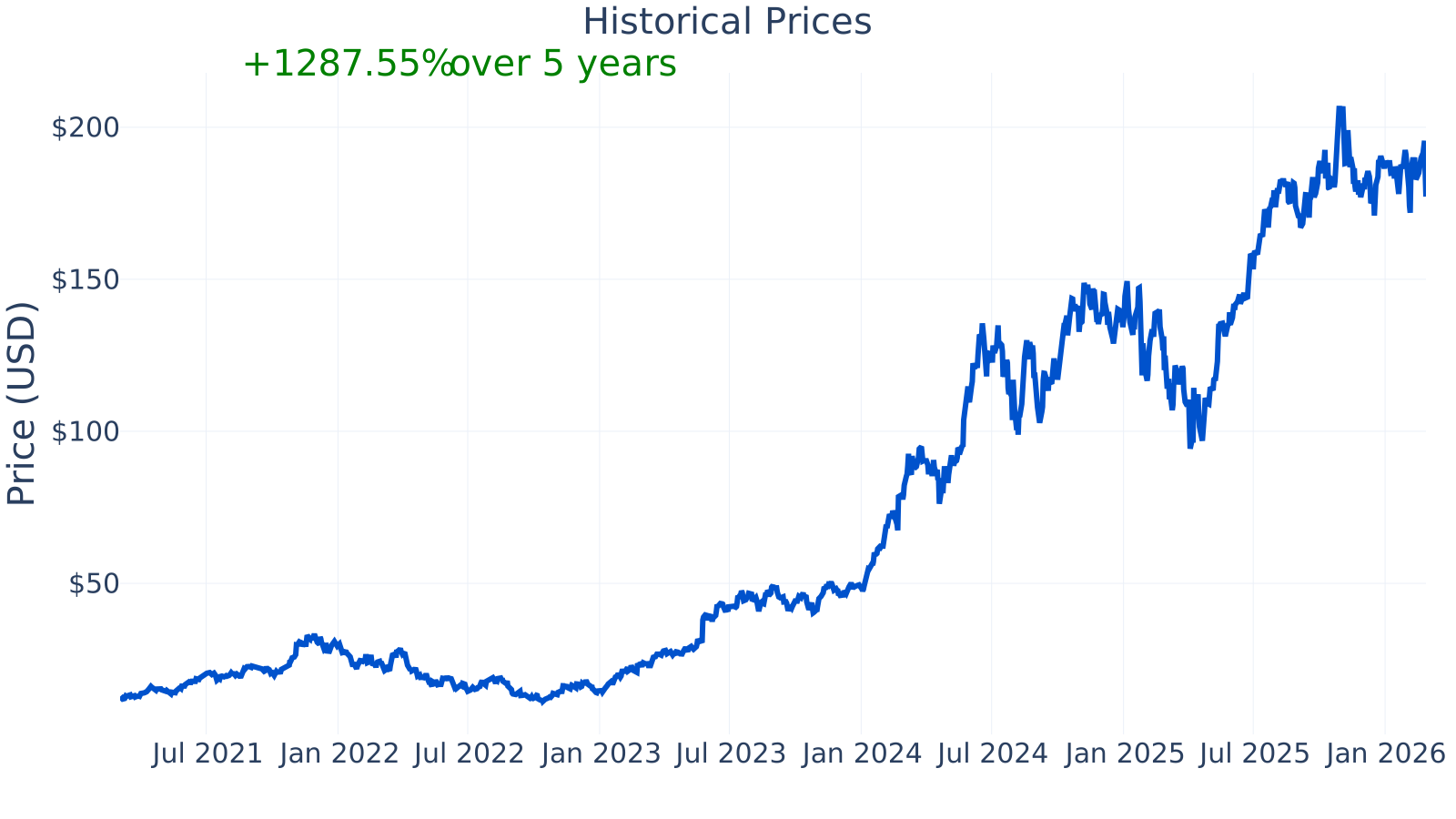
At the same time, the business operates in a fast-moving competitive environment and can be exposed to demand cycles and supply chain dependencies. The stock’s valuation has historically moved significantly as expectations changed, and its higher beta suggests the share price can be more volatile than the broader market.
Overall, the long-term investment case typically hinges on whether NVIDIA can sustain its platform leadership in AI computing (hardware, networking, and software) while navigating competition, customer concentration, and the normal cyclicality of semiconductor-driven markets.
Sources:
- NVIDIA Corporation — Form 10-K (Annual Report) for fiscal year ended January 26, 2025 (SEC EDGAR): “Business,” “Management’s Discussion and Analysis,” “Revenue by Reportable Segment,” and “Risk Factors” sections
- NVIDIA Corporation — Form 10-K (Annual Report) for fiscal year ended January 28, 2024 (SEC EDGAR): segment reporting and risk disclosures
- NVIDIA Corporation Investor Relations — Annual Report materials and shareholder communications (company-hosted)
- SEC EDGAR database — NVIDIA Corporation filings (10-K, 10-Q, 8-K) for definitions of segments, accounting policies, and risk disclosures
- Wikipedia — “Nvidia” (basic company background and history)
This article is for informational purposes only and does not constitute financial advice. Some content is AI-generated. See Disclaimer


