Stock Analysis · NVIDIA Corporation (NVDA)
Overview
NVIDIA Corporation is a semiconductor and software company best known for designing graphics processing units (GPUs). Over time, GPUs became essential not only for gaming graphics but also for running modern artificial intelligence (AI) workloads, because they can process many calculations in parallel. NVIDIA sells chips and complete computing platforms used in data centers (cloud providers and enterprises), gaming PCs, professional visualization workstations, automotive applications, and various embedded/edge devices.
At a high level, NVIDIA makes money by selling hardware (primarily GPUs and related systems) and by providing software and platform components that make its hardware easier to use for developers and enterprises. In its financial reporting, revenue is commonly discussed through its main platform groups, with Data Center and Gaming typically representing the largest portions in recent years, followed by smaller contributions from professional visualization, automotive, and OEM/other activities. Exact mix and percentages can shift meaningfully from year to year depending on demand cycles and product transitions, so the most reliable breakdown is the latest Form 10-K segment disclosures.
Main revenue sources (largest to smallest, categories as described in company reporting):
- Data Center (AI training and inference GPUs, networking, and systems sold to cloud providers and enterprises)
- Gaming (GeForce GPUs and related products)
- Professional Visualization (workstation graphics and enterprise visualization platforms)
- Automotive (hardware and software for in-vehicle computing and assisted/autonomous driving development)
- OEM & Other (various lower-volume activities that can vary by period)
The income flow over the last several fiscal years shows a business that scaled rapidly: total revenue increased from about $26.9B (FY2022) to about $130.5B (FY2025), while net income rose from about $9.8B to about $72.9B. Over the same period, research and development spending also increased (from about $5.3B to about $12.9B), indicating continued investment in next-generation chips and software even as profitability expanded.
Key Figures
| Metric | Value | Industry ⓘ |
|---|---|---|
| Date | Feb 08, 2026 | |
| Context | ||
| Sector | Technology | |
| Industry | Semiconductors | |
| Market Cap ⓘ | $4.51T | |
| Beta ⓘ | 2.31 | |
| Fundamental | ||
| P/E Ratio ⓘ | 45.89 | 45.89 |
| Profit Margin ⓘ | 53.01% | 9.42% |
| Revenue Growth ⓘ | 62.50% | 12.95% |
| Debt to Equity ⓘ | 9.10% | 25.62% |
| PEG ⓘ | 0.70 | |
| Free Cash Flow ⓘ | $77.32B | |
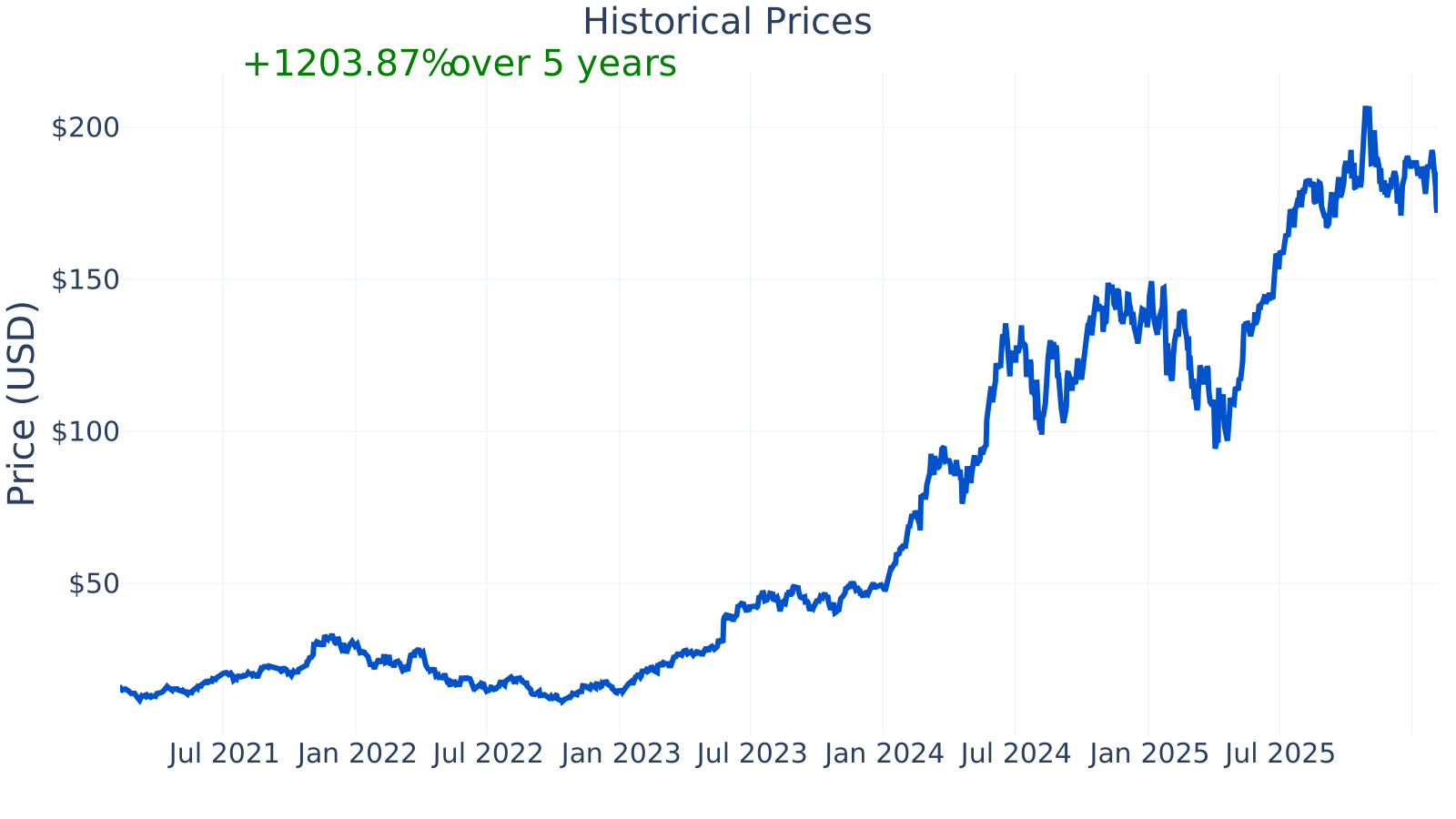
NVIDIA’s market capitalization is about $4.51T, placing it among the largest public companies. The stock’s beta of ~2.31 suggests it has historically moved more than the broader market, which can matter for long-term holders who want to understand potential swings.
On profitability, the company shows a profit margin of ~53.0%, far above the semiconductor industry median of ~9.4% in the table, reflecting unusually strong pricing power and operating leverage in the recent period. Growth has also been exceptional: year-over-year revenue growth of ~62.5% versus an industry median of ~13.0%.
Balance-sheet leverage appears modest based on debt-to-equity of ~9.1%, below the industry median of ~25.6%. Free cash flow over the trailing twelve months is about $77.3B, which is a key indicator of how much cash the business generates after operating needs and capital spending.
Growth (High)
NVIDIA operates in markets tied to long-running compute demand: more data, more complex software, and increased use of AI across products and business processes. The shift toward accelerated computing (using GPUs and specialized systems rather than only traditional CPUs) is a structural trend, and NVIDIA’s strategy has been to sell not just chips, but an integrated platform (hardware plus a large software ecosystem) that reduces friction for developers and enterprise buyers.
The company’s recent growth profile shows a sharp cycle: revenue growth slowed and turned negative in parts of 2022–2023, then surged dramatically as AI infrastructure spending accelerated. More recently, growth rates have moderated from the peak but remain high versus typical semiconductor patterns.
Cash generation has expanded alongside scale. After lower free cash flow around FY2023, free cash flow climbed strongly into FY2024 and FY2025, consistent with higher profitability and working-capital dynamics typical of a rapid demand upswing.
Potential catalysts for longer-term growth (descriptive, not predictive) include broader adoption of AI in enterprise software, continued build-out of cloud and data center capacity, and product transitions that improve performance-per-watt (which can matter because power and cooling are major constraints in modern data centers). NVIDIA also emphasizes its platform approach—developer tools, libraries, and system-level architectures—which can reinforce adoption over time if customers standardize on its ecosystem.
Risks (High)
This article is for informational purposes only and does not constitute financial advice. Some content is AI-generated. See Disclaimer