Stock Analysis · Novanta Inc (NOVT)
Overview
Novanta Inc is a technology company that designs and manufactures specialized components used inside advanced equipment. Its products are typically “mission-critical” parts that help machines sense, measure, illuminate, aim, or precisely move—capabilities that are important in areas such as medical and life science instruments, industrial automation, precision manufacturing, and some defense-related applications. Rather than selling directly to consumers, Novanta mainly sells to other businesses (often original equipment manufacturers) that integrate these components into larger systems.
Novanta describes its business through product-focused platforms that include photonics (laser/optical and illumination-related components), precision motion (high-accuracy movement and control), and vision (sensing and imaging). Revenue is therefore largely driven by demand for the end-markets where customers build high-performance instruments and automation systems. Detailed revenue percentages by product line and end-market can vary by year; the company provides this mix in its annual report and may adjust how it groups segments over time.
Main revenue drivers typically include:
- Photonics: laser/optical and illumination components used in medical, life science, and industrial systems
- Precision motion: motors, drives, and motion-control solutions used where accurate, repeatable movement is required
- Vision: sensing/imaging components that help machines “see” for inspection, measurement, and alignment
At a high level, Novanta’s financial profile reflects a company that invests meaningfully in operating expenses (including research and development) while aiming to translate revenue growth into profits and cash generation. In recent years, revenue has increased while operating costs have also risen, and interest expense has become a more visible item in the path from operating income to net income.
From 2021 to 2024, total revenue in the company’s filings increased from about $707M to about $949M, while net income moved from about $50M to about $64M. Over the same span, research and development spending rose (roughly $73M to $96M), which can support new product development but also adds to the cost base. Interest expense also increased meaningfully (roughly $7M to $31M), which suggests financing costs became more material.
Key Figures
| Metric | Value | Industry ⓘ |
|---|---|---|
| Date | Feb 08, 2026 | |
| Context | ||
| Sector | Technology | |
| Industry | Scientific & Technical Instruments | |
| Market Cap ⓘ | $5.09B | |
| Beta ⓘ | 1.62 | |
| Fundamental | ||
| P/E Ratio ⓘ | 96.90 | 45.31 |
| Profit Margin ⓘ | 5.50% | 12.33% |
| Revenue Growth ⓘ | 1.40% | 7.45% |
| Debt to Equity ⓘ | 63.04% | 49.68% |
| PEG ⓘ | 2.11 | |
| Free Cash Flow ⓘ | $102.61M | |
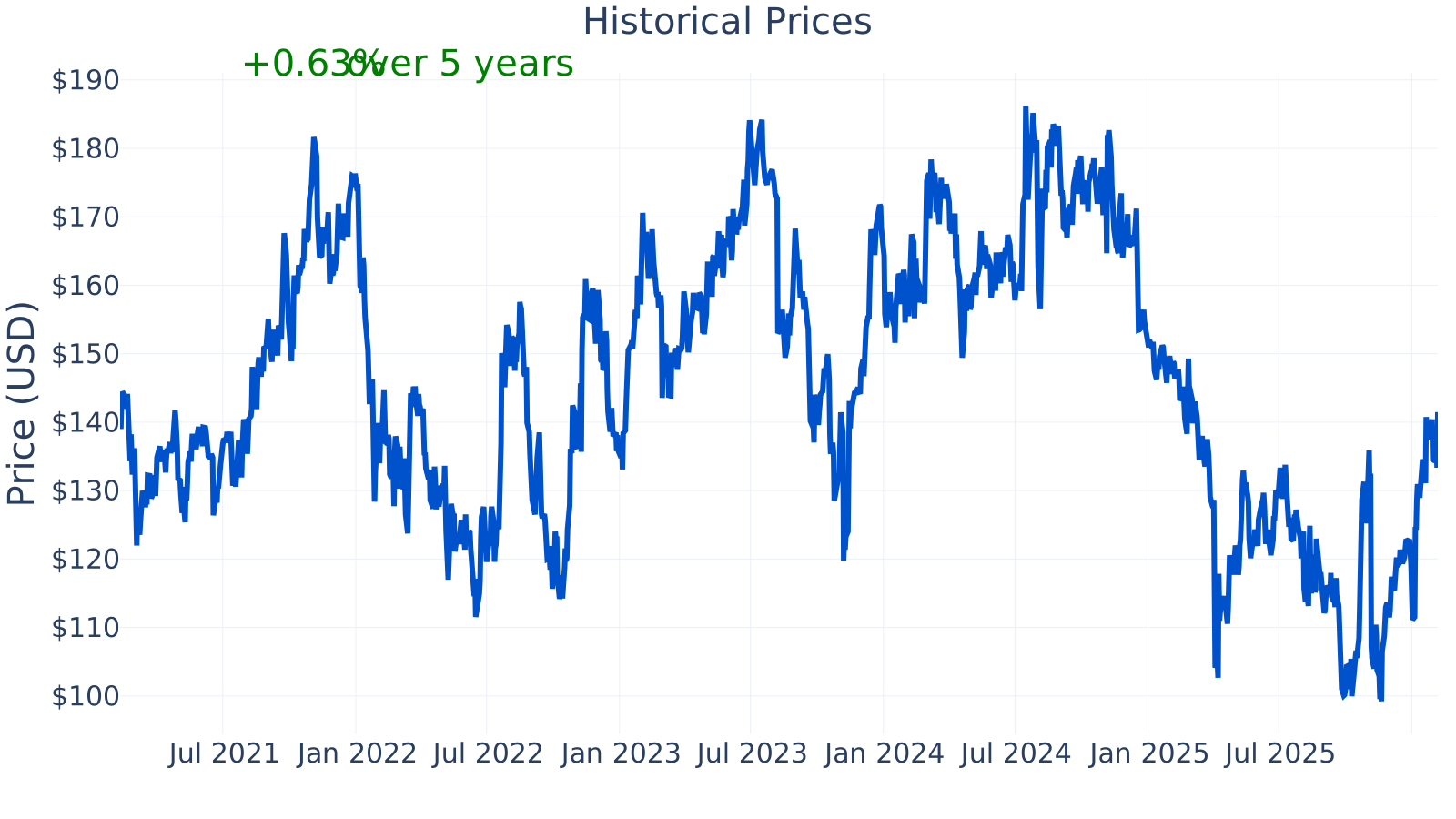
Novanta’s market capitalization is about $5.09B, placing it in the mid-cap range. The stock’s beta of ~1.62 indicates it has historically moved more than the overall market, which can mean larger price swings in both directions.
On profitability, the latest profit margin is ~5.5%, compared with an industry median near 12.3%, suggesting the company’s bottom-line profitability has recently been lower than many peers in its comparison group. Growth has also been modest recently: the latest year-over-year revenue growth is ~1.4% versus an industry median around 7.45%.
Financial leverage is moderate but above the industry median: debt-to-equity is ~63% compared with an industry median near 49.7%. Free cash flow over the trailing twelve months is about $102.6M, showing the business has continued to generate cash after operating needs and capital spending, even as growth and margins have fluctuated.
Growth (Medium)
Novanta participates in markets that are often supported by long-term trends: increased automation in manufacturing, rising complexity and precision requirements in medical and life science tools, and continued demand for sensors, motion systems, and optical technologies in high-performance equipment. These themes can create multi-year demand, but growth can still be uneven because customers may adjust capital spending with economic conditions and inventory cycles.
A key part of Novanta’s growth strategy is typically to deepen relationships with equipment manufacturers by offering specialized components that are hard to redesign quickly, and to broaden its portfolio through development and acquisitions. In practice, this can create a “design-in” dynamic (being engineered into a customer’s system), which can support repeat business over time if the customer’s platform is successful.
The revenue growth pattern has been variable. The company experienced strong year-over-year growth in 2021–2022 (including periods well above 20%), then moved through a softer phase in late 2023 (including slight declines), and returned to modest positive growth in 2024–2025. The latest reading near 1–2% highlights that the most recent period has been more about stabilization than rapid expansion.
Free cash flow has also fluctuated, dipping around 2022 and later recovering into 2024–2025 (with a recent level around $103M). For long-term business quality, the direction and consistency of free cash flow matter because it can be used to reduce debt, fund acquisitions, or reinvest in product development—though how it is allocated is ultimately a management decision described in filings.
Risks (Medium-High)
This article is for informational purposes only and does not constitute financial advice. Some content is AI-generated. See Disclaimer