Stock Analysis · nLIGHT Inc (LASR)
Overview
nLIGHT, Inc. (LASR) is a U.S.-based manufacturer of laser technology. In simple terms, it designs and produces laser sources and laser systems that other organizations use to cut, weld, measure, or deliver energy very precisely. These products are used in two broad areas: industrial uses (for example, manufacturing processes) and aerospace & defense uses (where lasers can be used in advanced sensing and directed-energy-related applications).
The company’s revenue is primarily generated by selling laser products (and related components/services) to customers in these end markets. In its SEC filings, nLIGHT typically discusses its business in terms of these two market areas rather than consumer-facing product lines, and revenue can shift depending on timing of customer demand and program ramps.
Main revenue drivers (high level):
- Industrial applications (lasers used in manufacturing and related industrial processes)
- Aerospace & defense applications (lasers and systems for defense-oriented programs and advanced capabilities)
Across recent years, revenue has moved up and down, but a visible theme is that operating expenses (notably research & development plus selling, general & administrative) remain large relative to gross profit. That has kept operating income negative even in years where revenue improved. In 2025, revenue and gross profit improved compared with 2024, and the net loss narrowed, but profitability was still not reached.
Key Figures
| Metric | Value | Industry ⓘ |
|---|---|---|
| Date | May 04, 2026 | |
| Context | ||
| Sector | Technology | |
| Industry | Semiconductors | |
| Market Cap ⓘ | $4.00B | |
| Beta ⓘ | 2.27 | |
| Fundamental | ||
| P/E Ratio ⓘ | N/A | 53.51 |
| Profit Margin ⓘ | -8.98% | 6.16% |
| Revenue Growth ⓘ | 71.30% | 19.70% |
| Debt to Equity ⓘ | 15.97% | 20.71% |
| PEG ⓘ | 1.78 | |
| Free Cash Flow ⓘ | $12.30M | |
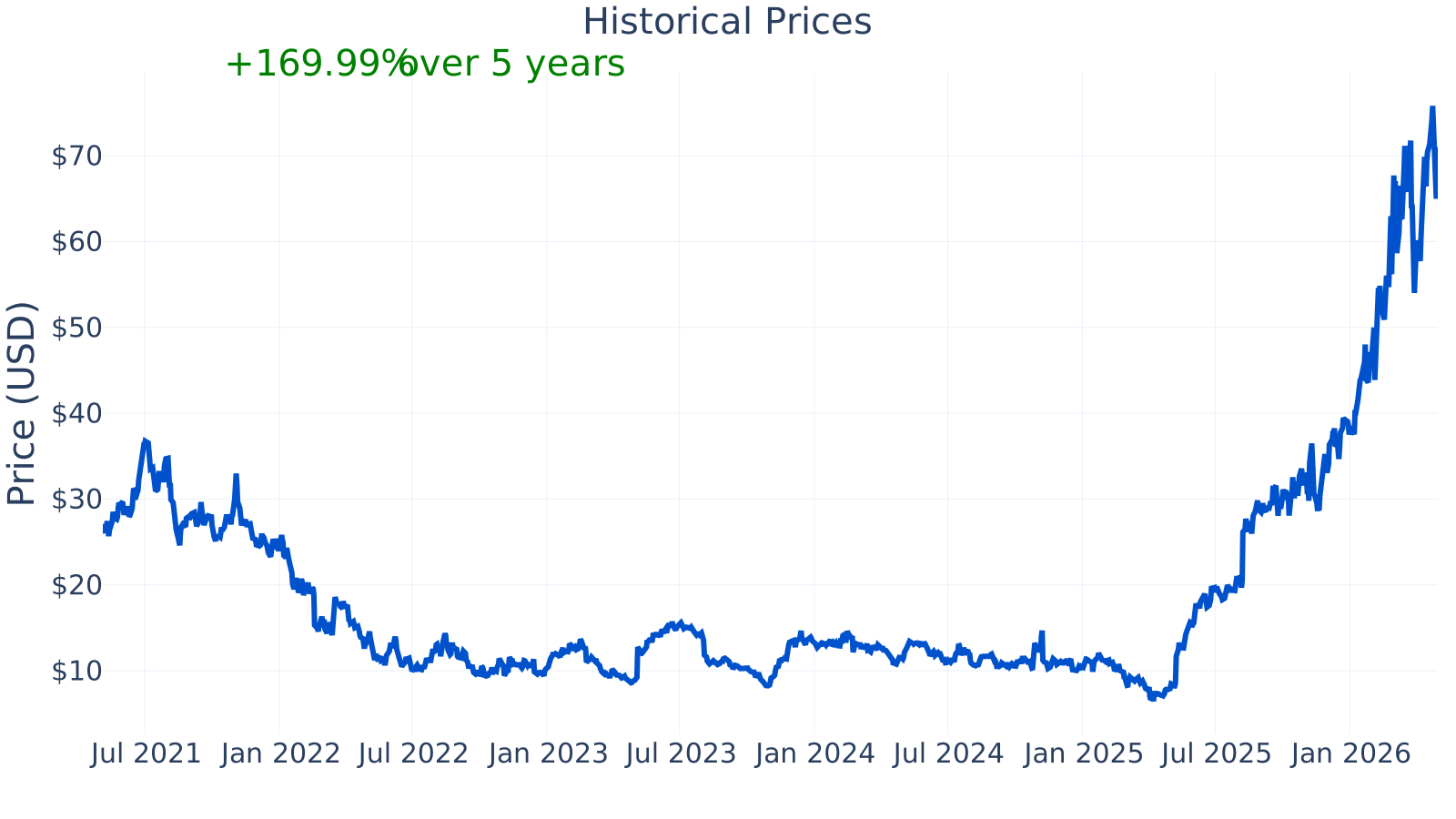
nLIGHT’s market capitalization is about $4.0B. The stock’s beta of ~2.27 indicates it has historically moved much more than the broader market (higher volatility). Profit margin is currently negative (about -9.0%) versus an industry median near +6.2%, showing the company is still operating below typical profitability levels for its peer group. On the other hand, the latest year-over-year revenue growth shown is ~71.3%, well above an industry median near ~19.7%, highlighting a period of sharp top-line acceleration. Debt-to-equity is about 16.0%, below the industry median near 20.7%, suggesting a comparatively modest use of balance-sheet leverage. Trailing twelve-month free cash flow is about $12.3M, indicating recent cash generation, although cash flow has been inconsistent over time.
Growth (Medium)
nLIGHT operates within the broader laser and photonics ecosystem, which is tied to long-running trends such as factory automation, precision manufacturing, and increased adoption of advanced optical technologies. In addition, defense-related laser programs (where applicable) can create periods of strong demand, though these programs may be uneven and depend on contract timing and government budgets.
A key question for long-term growth is whether revenue gains translate into consistently improving profitability. The company has continued to invest heavily in engineering and product development, which can support future product competitiveness, but also raises the “bar” for revenue scale needed to cover costs.
Revenue growth has been volatile over the period shown: it turned negative through much of 2022–2024, then improved in 2025, with a particularly strong acceleration by the end of 2025 (about +71% year over year). For a long-term view, the main point is that demand appears capable of ramping quickly, but the path has not been smooth.
Free cash flow has also swung between negative and positive. After being negative in 2022 and 2023, it turned positive in 2024, dipped back negative in 2025, and is shown as modestly positive on a trailing basis in the latest metric snapshot. This pattern suggests the business may be in a transition phase where working capital needs, investment levels, and customer delivery schedules can materially impact cash generation from year to year.
Risks (High)
The most important risk is profitability. Even with improving revenue in 2025, the company’s net income remained negative in the longer-running income statement view, meaning execution needs to improve further (through higher gross margin, operating cost leverage, or both) to reach sustainable earnings.
Another key risk is demand concentration and timing. Industrial spending can slow during downturns, and aerospace & defense programs can be subject to procurement timelines, testing milestones, and budget decisions. This can create uneven order patterns, which is consistent with the revenue-growth variability visible over multiple years.
Competition is also a meaningful factor. The laser and photonics space includes multiple established players across industrial lasers and defense-adjacent optical technologies. In many cases, competitors can compete on price, reliability, performance, manufacturing scale, and customer relationships. nLIGHT’s competitive advantages discussed in filings often relate to specialized laser design/manufacturing know-how and product performance in targeted applications; however, whether that translates into durable pricing power depends on the specific application and the availability of alternatives.
Debt-to-equity rose sharply in 2025 compared with prior years (moving from roughly the mid-single digits to about 16%). Even after that increase, it remains below the peer median in the chart for most periods, which can be viewed as a balance-sheet positive. Still, rising leverage can reduce flexibility if profitability takes longer to improve.
Profit margin has been negative for an extended period. The chart shows a notable improvement into late 2025 (to about -9%), but that is still below zero and also below the industry median (which remains positive). This gap is central to the overall risk profile: strong growth alone may not be sufficient if margins do not normalize over time.
Valuation
The price-to-earnings (P/E) ratio is not shown as meaningful for nLIGHT across the period displayed (values appear as zero on the chart), which typically happens when earnings are negative or otherwise make the P/E metric not informative. In those situations, valuation discussions often lean more on revenue growth, gross margin trajectory, operating expense discipline, and cash flow rather than traditional earnings multiples.
For context, the industry median P/E shown on the chart rises over time and is around the mid-50s most recently. With nLIGHT still reporting losses on a net-income basis in the longer view, a direct comparison to peer P/E levels does not provide a clean “expensive vs. cheap” signal. Instead, the main valuation debate tends to revolve around whether recent revenue acceleration can be sustained and converted into durable profitability, given the company’s cost structure and competitive environment.
Conclusion
nLIGHT is a laser technology company exposed to markets that can offer long-term demand tailwinds, especially where precision manufacturing and advanced defense capabilities require high-performance laser solutions. The recent period shows a sharp rebound in year-over-year revenue growth, alongside improving (but still negative) profit margins.
At the same time, the long-term record highlighted here includes extended net losses, volatile growth, and inconsistent free cash flow. The overall picture is a business with credible growth drivers but a higher uncertainty profile, where long-term outcomes depend heavily on sustained demand, competitive execution, and the company’s ability to translate scale into stable profitability.
Sources:
- SEC EDGAR — nLIGHT, Inc. Form 10-K (Annual Report)
- SEC EDGAR — nLIGHT, Inc. Form 10-Q (Quarterly Reports)
- nLIGHT Investor Relations — Press Releases and Shareholder Materials
- Wikipedia — “nLIGHT” (company overview and basic background)
This article is for informational purposes only and does not constitute financial advice. Some content is AI-generated. See Disclaimer


