Stock Analysis · Nice Ltd (NICE)
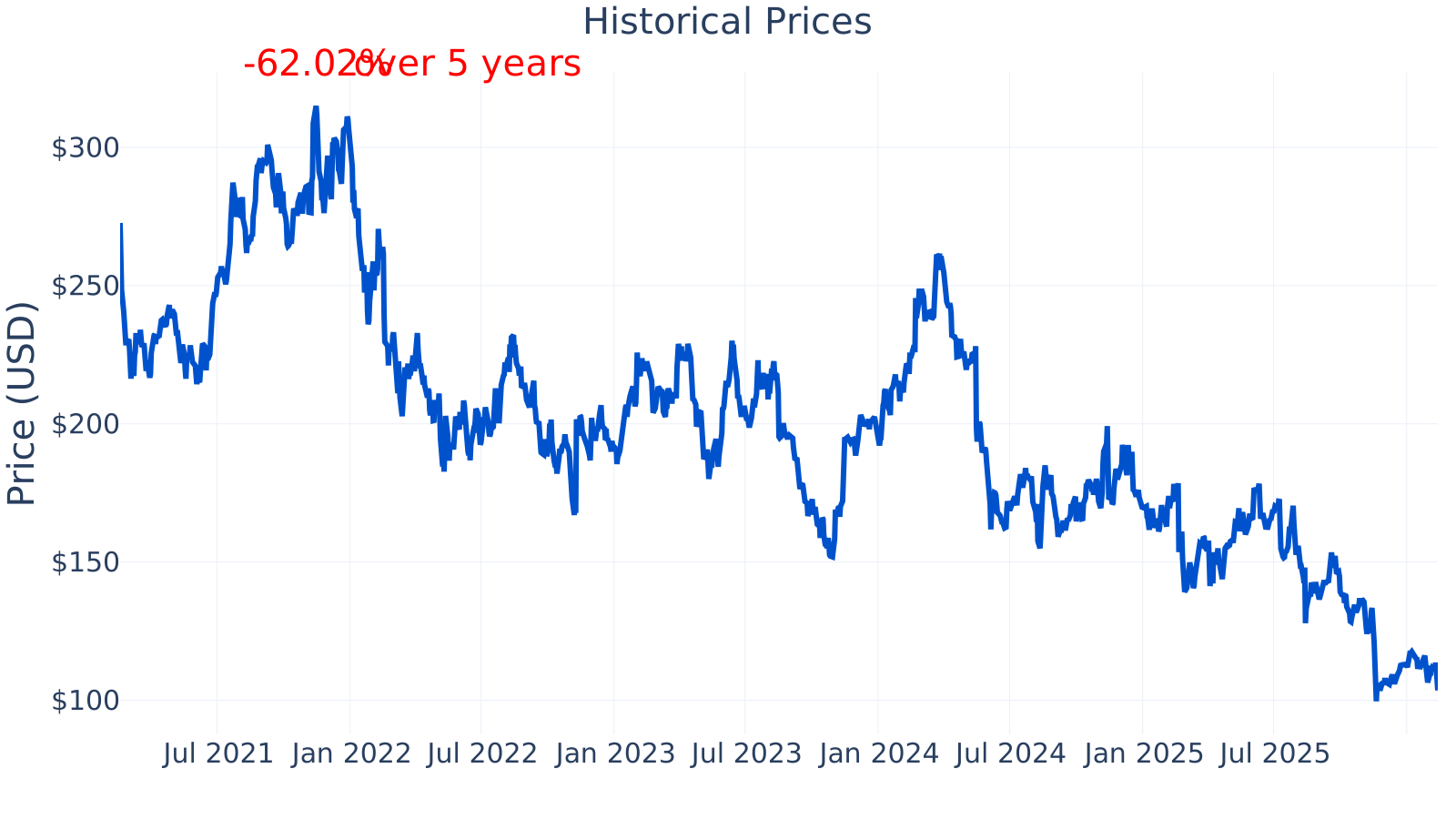
Overview
Nice Ltd (NICE) is a software company focused on helping organizations run customer service and customer engagement operations more efficiently. In practical terms, its products support contact centers and customer-facing teams with tools such as cloud-based platforms, analytics, automation, and AI-driven assistance. NICE also has offerings used in compliance-related and public safety contexts, depending on the segment and product line described in its filings.
A large part of the business is built around software and cloud services that are typically sold under subscription-style arrangements (often recognized over time), alongside related services. This kind of model can create recurring revenue, but results still depend on renewals, customer expansion, and the pace of new customer additions.
Based on the company’s reporting structure in its filings, revenue is commonly discussed by major business segments (and sometimes by cloud vs. on-premise categories, depending on the period and disclosures). Exact percentages can change year to year and should be taken from the most recent annual report.
Main revenue sources (high-level)
- Customer Engagement / CX (contact center software, cloud platform, analytics, automation) (typically the largest segment in company reporting)
- Financial Crime & Compliance (solutions used to detect and prevent fraud/financial crime and support compliance workflows)
- Services and other revenue (implementation, support, professional services—usually smaller than core software revenue, but important for deployments)
From 2021 to 2024, total revenue increased (about $1.92B to $2.74B), while net income also rose (about $199M to $443M). Over the same period, operating income expanded (about $256M to $549M), suggesting profitability improved as the company grew, even while it continued investing in areas like research and development.
Key Figures
| Metric | Value | Industry ⓘ |
|---|---|---|
| Date | Feb 16, 2026 | |
| Context | ||
| Sector | Technology | |
| Industry | Software - Application | |
| Market Cap ⓘ | $6.39B | |
| Beta ⓘ | 0.23 | |
| Fundamental | ||
| P/E Ratio ⓘ | 11.77 | 27.48 |
| Profit Margin ⓘ | 19.48% | 7.66% |
| Revenue Growth ⓘ | 6.10% | 15.80% |
| Debt to Equity ⓘ | 2.25% | 24.71% |
| PEG ⓘ | 0.86 | |
| Free Cash Flow ⓘ | $711.62M | |
NICE’s market capitalization is about $6.4B. The stock’s beta is about 0.24, which indicates the share price has historically moved less than the broader market (though beta is backward-looking and can change).
Profitability stands out relative to the industry median shown: profit margin is about 19.5% versus an industry median near 7.7%. Revenue growth year over year is about 6.1%, below the listed industry median (~15.8%), pointing to slower top-line expansion compared with many application software peers.
Leverage appears low: debt-to-equity is about 2.2%, well below the industry median (~24.7%). Free cash flow over the trailing twelve months is about $712M, which can matter for flexibility (investment capacity, acquisitions, buybacks, and resilience during weaker demand).
Growth (Medium)
NICE operates in application software markets tied to customer experience and contact center modernization, where organizations continue shifting from legacy on-premise systems toward cloud platforms and more automated customer service. Broadly, this is a long-running transition rather than a one-time event, and it can support multi-year demand for vendors with proven enterprise deployments.
The company’s strategy, as described in its public filings and investor materials, has typically emphasized expanding cloud offerings, embedding AI/automation, and selling additional modules to existing customers. For long-term business growth, this approach generally relies on (1) customer retention, (2) customers expanding usage over time, and (3) winning new large deployments—especially in competitive enterprise environments.
Revenue growth has varied over time. It was notably higher earlier in the period shown (mid-to-high teens at points in 2021–2022) and more recently has been in the mid-to-high single digits (around 6% in the latest point shown). A key question for future growth is whether newer product cycles, customer migrations to cloud, and expansion within existing accounts can re-accelerate the top line.
Free cash flow has improved over the longer period shown (roughly $443M in 2021 to about $769M by 2025-03-31 on a trailing basis), and the latest trailing figure is about $712M. Strong cash generation can help fund continued product investment and provides a buffer during slower growth phases, though it does not by itself guarantee future growth.
Risks (Medium)
Competition is a central risk. Customer experience and contact center software is a crowded space with well-funded vendors and platforms that can compete on product breadth, pricing, and ecosystems. Competitive pressure can show up as slower customer additions, lower expansion within accounts, or pricing concessions that affect margins over time.
Another major risk is execution in cloud transitions. Enterprise customers often migrate in phases, and purchasing cycles can be long. If implementations take longer than expected, or if customers delay platform changes, revenue timing can be impacted. In addition, large enterprise software providers must continuously invest in security, uptime, and compliance—any major service disruption or security issue can harm reputation and customer retention.
Customer concentration and macro sensitivity can also matter. Contact center spending may be scrutinized during cost-cutting cycles, and some customers may reduce seat counts or delay upgrades. Currency and international operations can introduce variability as well, depending on how the company earns revenue globally.
Financial leverage looks conservative in the period shown, trending down substantially and reaching very low levels (about 2.2% debt-to-equity at the latest point), compared with a materially higher industry median. Lower leverage can reduce refinancing risk, but it does not remove operational risks like competitive pressure or demand variability.
Profit margin has trended upward over time, reaching roughly 19.5% in the latest point shown, while the industry median displayed is materially lower. This gap can reflect product mix, scale, and operating discipline. However, maintaining higher margins can become harder if the company faces price competition, needs to increase sales and marketing spend to win deals, or accelerates R&D investment to keep pace with AI-driven product change.
On competitive positioning, NICE is commonly described (in company materials and filings) as a significant provider in its core categories, particularly in enterprise contact center software and related analytics/automation. Key competitors in these areas often include large cloud and enterprise software vendors as well as contact-center specialists (for example, vendors that provide CCaaS platforms, CRM ecosystem solutions, and workforce/customer analytics tools). Relative positioning tends to depend on factors like platform breadth, AI capabilities, integration with major CRM systems, reliability, and global support—areas where leaders can differentiate, but where switching costs and procurement decisions vary by customer.
Valuation
The company’s current P/E ratio is about 11.8, below the industry median shown (about 27.5). The historical P/E trend in the chart shows a substantial decline from very high levels earlier in the period (often above ~40–100 in 2021) down to the low teens more recently.
In descriptive terms, a lower P/E can indicate the market is assigning a more cautious outlook for future growth, or that earnings have risen relative to the share price, or both. In NICE’s case, this lower multiple appears alongside (1) profit margins that are higher than the industry median shown and (2) revenue growth that is lower than the industry median shown. That combination can be consistent with a company that is generating solid profitability and cash flow, while the market is discounting slower growth versus faster-growing software peers.
Because valuation depends heavily on expectations for future revenue growth, competitive intensity, and the durability of margins, the same P/E level can look very different under different scenarios (re-acceleration in growth vs. continued deceleration, margin stability vs. margin compression). The PEG ratio shown (~0.86) is one indicator that relates price, earnings, and growth assumptions, but it is sensitive to how growth is estimated and can change meaningfully with updated forecasts.
Conclusion
NICE is a software company with a focus on customer engagement and related analytics/automation, with financial crime and compliance solutions also contributing to its business mix. Over recent years, it has increased revenue and improved profitability, and it shows strong cash generation with low financial leverage in the metrics shown.
The main balancing factor is growth: year-over-year revenue expansion appears to have slowed compared with earlier periods and compared with the industry median shown. Long-term outcomes may depend on whether cloud adoption and AI-driven product upgrades translate into faster demand, while sustaining margins amid competitive pressure.
From a valuation description standpoint, the shares trade at a P/E ratio well below the industry median shown and far below the company’s own earlier historical levels in the chart. That lower multiple aligns with a more muted growth profile relative to many software peers, while profitability and cash flow appear comparatively strong based on the metrics displayed.
Sources:
- NICE Ltd — Annual Report (Form 20-F) and other filings (SEC EDGAR)
- NICE Ltd — Investor Relations materials and press releases (company website)
- Wikipedia — “NICE Ltd” (basic company background)
This article is for informational purposes only and does not constitute financial advice. Some content is AI-generated. See Disclaimer


