Stock Analysis · Nextnav Acquisition Corp (NN)
Overview
NextNav Acquisition Corp (NN) is associated with NextNav, a company focused on positioning, navigation, and timing (PNT) technology that aims to improve location services—especially vertical location (for example, determining which floor of a building someone is on). The general idea is to provide more reliable and precise location capabilities than standard GPS can deliver in many indoor or dense urban settings. These capabilities can be used in public-safety scenarios (such as emergency response and 911 location), as well as in commercial applications that depend on accurate location.
Based on the company’s financial profile in recent years, revenue has been relatively small compared with operating costs, which suggests the business has been in an investment/build-out phase rather than a mature, steady-profit model.
Main revenue sources (ordered from largest to lowest) are not broken out here with percentages because a segment-level split is not provided in the included metrics. In general terms, for a company in this area, revenue typically comes from a combination of service contracts, licensing, and partnerships connected to its location platform.
Looking at the income statement flow over time, revenue remains modest (in the low single-digit millions in the most recent years shown) while operating expenses are much higher, driven mainly by selling, general and administrative costs and research and development. Interest expense is also meaningful in several years, which has weighed on net income.
Key Figures
| Metric | Value | Industry ⓘ |
|---|---|---|
| Date | Mar 30, 2026 | |
| Context | ||
| Sector | Technology | |
| Industry | Software - Infrastructure | |
| Market Cap ⓘ | $2.42B | |
| Beta ⓘ | 1.00 | |
| Fundamental | ||
| P/E Ratio ⓘ | N/A | 25.89 |
| Profit Margin ⓘ | N/A | 7.12% |
| Revenue Growth ⓘ | -50.60% | 15.80% |
| Debt to Equity ⓘ | -334.67% | 24.92% |
| PEG ⓘ | N/A | |
| Free Cash Flow ⓘ | -$51.11M | |
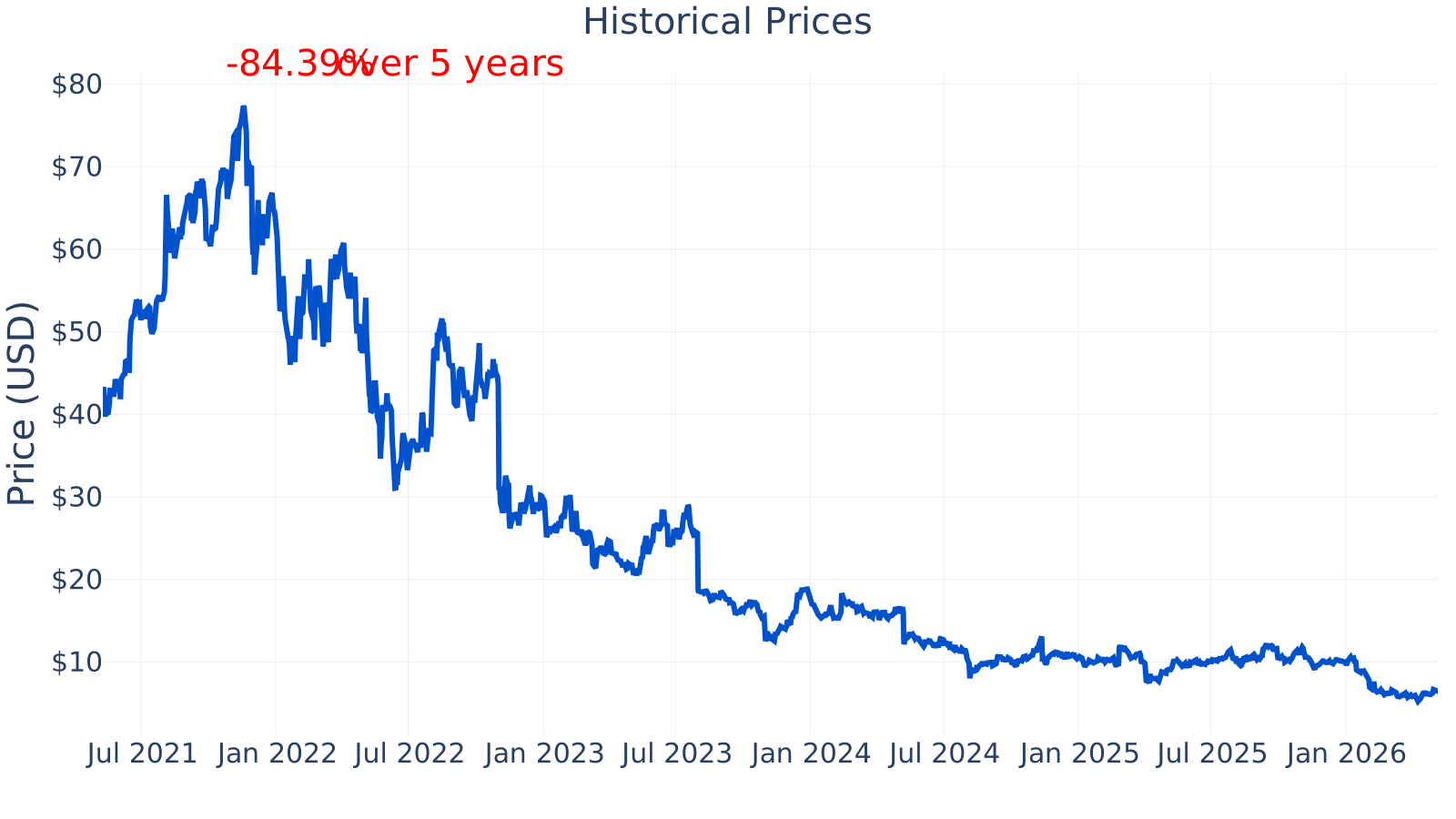
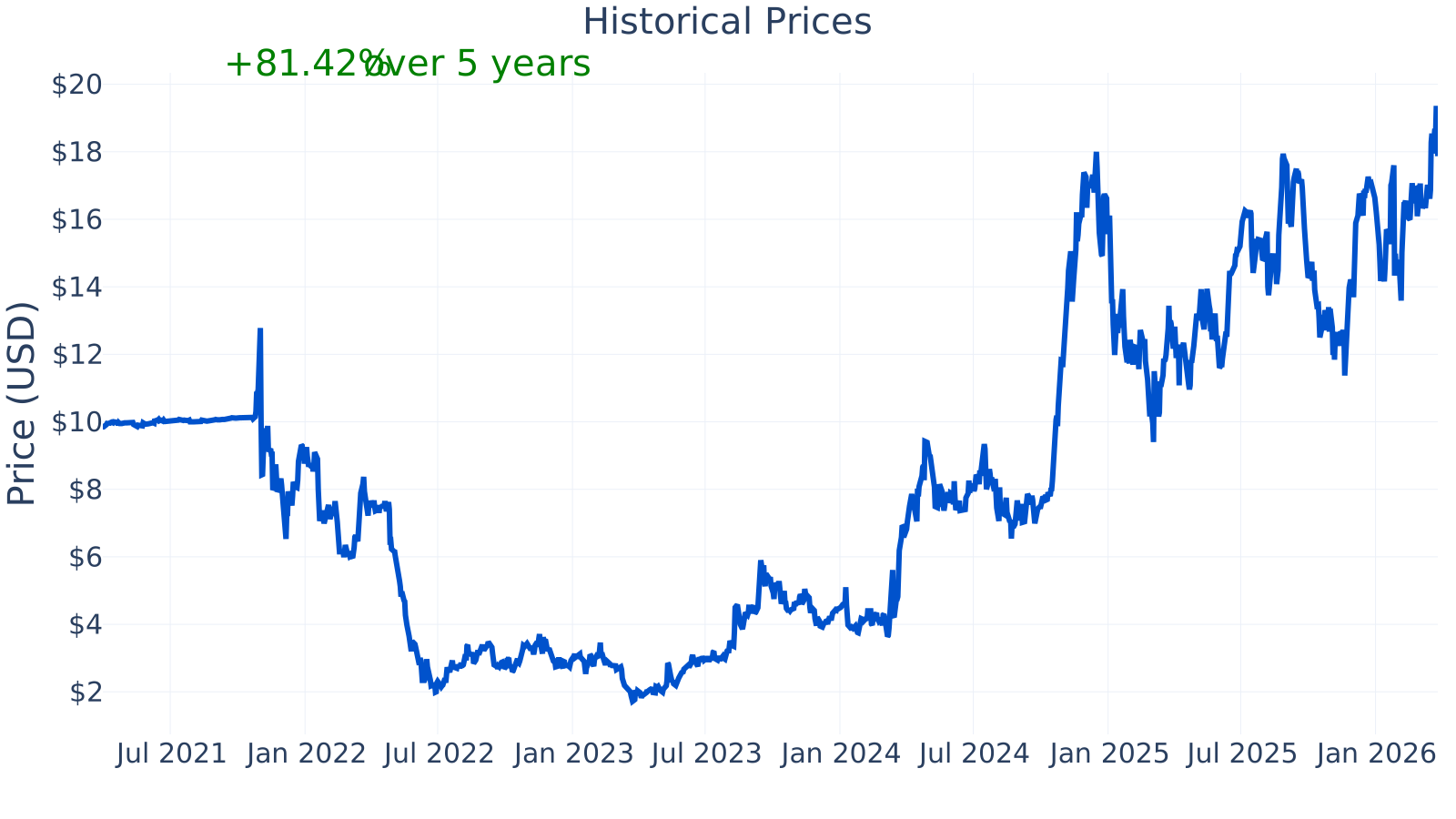
The latest snapshot shows a market capitalization of about $2.42B and a beta close to 1.0, which indicates the stock has tended to move roughly in line with the broader market. Profit margin is shown at 0% in the latest table view, while the longer history indicates persistent negative margins over time. Year-over-year revenue growth is listed at about -50.6% versus an industry median around +15.8%, highlighting that the most recent period reflected contraction rather than expansion. Free cash flow over the trailing twelve months is approximately -$51.1M, pointing to continued cash burn. Debt-to-equity is shown as a negative figure in the latest snapshot, which commonly happens when accounting equity is negative (often due to accumulated losses and balance sheet structure), making this ratio harder to interpret than it is for companies with positive equity.
Growth (Medium)
The broader industry backdrop—location infrastructure and more precise positioning—has long-term demand drivers. Emergency services and public safety modernization, indoor navigation, logistics, and location-aware applications are all areas where better accuracy (including altitude/floor-level positioning) can matter. In that sense, the end-market need can be described as durable, particularly where regulation, reliability requirements, and safety use-cases raise the value of better performance.
At the same time, the company’s recent results suggest that scaling is still a challenge. Revenue growth has been highly volatile across periods, including very high growth rates in some earlier quarters followed by slower growth and then declines more recently.
The year-over-year revenue growth trend shows large swings over time, with a notable shift into negative territory in the most recent periods displayed. Compared with an industry median that is positive, the company’s recent trajectory indicates it has not been consistently converting its positioning concept into steadily expanding sales.
Free cash flow over time remains negative (roughly in the range of about -$37M to -$46M in earlier points shown, and about -$51M most recently). For growth to become self-funding, a typical expectation would be either meaningfully higher revenue, improved gross margin, lower operating expense intensity, or a combination of all three. Until that happens, growth may depend on maintaining adequate liquidity and access to capital.
Potential catalysts for future progress (in general terms for this kind of business) can include expanded commercial partnerships, broader adoption by public-safety ecosystems, winning large contracts, or achieving technical milestones that improve performance and lower deployment friction. Whether those translate into measurable financial improvement is usually visible in revenue consistency and improving margins over several reporting periods.
Risks (High)
A central risk is profitability. The company has shown sustained losses over time, and the margin profile has been far below the industry median. This creates pressure to either scale revenue materially or reduce the cost structure.
The profit margin history is consistently negative and, in many periods, substantially below the industry median (which moves into positive territory in more recent periods). The most recent value shown is roughly -41.4%, while the industry median is about +6.9%. This gap implies the business has not yet reached the efficiency level typical of more established infrastructure software peers.
Another key risk is balance-sheet complexity and leverage interpretation. The debt-to-equity measure becomes difficult to read when equity turns negative, and the series shown is volatile, including extreme values.
The debt-to-equity trend includes periods around ~80% to ~140% earlier, followed by very large swings (including extreme positive values and then negative values). This pattern often reflects significant balance sheet changes and/or negative equity rather than a stable, easily comparable leverage profile. In practical terms, it signals that investors may need to rely more on detailed balance-sheet review (cash, debt maturities, covenants, and dilution risk) than on this single ratio.
Competitive positioning is also a meaningful risk area. The company operates in a space adjacent to major platform providers and established location-technology ecosystems. Competitors and alternatives can include:
- GPS/GNSS ecosystem providers (and augmentation approaches), which set the baseline for outdoor positioning.
- Mobile operating system and device ecosystems that integrate location services deeply into hardware and software stacks.
- Indoor positioning solutions using Wi‑Fi, Bluetooth beacons, ultra-wideband (UWB), and other sensor-fusion approaches.
- Public-safety and mapping/location infrastructure vendors that already serve government and enterprise customers.
The company’s potential competitive advantage, based on its stated focus, is improved vertical location and resilient positioning in environments where conventional GPS is weak. However, leadership is difficult to establish without clear, sustained evidence in public filings of broad adoption, strong retention, and improving unit economics. In addition, reliance on partnerships, standards, or regulatory pathways can increase execution risk and lengthen sales cycles.
Valuation
A traditional P/E ratio framework is not currently informative here because the company has not generated consistent positive earnings, and the chart shows the company P/E as not meaningfully available (displayed as 0). In contrast, the industry median P/E shown in the later periods is around the high 20s to low 30s, reflecting that many peers have positive earnings that can support an earnings-multiple comparison.
In practice, valuation for a company with negative earnings and negative free cash flow is often discussed using alternative lenses (such as revenue multiples and liquidity runway), but those are not provided in the included metrics. What can be stated from the available fundamentals is that the market capitalization is substantial relative to the recent revenue levels shown in the income statement flow (single-digit millions annually in the periods displayed). That combination typically implies that the market is pricing in significant future growth and/or strategic value that has not yet been reflected in current profitability.
Conclusion
NextNav Acquisition Corp is tied to a conceptually important area—more precise and reliable positioning, including vertical location—which has credible long-term use-cases in public safety and location-aware commercial services. The industry backdrop can support growth if the company converts technical capabilities into repeatable customer adoption.
However, the financial profile shown here reflects a business that has not yet demonstrated stable scaling: revenue has been volatile with recent declines, free cash flow is negative, and profit margins have been consistently below industry norms. Balance-sheet ratios also appear unstable, which can be a sign that capital structure and accumulated losses are important parts of the story. From a long-term perspective, the main factual question to monitor is whether revenue becomes consistently larger and whether margins and cash flow move toward sustainability over multiple reporting periods.
Sources:
- U.S. SEC EDGAR — Company filings for NextNav/NextNav Acquisition Corp (Form 10-K, Form 10-Q, Form 8-K)
- NextNav — Investor Relations materials and press releases (company-hosted)
- Wikipedia — “NextNav” (basic company background)
This article is for informational purposes only and does not constitute financial advice. Some content is AI-generated. See Disclaimer