Stock Analysis · Nextracker Inc (NXT)
Overview
Nextracker Inc. designs and sells equipment that helps large, utility-scale solar power plants generate more electricity. Its core products are “solar trackers,” which are mechanical systems that move solar panels during the day so panels stay oriented toward the sun. By improving the amount of sunlight captured, trackers can raise the output of a solar project compared with fixed-tilt panel installations.
The company primarily serves developers and owners of large solar projects (often called utility-scale solar). In addition to the tracker hardware, Nextracker also provides related software, controls, and services that help customers monitor performance and operate projects over time. Because the business is tied to the building of large solar farms, results can be influenced by the pace of new project construction, supply chain conditions, and customer ordering patterns.
Public filings generally describe revenue as coming mainly from solar tracker products and related offerings (such as software and services). In many industrial businesses like this one, trackers represent the vast majority of sales, while services and software are smaller contributors, but exact percentages can vary by period and are best confirmed in the most recent annual report segment disclosures.
Main sources of revenue (typical breakdown based on company descriptions in filings):
- Solar tracker products (hardware, components, and related controls) — typically the largest contributor
- Software and services (monitoring, controls, and support offerings) — generally smaller than hardware
Over recent fiscal years, total revenue increased meaningfully (about $1.20B in FY2021 to about $2.96B in FY2025). Over the same span, profitability improved: gross profit rose substantially (about $232M to about $1.01B), and net income increased (about $124M to about $509M). This suggests the company has not only grown sales, but also expanded the dollars left after direct costs and operating expenses, although costs and margins can still move around from year to year.
Key Figures
| Metric | Value | Industry ⓘ |
|---|---|---|
| Date | Feb 07, 2026 | |
| Context | ||
| Sector | Technology | |
| Industry | Solar | |
| Market Cap ⓘ | $18.25B | |
| Beta ⓘ | 2.36 | |
| Fundamental | ||
| P/E Ratio ⓘ | 30.96 | |
| Profit Margin ⓘ | 16.43% | 0.27% |
| Revenue Growth ⓘ | 33.90% | 33.90% |
| Debt to Equity ⓘ | N/A | 139.55% |
| PEG ⓘ | 3.16 | |
| Free Cash Flow ⓘ | $589.26M | |
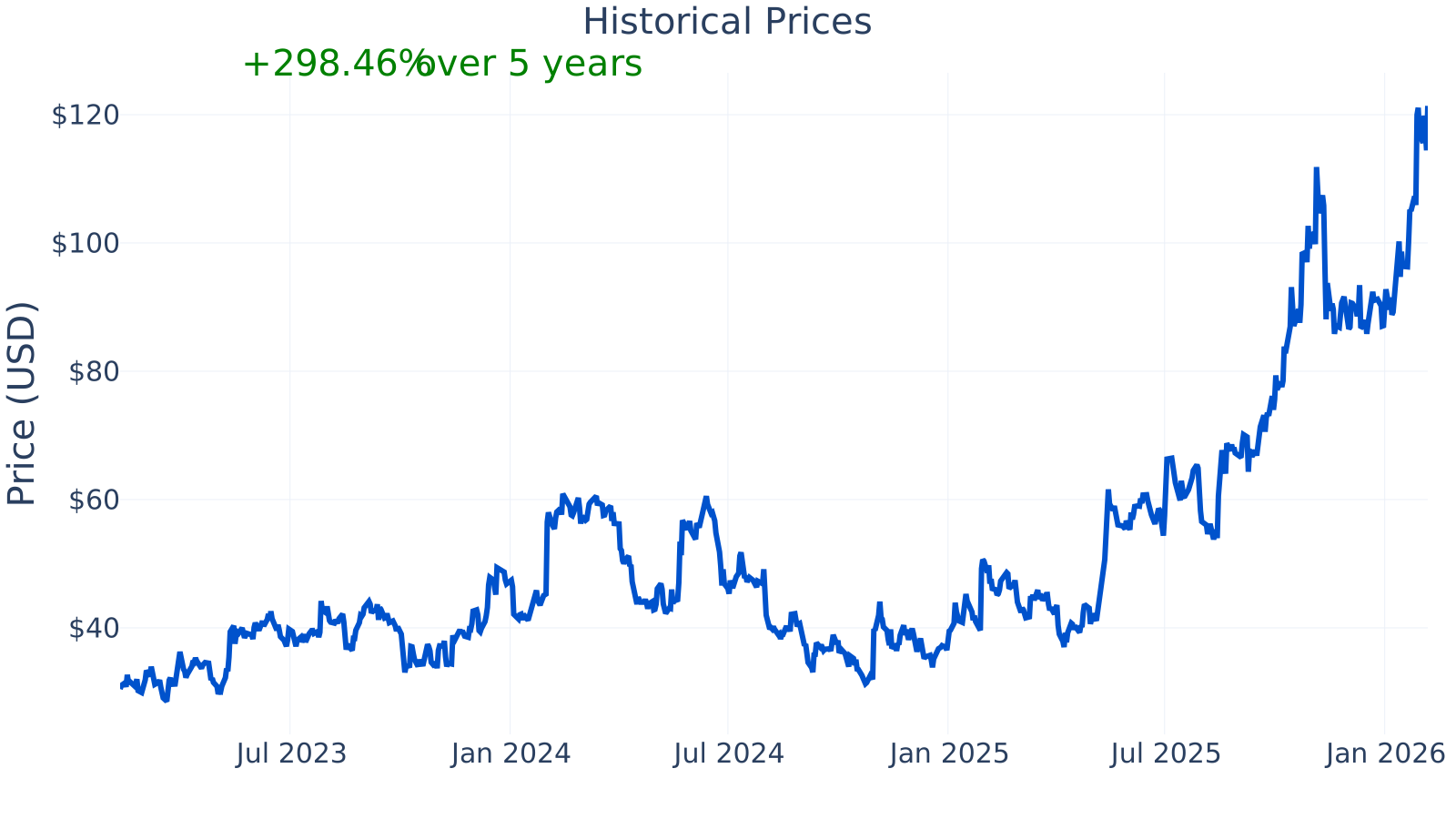
Nextracker’s market capitalization is about $18.3B. The stock’s beta of ~2.36 indicates it has historically moved more than the broader market (higher volatility). The latest P/E ratio is ~31.0. Profitability stands out versus the industry median in the table: profit margin is ~16.4% compared with an industry median ~0.27%. Revenue growth year-over-year is ~33.9%, matching the listed industry median. Trailing twelve-month free cash flow is about $589M, showing the business has recently generated meaningful cash after operating costs and capital needs.
Growth (medium)
Nextracker operates in utility-scale solar, an area supported by long-term electrification trends and ongoing solar adoption. Trackers are commonly used in large projects because improving energy output can meaningfully affect project economics over decades. In that context, the company’s focus—hardware that boosts production plus software and services to help operate assets—fits how large solar projects are built and managed.
Revenue growth has been strong but not perfectly smooth. The year-over-year growth rate ranged from very high levels in mid-2024 (roughly 42% to 50% in several periods) to a brief decline around late 2024 (about -4%), then returned to positive growth through 2025 (including readings around 20% to 42% and ~34% most recently). This pattern is consistent with a project-driven business where orders and shipments can shift between quarters.
Cash generation has improved significantly over time. Trailing twelve-month free cash flow increased from roughly $55M (FY2023 timeframe) to about $422M (FY2024) and about $622M (FY2025), with the latest value around $589M. For long-term business durability, the combination of growth and sustained positive free cash flow is often an important signal, since it can support reinvestment, balance-sheet strength, and operational flexibility.
Potential catalysts in this type of business typically include: continued buildout of utility-scale solar, broader adoption of trackers versus fixed-tilt systems, and the ability to win large multi-project supply agreements. The company’s filings also commonly emphasize product innovation (tracker designs, controls, and software) as a way to stay competitive and support future demand.
Risks (medium)
The biggest risks generally come from the nature of utility-scale construction markets. Demand can be cyclical and tied to project financing conditions, permitting and interconnection timelines, and customer ordering schedules. A few delayed projects or push-outs can shift quarterly results. In addition, tracker manufacturing depends on steel and other inputs, and margins can be affected by material prices, logistics costs, supplier reliability, and the company’s ability to pass cost changes through to customers.
Leverage appears relatively modest compared with the industry median shown on the chart. Debt-to-equity moved from slightly negative values in 2023 (which can happen due to accounting equity levels) to low positive levels more recently, around the low single digits to mid-teens percent (for example, roughly 3% to 15% across 2024–2025 points). This is well below the industry median line on the chart (often near or above 100%), suggesting the balance sheet is not heavily debt-funded relative to peers—though the most meaningful interpretation should come from the company’s latest balance sheet and footnotes in its filings.
Profit margin improved sharply from about 5%–6% in 2023 to roughly 12%–20% through 2024–2025, landing near 16.4% most recently. The industry median shown is much lower in the same periods. Higher margins can reflect scale, pricing, product mix, execution, or temporary factors; the key risk is whether margins normalize downward if competition intensifies or if costs rise faster than pricing.
Competition is a key consideration. Utility-scale solar trackers are a specialized but competitive market, and customers are often sophisticated buyers who compare cost, reliability, performance, delivery capability, and long-term service support. Major competitors commonly cited in industry discussions include other tracker manufacturers such as Array Technologies and Arctech Solar, along with additional regional or vertically integrated providers. Competitive positioning tends to depend on product performance (including reliability in wind conditions), supply chain execution, total cost of ownership, and the ability to support large global deployments.
Another risk is concentration: large solar projects can be very large contracts, so a relatively small number of major customers or EPCs (engineering, procurement, and construction firms) can account for a meaningful portion of shipments in a given period. Policy and trade-related factors can also influence the solar supply chain and project timing, which can indirectly affect tracker demand.
Valuation
The stock’s valuation has varied significantly over time. The chart shows Nextracker’s P/E ratio rising to a peak around early 2024 (roughly 55) and then spending much of 2024–2026 in a lower band, often in the low teens to low 20s. The most recent P/E is about 23.4 on the chart, below the industry median shown (about 25.0 at that point). The latest metrics table lists a current P/E of about 31.0, which can differ from chart points due to timing and price/earnings changes.
Interpreting whether the price is “expensive” depends on how durable the company’s recent profitability and growth are. A higher P/E can be easier to justify when revenue is expanding quickly and margins are elevated, but it leaves less room for disappointment if growth slows, margins compress, or project timing becomes more volatile. The PEG ratio in the table (~3.16) is one indication that the price may be embedding meaningful growth expectations relative to near-term growth assumptions, though PEG is sensitive to the growth rate used and can be less reliable for cyclical, project-based businesses.
Conclusion
Nextracker is a utility-scale solar equipment company centered on tracker systems that can improve the energy output of large solar installations. The business has shown strong expansion in recent years, with revenue rising from about $1.20B (FY2021) to about $2.96B (FY2025) and net income increasing from about $124M to about $509M. Margins improved materially compared with earlier periods and appear high relative to the industry median shown, while free cash flow has been solidly positive and much higher than a few years ago.
At the same time, the company operates in a project-driven market where results can be uneven quarter-to-quarter, and competition, input costs, and policy or supply-chain disruptions can affect performance. Valuation multiples have moved around widely over the past few years, and current valuation levels should be interpreted in the context of whether recent growth and margins are sustainable across a full project cycle.
Sources:
- U.S. SEC EDGAR — Nextracker Inc. Form 10-K (Annual Report)
- U.S. SEC EDGAR — Nextracker Inc. Form 10-Q (Quarterly Reports)
- Nextracker Inc. — Investor Relations materials and SEC filings (company-hosted)
- Wikipedia — “Nextracker” (basic company background)
This article is for informational purposes only and does not constitute financial advice. Some content is AI-generated. See Disclaimer